



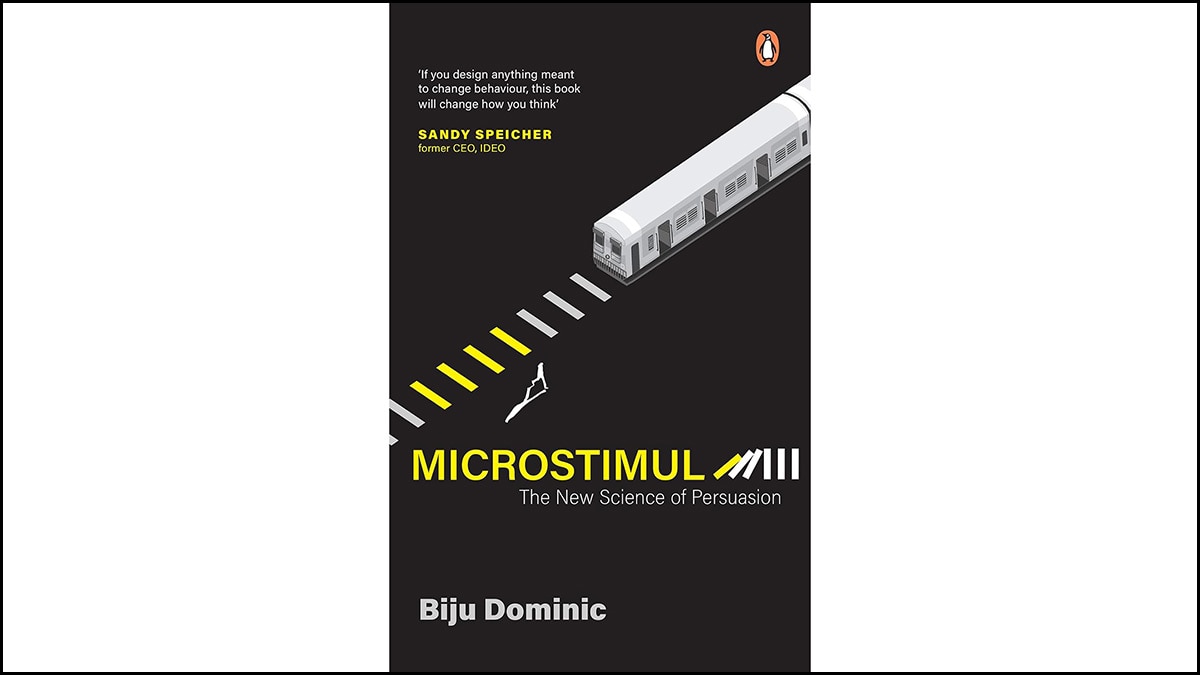
If you are what you think you are, then you have to change your thinking to change your behaviour. This is one of the basic premises of Biju Dominic’s new book, MicroStimuli: The New Science of Persuasion—the assumption that the source of all behaviour is the brain. This is also what helped him devise the concept of MicroStimuli—“persuasion stimuli that trigger the fastest neural pathways to create behaviour change in milliseconds, at the speed of human instinct”.
It was conceptualised after some discoveries about the brain. First, over 99.99 per cent of the brain processes occur at the non-conscious level. A million times more information enters our brain than what is processed at a conscious level. Second, emotions cannot be controlled through conscious effort. Take the act of smiling. Dominic says it engages two key facial muscles. One lifts the mouth when we smile and can be controlled consciously. The other, found just beneath the skin around the eyes, activates only at a non-conscious level. This means that we can’t voluntarily control it; it only engages during a genuine, emotionally driven smile.
All this led Dominic to the conclusion that if you want to change behaviour in a lasting manner, the best way is through emotional, non-conscious triggers that last only a few milliseconds. Once they formulated the outline of this new behaviour theory, Dominic along with three others left their jobs and started FinalMile Consulting.
They have applied the concept of MicroStimuli in various scenarios to change human behaviour. Take, for example, the time a major ice-cream manufacturer approached them with a conundrum: they had run excellent advertising campaigns and offered attractive discounts, but still their ice-cream sales weren’t meeting expectations. Dominic’s team conducted field visits to several supermarkets. They observed children excitedly approaching the ice-cream freezers. Adults, however, leaned in, scanned the options and even picked up a pack of ice-cream, only to return it moments later. Despite high visibility and eager kids, many walked away without making a purchase.
When the team assessed the emotional state of these adults through a research method they had devised called Ethnolab, they discovered something surprising. The dominant emotion at the point of purchase wasn’t desire or delight; it was guilt. Ethnolab came up with a creative solution. They dug into people’s emotional memories associated with ice-cream, which could be summarised in a simple sound—ding, ding, ding. “For many, this wasn’t just a noise,” writes Dominic. “It transported them back to dusty lanes and sunlit childhoods, when an ice-cream vendor would pedal through the neighbourhood, the bell on his bicycle ringing out like a sweet invitation.” The brand introduced the sound at the point of purchase, which activated the appropriate emotional memories in the buyers. Guilt melted into nostalgia, and sales soared by 55 per cent.
Dominic used MicroStimuli to change behaviour in various other scenarios, from fostering a culture of integrity at a morally-compromised insurance firm and reducing the death rates caused by illegal crossings on Mumbai’s railway tracks to inducing people in Dubai to take up exercise on a regular basis. Some of the solutions they came up with are truly creative (like connecting walking with the process of growing a rose, thus converting it into an activity people cared about). Perhaps Dominic could write a sequel giving more detailed instructions on how individuals can devise MicroStimuli to change their behaviour. We could all do with some. That phone addiction is not going away on its own.
MICROSTIMULI: THE NEW SCIENCE OF PERSUASION
By Biju Dominic
Published by Penguin
Price Rs699; pages 270
