



There is something deceptively ordinary about the way the three men at the top of India’s election machinery work together. Gyanesh Kumar, Sukhbir Singh Sandhu and Vivek Joshi meet in each other’s offices, sit across files, exchange views and, after difficult meetings, can still sit down over tea. They have a private WhatsApp group, where communication is informal and direct. Inside Nirvachan Sadan, they are colleagues who have to work with one another every day. There is also an important constitutional fact behind that everyday camaraderie. Gyanesh Kumar is the chief election commissioner and chairman of the Election Commission, but Sandhu and Joshi are not his constitutional subordinates. The three are members of the same constitutional body.
For a long time, that distinction remained largely invisible to the public. The EC spoke as one institution, and what happened inside its rooms rarely became a subject of public discussion.
That has now changed. Sandhu and Joshi reportedly recorded objections on at least a dozen occasions in less than a year, bringing the internal working of the EC into question. Their concerns touched upon some of the most sensitive functions of the poll panel: the addition and deletion of voters, restoration of names, appeals, Form 6 (for first-time voters to provide details), access to the electoral-roll database and the technology through which voter lists are maintained. In some instances, the two commissioners said decisions or directions had been taken without their knowledge.
The EC has formally rejected the suggestion that this represents a breakdown. Its position is that questions, observations and differing views are part of deliberation in a multi-member body and that the final decisions, including those concerning the Special Intensive Revision, were approved unanimously. That distinction is at the heart of the controversy.
A constitutional body can disagree internally and still arrive at a unanimous decision. A commissioner can raise an objection during deliberation and subsequently accept the final decision. But the more difficult question is whether all three commissioners had a meaningful opportunity to deliberate before a decision was taken under the umbrella of the EC.
There have been periods of controversy and institutional disagreement over the decades, but the fact that its battles are compounding is a matter of concern. In March 2024, election commissioner Arun Goel resigned abruptly, just weeks before the Lok Sabha elections. His resignation followed the retirement of another election commissioner. These exits temporarily left the three-member commission without its full strength. Goel’s resignation was accepted by the government, but no public explanation for his departure was given. At the time, the episode did not result in an open institutional confrontation. But it raised a question that has returned now with greater force: how many functions of a constitutional watchdog like the EC should remain behind closed doors?

Gyanesh Kumar and Sandhu came into the EC together in March 2024. Kumar later became chief election commissioner and Vivek Joshi joined as the third member in February 2025.
Kumar arrived at Nirvachan Sadan after more than three decades in the bureaucracy. The Election Commission’s own profile describes him as a 1988-batch Kerala-cadre IAS officer who studied engineering at IIT Kanpur and later studied business finance and environmental economics. His administrative career took him through Kerala postings, including district administration and senior secretariat assignments, before he moved to the Centre. He served in the defence ministry and later held senior positions in the home ministry, ministry of parliamentary affairs and ministry of cooperation. He was also associated with the home ministry’s Jammu and Kashmir desk when the Centre abrogated Article 370 in August 2019.
He retired from government service in January 2024 and was appointed election commissioner two months later. His appointment itself became part of a larger argument over how India’s election watchdog should be constituted. The Chief Election Commissioner and Other Election Commissioners Act, 2023, created a statutory selection mechanism under which the prime minister, a Union cabinet minister nominated by the prime minister and the leader of opposition in the Lok Sabha constitute the selection committee. The law replaced the interim arrangement laid down by the Supreme Court in 2023, under which the prime minister, the leader of opposition and the chief justice of India were to make the selection until Parliament enacted a law.
When Kumar and Sandhu were appointed in March 2024, Congress leader Adhir Ranjan Chowdhury, who was then part of the selection committee, recorded his dissent over the process. When Kumar was elevated as chief election commissioner and Joshi was appointed election commissioner in February 2025, Rahul Gandhi, as leader of opposition, also objected to the selection mechanism. The government has defended the 2023 law as a framework enacted by Parliament. The opposition, meanwhile, has argued that the composition of the selection committee gives the government greater influence over appointments and, therefore, raises questions about the independence of the institution. Those arguments would have remained largely theoretical were it not for what is now happening inside the EC itself.
To understand why that matters, it is necessary to go back to T.N. Seshan, who took over as the tenth chief election commissioner of India in 1990. He transformed the EC’s public presence. He enforced the model code of conduct aggressively, brought election expenditure into sharper focus, strengthened the use of observers and pushed voter identity cards.
In 1993, the government appointed M.S. Gill and G.V.G. Krishnamurthy as election commissioners. Seshan challenged their appointment, arguing that the creation of a multi-member EC diluted his authority. The dispute reached the Supreme Court. In its 1995 judgment in T.N. Seshan v Union of India, the Constitution Bench settled an institutional principle that remains relevant today: the chief election commissioner is the chairman of the Election Commission, but he is not the Commission itself. The EC is a multi-member constitutional body. That history matters because the present controversy can too easily be reduced to a personality clash between Kumar and his two colleagues.
It is not simply that. The law itself contemplates disagreement. Section 18 of the 2023 Act says that the EC should, as far as possible, transact its business unanimously. Where the members differ, the matter is decided according to the majority view. So disagreement is not a constitutional failure. The question is what happens when disagreement occurs. If one commissioner objects to a proposal and the other two agree, the majority prevails. If two commissioners object to a proposal, their position is itself the majority view. That is why the reported objections by Sandhu and Joshi have attracted such attention. The issue is not simply that two commissioners disagreed with the chief election commissioner. Instead, the reported concern was that on certain occasions they said they were not involved in the decisions.
The EC’s response to the latest crisis raises questions about its functioning so far, says former chief election commissioner S.Y. Quraishi. If agendas would now be circulated in advance, meetings formally recorded and minutes issued afterwards, what was the procedure before these measures were announced. “These are not merely procedural questions,” says Quraishi. “For a body whose decisions can determine who gets to remain on, or enter, the electoral rolls, the process by which those decisions are taken matters as much as the decision itself.”
The worry has also found a voice in former chief election commissioner O.P. Rawat’s concern over another aspect: the growing role of technology in the management of electoral rolls and the potential dangers of centralised software that could possibly constrain the statutory powers of officials working at the ground level. An electoral registration officer may have the legal authority to add, delete or restore a name. But if the software through which that authority is exercised does not permit the correction, the legal power may exist on paper while making it difficult to exercise in practice. This is where the story moves from the commissioners’ offices to the doorstep of the Indian voter.
In Goa, for instance, discrepancies in the names of voters who were subsequently found eligible by local officials could not be tackled immediately because of difficulties in restoring their names through the software. State officials were heard demanding a mechanism to reverse the deletions. For a voter, there is little comfort in being told that the problem is more administrative than technical. For them, a missing name is the real issue.
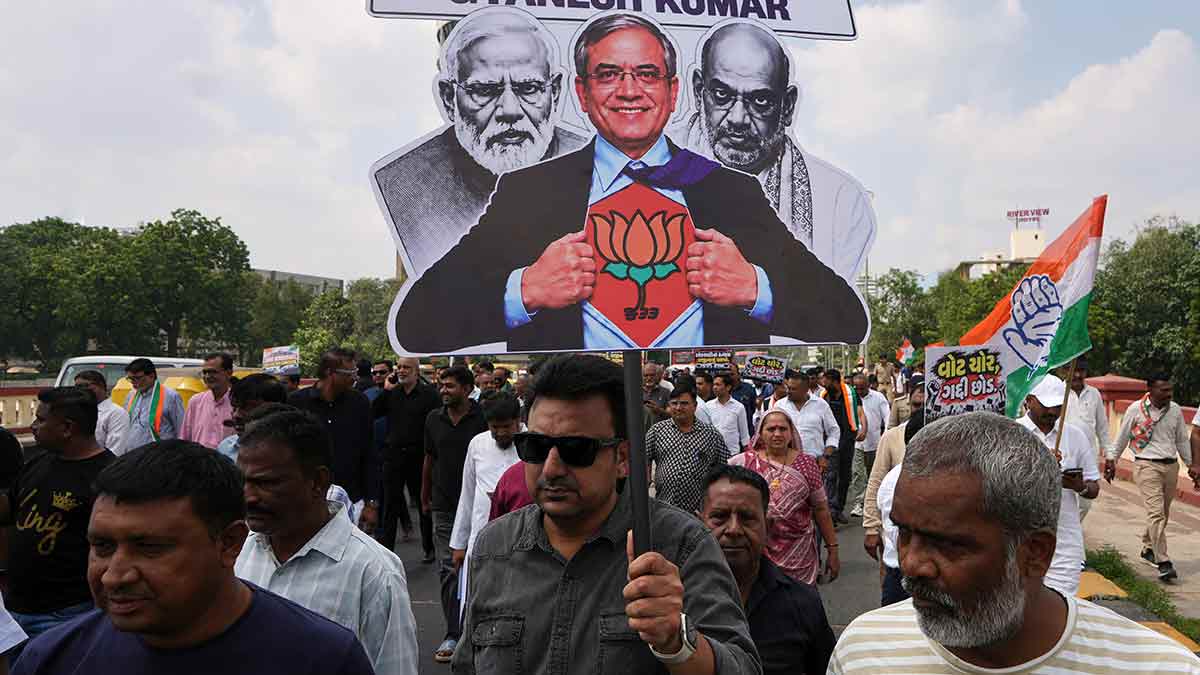
The EC has since announced a review of its electoral-roll software and said that an independent technology expert would be involved in examining whether the system conforms to electoral laws. It has also indicated that technology initiatives will receive greater scrutiny before being introduced. But the knives are out as the political battlefield readies for a bruising contest. Abhijeet Dipke, founder of the Cockroach Janta Party, called Kumar “the biggest threat to India’s democracy”. The CJP has threatened nation-wide demonstrations asking Kumar to step down. The Congress, too, has demanded Kumar’s resignation and has linked the demand to the reported objections raised by the two election commissioners and to its wider allegations concerning electoral-roll management.
The Congress’s argument is that the reported objections from two EC members expose a deeper institutional problem and raise questions about whether decisions were being taken in accordance with the constitutional and statutory structure of the Commission. The government and the BJP have rejected that interpretation. Their position is that disagreements within a multi-member constitutional body are not evidence of institutional collapse. The EC’s own defence has been broadly similar: internal observations and differences are normal, final decisions were unanimous and the EC continues to discharge its constitutional responsibilities.
Two things can be true simultaneously: commissioners can disagree during deliberations but the final decision can be unanimous. What matters is whether the deliberations were real, whether all three members were aware of the decision being considered, whether objections were placed on record and how those objections were dealt with. That is where the EC’s internal procedures suddenly matter to the outside world.
And that is also where the story finally reaches the SIR.
The special intensive revision of electoral rolls began in Bihar in June 2025 and subsequently expanded across states and Union territories. It has become one of the most consequential exercises undertaken by the EC in recent years, bringing questions of documentation, verification, deletion, restoration and appeals directly into millions of households. The reported internal objections of Sandhu and Joshi have overlapped with several of these issues. The concerns included voter additions and deletions, the functioning of the electoral database, Form 6 and the role of technology in electoral-roll management.
The controversy over Form 6 is a particularly revealing example. The EC added an extra section to Form 6 requiring first-time and new applicants to provide details and declare whether their parents or grandparents were listed in previous SIR rolls. The EC has maintained that Form 6 itself was not changed and that a separate declaration introduced in connection with SIR was an additional requirement. The issue became contentious because the process for new voters was linked to the electoral roll of an earlier SIR, raising questions about the documentary burden placed on first-time voters. “Can there be two sets of laws in India,”? asked Quraishi. “One version of Form 6 will be used for you. Will a different version be used for me? The issue is not simply about one form. It is about whether the EC’s procedures are transparent, consistently applied and open to scrutiny.”
For someone entering the electoral system for the first time, the problem is not an abstract argument. It is whether the application goes through or not. For an older voter, the problem can be different. A person who has voted for decades may suddenly be asked to establish a connection with an earlier electoral roll, records that may be difficult to locate after several decades. For a daily-wage worker or a domestic worker, the problem is more difficult and time-consuming: attending a hearing, understanding which documents are required and trying to make sense of what happens if those documents cannot be produced.
This is where a seemingly institutional problem has raised constitutional questions, setting off unease in power corridors in New Delhi. Suddenly, the problems are one too many. For Sunita Devi, a 40-year-old sweeper with the Delhi Metro, the debate over the internal functioning of the EC has offered little comfort when she was confronted with a notice under SIR recently. She had work to attend to, a hearing to understand and documents to produce. Clearly, her concern was not who had won an argument inside Nirvachan Sadan. Her concern was whether her name would remain on the electoral roll.
For Shanti Devi, 72, the difficulty was different. She had voted for decades but was required to establish a link with an earlier electoral roll. The system was asking her to prove a part of her past that had never previously been necessary to establish her eligibility to vote. This is where the SIR finds itself battling a massive administrative and political controversy of its own, even as the debate over the EC’s internal functioning touches larger questions of propriety.
Whether Nirvachan Sadan can pass the test will depend heavily on how it solves its problems one by one.
As a first step, the EC has sought to draw a line under the recent controversy. At a meeting on September 26 attended by all three commissioners, it said the SIR order and schedules had been approved unanimously. It also announced that agendas would be circulated before meetings, minutes would be issued afterwards and directions issued by ECs to officials would be meticulously followed.
In institutional terms, these measures are intended to reinforce collective decision-making and procedural clarity. But they also underline the question that the controversy has now placed before the EC: the role of the chief election commissioner and the commissioners, and whether their identities and functions overlap. It may be recalled that Seshan fought to establish the authority of the chief election commissioner. The Supreme Court then made clear that the authority belonged to the EC as a multi-member body and could not simply be equated with the authority of its chairman.
The present EC operates in a vastly different environment. But over time, the institution has acquired wider reach, more technology and greater capacity to affect a voter’s status without that voter ever coming face to face with a commissioner.
The three men at the top may continue to walk into each other’s offices, argue over files, exchange messages and sit down for tea after a difficult meeting. They may disagree and then arrive at a common decision. That, in itself, is not unusual for a collegial constitutional institution. What remains unanswered is whether the institutional process has given each of them a genuine voice and whether the public can have confidence that the decision announced in the name of the EC was, in fact, the decision of the Commission. That is the unfinished story inside Nirvachan Sadan.
