



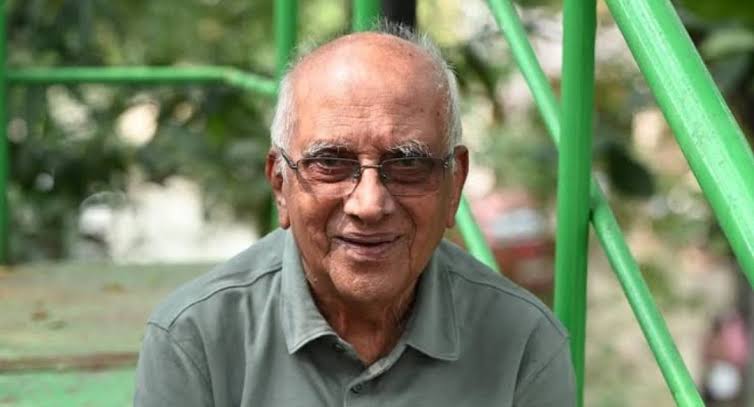
To live to the age of 95, I believe, the man must've led quite a stress-free existence — without treating life so seriously, just like the characters in his movies. Whenever I revisit a Singeetam Srinivasa Rao film, I wonder how he perceived the world at large. His films, most importantly “Pushpaka Vimana” and “Michael Madana Kama Rajan”, now sit comfortably among a handful of films that I pick to alleviate those occasional blues.
In that list of mood-lifting films are also those made by two international filmmakers — French filmmaker Jacques Tati (the most well-known comparison) and Finnish filmmaker Aki Kaurismaki, with whom Singeetam shared, in my book, a strikingly unconventional, yet accessible penchant for telling stories about ordinary people (characters that don't quite fit into the world around them), visual comedy, and social absurdity, despite their relatively different filmmaking grammar and overall texture. But one quality is common: the way his characters reacted to the various absurd scenarios around them.
The Tati parallel is most pronounced in “Pushpaka Vimana”, a one-of-a-kind silent masterpiece that benefited greatly from the presence of Kamal Haasan, who rose to the task of pulling off a feat that would be unimaginable to many others — even if it's imaginable, one doubts whether they would be able to execute it with Singeetam's same finesse.
The filmmaker's comedy owed something to not only silent comedy but also to classical farce. Take how Singeetam loved giving inanimate objects dramatic functions: the ice dagger in “Pushpak”; circus mechanisms in “Apoorva Sagodharangal”; the time machine in “Aditya 369,” and, of course, the entire cliffside house in “Michael Madana Kama Rajan.”
The Kaurismaki parallel, on the other hand, is seen in the tremendous affection these filmmakers showed for people near the bottom of the social hierarchy. The unemployed. The workers. Loners. People ignored by society. People who yearn for the most basic, simplest things — dignity, companionship, food, work... The unemployed protagonist of “Pushpaka Vimana”, I think, would feel right at home in a Kaurismaki film.
All three filmmakers — Singeetam, Tati, and Kaurismaki — possessed the gift of revealing things (or suggesting stories) through body language and gestures. Singeetam, perhaps, understood visual storytelling more than any other Indian filmmaker. His strongest and most enviable quality? Inventiveness. In his work, human ingenuity is the secondary protagonist.
That is why even when Singeetam depicts unemployment, inequality, disability, patriarchy or greed, his films seldom appear nihilistic. His characters take action. They take control. They improvise. Appu, from “Apoorva Sahodharangal”, turns what society perceives as limitation into an advantage. The hero from “Pushpaka Vimana” tries to manufacture his own escape, albeit brief, from poverty. The women of “Magalir Mattum” fight back. The characters in “Aditya 369” (a film that demonstrated that science fiction stories can succeed when mixed with ingredients familiar to Indian audiences) travel through history.
It's like Singeetam was telling us, through them, “The world is absurd. So let's play with it.” For him, comedy was a means to restore power to the powerless.
That said, despite the laughs, there was never an attempt to pretend that the underlying pain wasn't real. This is where Singeetam came close to even Charlie Chaplin. The more we look at the former's films, the more this comparison becomes evident. As in Chaplin's films, a situation can be simultaneously tragic and absurd, most strikingly in "Apoorva Sagodharangal." Rao could've turned Appu into an entirely tragic victim, but he is revealed to be astonishingly capable. What society generally perceives as weakness becomes a tactical advantage.
I was also particularly struck by how Singeetam managed to generate comedy out of what, for most people, are the unlikeliest of events to do that: funerals. In "Pushpaka Vimana", it became an opportunity to stage one of the most romantic events ever put to film. Kamal Haasan and Amala kept moving around the dead body to spend more time together. Singeetam also found an opportunity to generate laughs from elements moving around them. One man appears blank and focused, calmly moving past the couple, and, as though some unseen switch on his body has been suddenly activated, goes into a dramatic "sad" performance, then immediately returns to his former state, as though that switch had been deactivated. And what about that dead performance of Nagesh in "Magalir Mattum"? No dialogues. Just images.
The National Award winner left us on the night of October 3. He was born on September 21. Filmmaker Nag Ashwin, who backed his swan song, aptly titled "Sing Geetam", earlier shared the screenshot of a message that the former had shared with him before his passing — of a script titled "A Fruit Cuts the Knife."
To be intensely passionate about cinema at that age… Most artists give up too early due to various circumstances. Singeetam, like Clint Eastwood (currently 96), Martin Scorsese, Steven Spielberg, and Ridley Scott, showed us that the love for cinema doesn't have an expiry date.
I wonder how Singeetam would have wanted his fans to view his passing. Would he have preferred that we mourn him briefly (or put on a dramatic performance like that man) and then immediately move on and say/do something comical later?
