


1025 Chola maritime conquests
Rajendra Chola stands out as that rare king who conquered lands beyond India, and that too, by sea. Rajendra’s conquests brought a large chunk of southeast Asia under an Indian empire. He brought north Sri Lanka, Thailand, Indonesia and the Maldives, and some even say the Andaman archipelago, under his rule. His conquest of Srivijaya (now in Indonesia) in 1025 brought an end to the Sailendra dynasty.
1303 Siege of Chittor
Legend and fact have got terribly enmeshed in this story. In its most fantastical version, Alauddin Khilji was enamoured by the queen of Chittor, Padmavati, and attacked the fort to claim her. Practical sense suggests that Chittor was strategically important. Khilji put Chittor under siege for seven months. In some accounts, when the Rajputs realised they could not hold out much longer, the women, led by their radiant queen, committed jauhar (suicide), while the men dashed for the saka (fight unto death). In other versions, Khilji ransacked Chittor, killing 30,000 Hindus. From any telling, Khilji remains that dark villain, and the Rajputs seem knights in shining armour.
1576 Battle of Haldighati
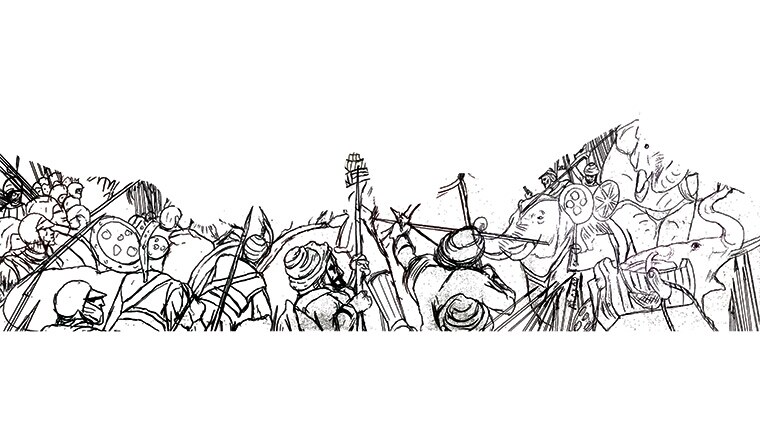
Maharana Pratap of Mewar clashed with Akbar’s army—led by his vassal Man Singh—in a narrow mountain pass in the Aravallis.
The Mughal army was double the size of Pratap’s; the Mughals also had gunpowder. The battle saw one of the best recorded clashes of war elephants. Pratap was injured, but before he fell, a loyal soldier took away his umbrella and charged at the enemy, pretending to be the king. He and his loyal 350 fought to death, while Pratap escaped on his stallion, Chetak.
Akbar won that day, but Pratap reclaimed his territory later. Pratap, not Man Singh, is remembered as the hero of Haldighati.
1671 Battle of Saraighat
The penultimate clash with the Ahoms ended Aurangzeb’s ambition of grabbing Assam. The Ahoms made land access to their kingdom impossible, forcing the Mughals to use their navy in the Brahmaputra. The Mughal navy was mightier than the Ahom flotilla. Worse, Lachit Borphukan, the Ahom commander, fell seriously ill. Seeing the morale of his men dip, he, however, got onto a ship himself and led the forces to victory.
1761 Third Battle of Panipat
Ahmed Shah Abdali clashed with the Marathas in a battle that saw one of the largest numbers of casualties in a single day. Abdali was an Afghan invader, but he had the support of the Mughals and Awadh. He won the battle, but left fearing Maratha retaliation and Alexander’s problem—restless troops. While the casualties in battle were almost equal on both sides, Abdali’s men massacred around 40,000 Maratha men and civilians the day after. The battle put the brakes on the Maratha ambition to resurrect Hindu rule in the subcontinent.
1799 Battle of Srirangapatna
Tipu Sultan was the last major resistance to the British East India Company in the south. Tipu and the British had clashed thrice before in the Anglo-Mysore wars. This time, the British besieged the fort of Srirangapatna and stormed it.
Tipu fought royally, but the Tiger was felled in the field. His attendants tried to whisk him away, but a stray enemy soldier killed him for the expensive jewels he was wearing. The trooper, apparently, did not know that it was Tipu. The Sultan’s body was later recovered from a heap of corpses.
1839 First Anglo-Afghan War
The British invaded Kabul, from India, and put Shah Shuja Durrani on the throne in 1839, defeating Dost Mohammad of the Barakzai dynasty. The Afghan tribes retaliated in 1841, massacring a British contingent returning to India. Then, in 1842, when the British troops were retreating in entirety, Afghani guerrilla attacks and the harsh journey decimated the party. Only one man, army surgeon William Bryden, returned to tell the tale. The British returned in 1878. Though they won, they dared not station a resident in Kabul; Afghanistan never really became their territory. British India halted this side of the Hindukush.
1845 Anglo-Sikh wars
The two wars between the Sikhs of Punjab and the British East India Company resulted in the annexation of Punjab in 1849 by the British. After the Sikhs, there were no major powers left to challenge British dominance in India. The company annexed land right up to the North-West Frontier, which would remain the outer boundary of its Indian empire and of undivided India.
1962 India-China War
Modern India’s most humiliating rout came in this conflict. Unprepared for war, India could still have managed some success against the Chinese, had it used its air power. “But [prime minister] Jawaharlal Nehru took the advice of the Intelligence Bureau and John Galbraith, the US ambassador to India, against it,” says retired Major General Ian Cardozo. There was fear that China would bomb Kolkata if India went on the offensive with its air force. In retrospect, that was a serious miscalculation. China had not advanced its air fleet towards India, while India had several airfields which could have been used to launch offensives.
1965 India-Pakistan War
Fought largely on air and land, the Indo-Pak war of 1965 saw some of the largest tank battles since World War II. India’s smart ploy of luring Pakistani tanks into a water-logged field in the Battle of Asal Uttar resulted in Pakistan losing 97 tanks in a single battle. India advanced to Sialkot and Lahore, but was not able to hold them. Pakistan could not march into Delhi, as it had planned. The western world was of little help for both the countries. In the aftermath, India moved closer to the Soviet Union, and Pakistan to China.
