



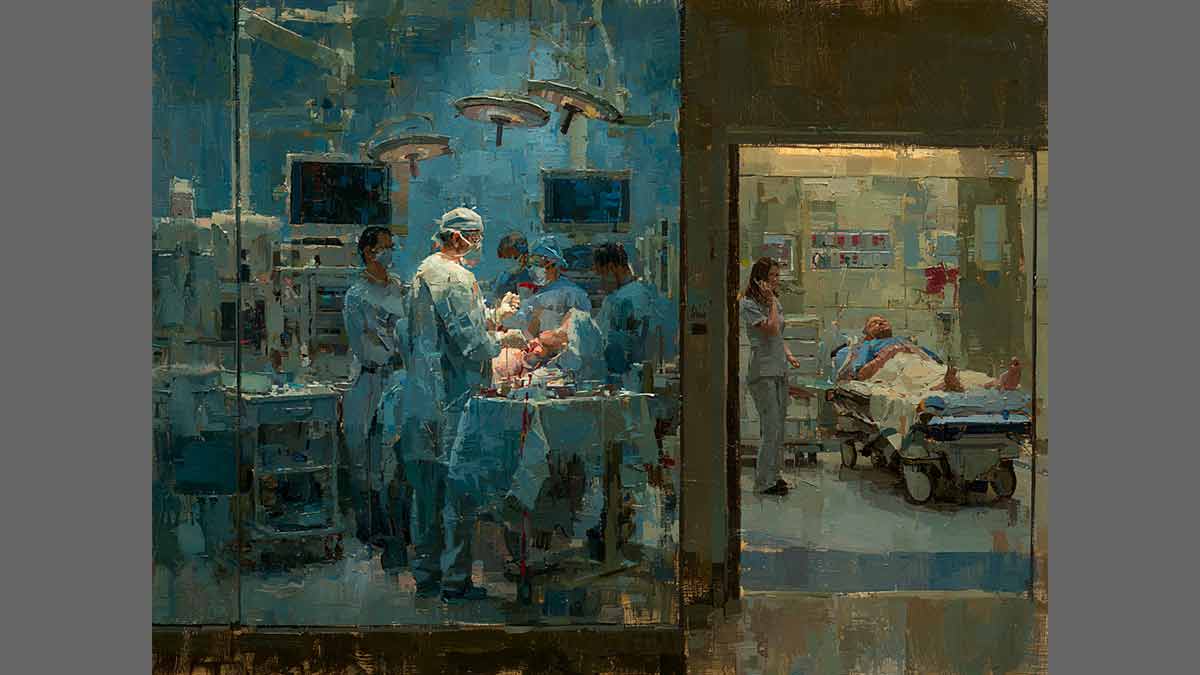
THE CALL
It was early in my years as a surgeon—the kind of time when every decision felt heavier than it should, and every outcome seemed to define who you are becoming.
The microscope light had carved out a small, intense universe in Theatre Three. Beyond its circle, the world did not exist. Inside it, everything mattered.
I was stitching a delicate flap of tissue onto a patient’s tongue—work that demands absolute stillness and absolute presence. In this kind of surgery, there is no pause button. You cannot step away. Time is measured not in minutes, but in how long living tissue can survive without blood.
Then the phone rang. The ICU. Another patient. Four days after surgery. The tissue we had transplanted was failing—darkening, congesting, slipping toward death.
I stood there, gloved, suspended between two lives. If I left, the patient in front of me could lose his reconstruction. If I stayed, the one in the ICU might lose hers.
I called for help. The senior plastic surgery colleague who was part of the first surgery and could have stepped in was miles away, already leaving town. His voice carried something worse than refusal—it carried helplessness.
In that moment, the weight of two chances rested entirely on me.
I chose to stay and finish what I had begun. Not because it was easy, but because it was the least harmful path.
I worked with a cold urgency I had seldom known before. Every stitch was deliberate. Every movement stripped of hesitation. There was no room for doubt, only the quiet, relentless push to finish what I had started.
When the first faint blush of blood returned to the tissue, I stepped back.
It was enough. All fine here.
I stripped off my gloves and rushed.
THE EMPTY THEATRE
By the time I reached the second operating room, the clock had already moved past forgiveness.
It was late, well beyond the rhythm of a normal hospital day. The corridors were quieter, emptier. The familiar team I depended on was gone. In their place stood a young nurse. She was new—I could see it in the way she held herself, in the way her eyes searched the room for cues. This was not the environment she had been trained for.
“Jeweller’s forceps,” I said.
She hesitated, just a fraction of a second. But the moment was enough for me to realise clearly: I’m going to be alone here.
THE LONG NIGHT
I opened the surgical site. It was not a clean problem to fix—it was a battlefield.
The vessels were fragile, damaged, uncooperative. Already handled once, burdened by age and illness. Each movement felt like negotiating with something that did not want to survive.
I cleared the clots, rebuilt the connection. For a moment, there was flow—weak, unconvincing, not enough. “Again.”
I started over. Time dissolved. Midnight passed. Then one. Then two.
Fatigue crept in—not suddenly, but as a slow weight behind the eyes, dulling thought, blunting instinct. My hands continued, but my mind grew heavier with each passing minute.
I felt the need for someone beside me, not to take over, not even to advise but simply to feel supported in an effort that might ultimately end without the outcome we hoped for.
But there was no one. Only the hum of the microscope. The quiet room. And the growing sense that I was fighting alone against something I could not control.
THE WITNESS AT 3AM
By three in the morning, the silence had become overwhelming. I checked the flow again—sluggish, reluctant.
I knew what that meant. The odds were slipping away. And with them, something inside me began to sink, not just fear of failure, but the weight of carrying it alone.
Then, a voice—soft, careful. “Sir… it will be all right.”
I didn’t respond or look up. I didn’t have the energy to explain why it might not be.
She didn’t understand the anatomy, the statistics, the fragility of what lay under the microscope.
She only knew this: I was tired. And I was still trying.
“Sir,” she said again, steadier now, “it will be all right.”
I could now feel the concern clearly—the quiet compassion that can make any human being feel a lot lighter.
THE SECOND CHAIR
I paused. For the first time in hours, I looked away from the microscope.
I saw her across the table—not fully, not clearly. Just a pair of eyes framed by a surgical cap and a mask.
I never saw her face. I still don’t know who she was. But in that moment, it didn’t matter.
She wasn’t offering a medical opinion. She wasn’t solving the problem. She was refusing to let me stand there alone. She had seen something no monitor could measure—the effort, the persistence, the quiet refusal to give up.
And somehow, that was enough.
THE SHIFT
I took a breath. The fatigue didn’t disappear. The vessels didn’t improve.
But something shifted. The isolation lifted.
I returned to the microscope. Adjusted the tension. Refined the sutures. Slowed down—not out of hesitation, but with a steadiness that had not been there before.
We were still fighting the same battle. But now, it felt shared.
WHAT REMAINS
The flap ultimately failed. Time has a way of softening outcome, of blurring results.
A few days later, I returned to salvage what I could—a pedicled soft tissue flap [a technique where a section of living tissue from another part of the body is cut and used to repair the defect]. The next best solution, given the circumstances. The patient could be sent home safely.
But I remember that night, and the weight it carried, made lighter only by the care and concern of someone who saw it and made sure she was not merely nearby, but truly with me.
THE QUIET TRUTH
Sometimes, in our work—and in our lives—we reach a point where everything feels too much. The responsibility, the fatigue, the silence. We believe we are alone, carrying something no one else can see. But we are not.
Somewhere in that silence, someone is watching. Not our success or failure, but our effort. The way we stay. The way we continue, even when the outcome is uncertain.
The surgery may fail. But the spirit must not. Because in the end, what carries us through is not the certainty of saving, but the quiet, enduring grace of being there for one of our own. We did not let go. Together, we tried against all odds.
