



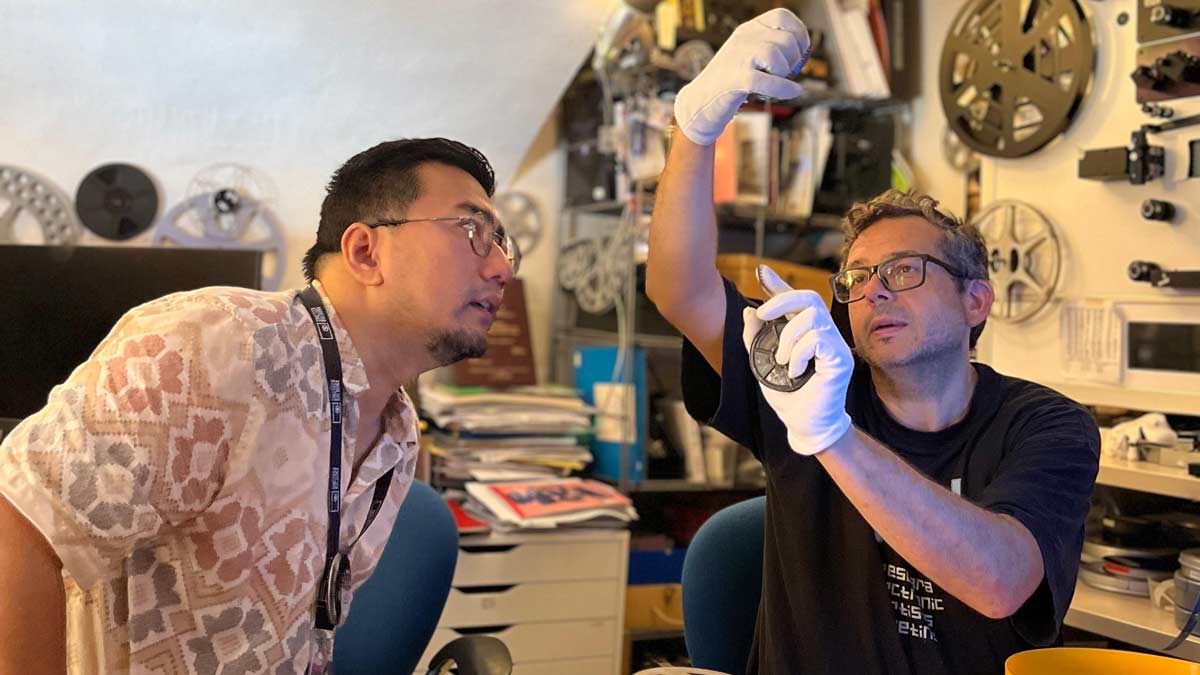
Manipur mostly appears in the news now through images of conflict: burnt homes, relief camps, protests, security forces, and families displaced from their homes. Against that backdrop, something significant is happening at the National Archive of Family Films in Bologna, Italy.
Fifteen old 8mm reels, some nearly a century old, are being restored and digitised there. Shot between the mid-1930s and the 1960s, they capture a state that few people alive today would recognise: its landscapes, festivals, ceremonies, people, and everyday life.
The footage was recorded by two Manipuris, Maharaj Kumar Priyobrata Singh and K. Ibohal Sharma, who were filming a society they knew from within.
The films remained largely forgotten in the collection of Sharma's old studio, X-Cine, until his son, filmmaker K. Bimal Sharma, came across them. They were later handed over to the SN Chand Cine Archive and Museum (SNCCAM), run by the Manipur State Film Development Society (MSFDS).
“We are making efforts to identify and preserve Manipur's cinematic heritage by collecting old physical films from private donors and ensuring their professional conservation,” said Sunzu Bachaspatimayum, filmmaker and secretary of the Manipur State Film Development Society.
He considers the material from Sharma's studio particularly valuable. Some reels shot by Singh date back to 1935.
A member of Manipur's royal family, Singh later became the state's first chief minister. During British rule, he was responsible for several departments, including education, police, public health and engineering. He also headed the state arts and crafts department.
Away from his official responsibilities, he carried a camera and filmed the people and places around him.
Sharma, on the other hand, was a cinematographer and producer, and founded X-Cine, one of the earliest film companies in the state. The studio was later run by his son, Bimal.
“Commercial filmmaking had begun across India at that time. However, Kumar Priyobrata and K. Ibohal wanted to document people's lives and cultural heritage,” Bachaspatimayum said.
Insiders’ view of a troubled state
The two men used Bell & Howell 8mm cameras to record their surroundings. The footage could fill gaps in the written history of the state.
It may show how people dressed, what they ate, how ceremonies were conducted, and how communities lived. It could also provide images of towns, villages and landscapes before modern construction changed them.
“For future generations of Manipur, these reels can tell us what our people were like nearly a century ago,” Bachaspatimayum said.
Johnson Rajkumar, principal film conservator at SNCCAM, sees another important distinction.
“These films are much more than historical footage. They are among the earliest visual records created from within Manipur itself, by someone who belonged to the society he was documenting,” he said.
Much of the imagery of the region from the colonial period was produced by outsiders. These reels were made by people who knew the communities, customs, and places in front of the camera. That makes them valuable not just as old footage, but as a record of how Manipuris saw their own world.
A race against time
The films are fragile. Celluloid deteriorates with age, and once damage becomes severe, the images can be lost permanently.
Rajkumar spent June 19 to July 12 this year training in Italy under a FIFF Film Restoration programme. He was the only participant from India and helped arrange for the most fragile reels to be sent to Bologna.
The restoration and digitisation work is being carried out under the guidance of Paolo Simoni of the Italian archive. Rajkumar said the digitised versions are expected to be produced at 2K resolution, which would provide a high-quality copy for future research and viewing while reducing the need to handle the original reels.
“These reels cannot be treated simply as films to be scanned for viewing,” Rajkumar said. “They are fragile historical documents that need preservation-level treatment.”
India has limited specialised infrastructure for handling film of this age and condition. For a regional archive, sending original reels abroad involves considerable cost and logistical challenges. But leaving them untreated could mean losing the material altogether.
All 15 priority reels are now being digitised in Bologna, with the process expected to be completed next month.
“At present, the digitisation of these fragile reels is underway in Bologna and is expected to be completed by next month,” Rajkumar said. “This process will help secure the visual material for future restoration and academic research.”
“Our aim is to ensure that these images survive in a form that future generations of Manipuris can access, study, and, most importantly, reclaim as part of their own cultural heritage,” he said.
That takes on added significance in a state that has spent more than three years dealing with ethnic violence. For audiences outside the state, Manipur is now often seen through images of violence and displacement.
The old reels show something else. People attend ceremonies. Communities gather. They move through landscapes that have since changed. Life carries on in ways that were probably unremarkable to the people holding the camera.
That ordinariness is what makes the footage valuable.
Singh and Sharma were not making films for historians of the future. They could not have imagined that their footage would one day help researchers understand a society almost a century earlier.
They were simply recording what they saw.
Now, those images could help younger generations see part of their history that has otherwise survived mainly in memory.
The films cannot explain the violence of the present or undo what has been lost. But they can show a side of Manipur that rarely makes it into today's news.
