



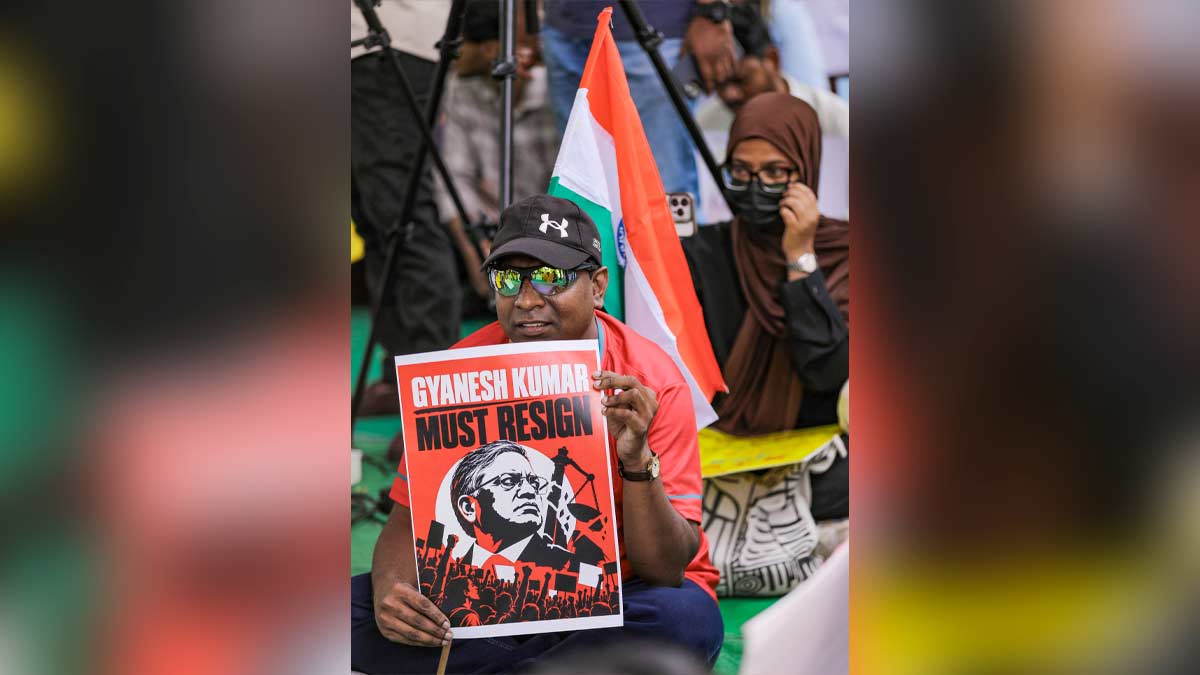
Gyanesh Kumar can breathe easy. Kharge and co have dropped the idea of impeaching him, knowing it’d be like tilting at the windmill. They want him to go on his own. Fond hope! Or under pressure from street protests. Fonder hope, when they have outsourced street stir to cockroaches.
Impeachment is a sharp sword in the Constitution, but one too heavy to lift and strike. Till date no high worthy of India has been impeached after Warren Hastings and Elijah Impey. The one who came closest was Justice Soumitra Sen of the Calcutta High Court. The motion was passed by the upper house in 2011, and would have succeeded in the Lok Sabha, but Sen upstaged them by quitting.
Next closest was V. Ramaswami of the Supreme Court. The motion was moved in 1993 in the Lok Sabha where it failed when the Narasimha Rao-led Congress abstained. The motion fell through for want of numbers.
Four categories of constitutional authorities are protected in such a way that they can be removed only through impeachment—the president, judges of the Supreme Court and high courts, the comptroller and auditor-general, and the chief election commissioner. The vice president isn’t.
The Constitution uses the term ‘impeach’ only in the case of the president—in Article 61, for violating the Constitution. The process can be initiated in either house, requires a 14-day notice by one-fourth of the members and votes of two-thirds of the total membership in both houses. The move hasn’t been even initiated against any president, though a few Congressmen talked of getting Zail Singh impeached when they thought he was plotting to sack the PM.
Judges of the Supreme Court and High Courts can be removed under Articles 124(4) and 218 for misbehaviour or incapacity if a Parliament-appointed probe team indicts them, and each house passes the motion with a majority of the total house and of two-thirds of the members present and voting. Sikkim Chief Justice P.D. Dinakaran quit in 2011 pre-empting an impeachment. A notice was moved in 2015 to remove J.B. Pardiwala of the Gujarat High Court (now in SC) for his comments against caste quota, but the motion was dropped after he expunged the remarks. S.K. Gangele of the MP High Court escaped after the probe team found insufficient evidence in a sexual harassment case. Motions to remove C.V. Nagarjuna Reddy (AP & Telangana HC, 2017) and G.R. Swaminathan (Madras, 2025) were dropped midway. A move to impeach CJI Dipak Misra in 2018 failed when Rajya Sabha chairman Venkaiah Naidu rejected the notice saying the charges were mere “suspicion, conjecture or an assumption”. The most serious case has been the one against Yashwant Varma of burnt notes fame. The case seems to have burnt out itself like the notes.
There has been no move against any CAG, but a few MPs sought CEC T.N. Seshan’s removal after he postponed and countermanded bypolls and assembly polls whimsically. The Rao regime clipped his wings by posting two commissioners who outvoted him in meetings.
Is Gyanesh another Seshan? I don’t know. The rulers hated Seshan, the masses adored him. Kharge and co say, the rulers love Gyanesh. The masses? The answer lies in Jantar Mantar and other town squares.
Tailpiece: The first governor-general Hastings and the first chief justice, Impey, were alleged to have colluded to hang Hastings’s enemy Maharaja Nandakumar for forgery, though forgery was not a capital offence under Indian law. Both were recalled to England in the 1780s. Hastings’s impeachment ended in acquittal; the motion against Impey wasn’t followed up.
