



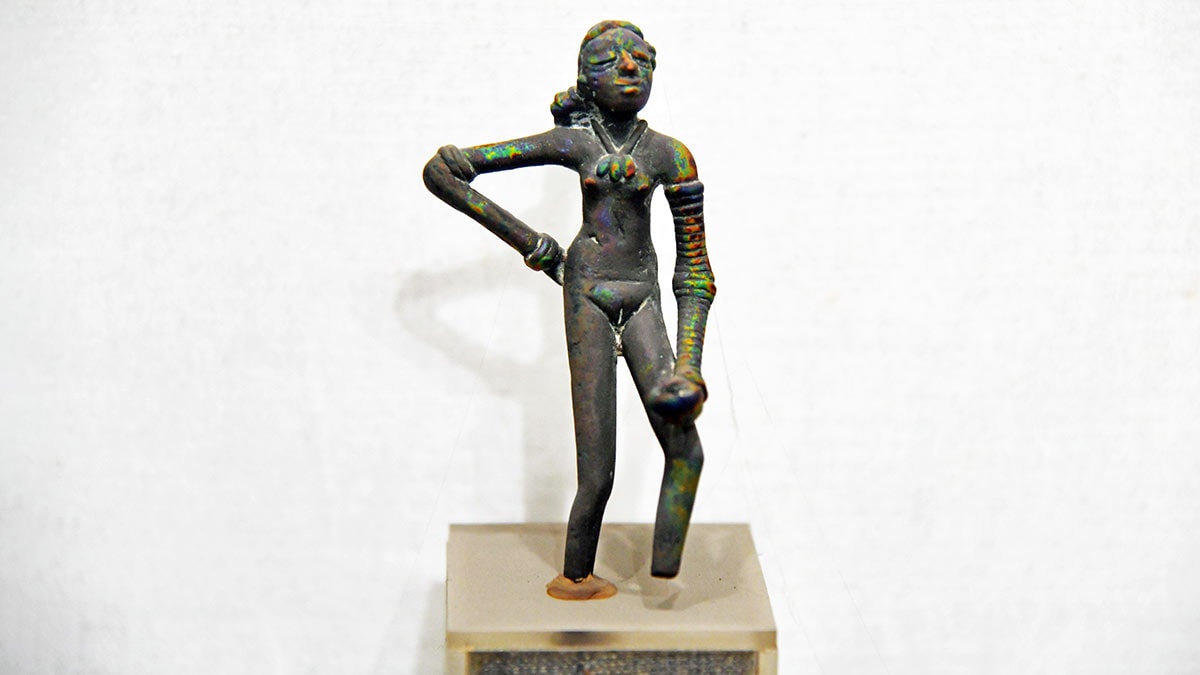
For a hundred years, she danced with naked abandon, and the world of antiquarians enjoyed watching her. Replicas of her dancing pose were made in thousands, and sold to art-lovers and souvenir-hunters who kept them on their mantelpieces, in sitting-room showcases, in bookshelves, and on bedside stools. Her picture has been adorning chapters on Harappan civilisation in schoolbooks for long.
Now, in the year when we should be celebrating her centennial birthday—she was dug out by Ernest Mackay in 1926, and now lives in Delhi’s National Museum—a few fig-leafed pedagogues have sought to clothe the four millennia-old dancing girl of Mohenjo-daro. A few textbook writers of NCERT, who thought her nakedness a national shame, and made an attempt to mask her nakedness to the satvik class nine schoolboys and girls of Bharatvarsha. Luckily, historians and art historians objected, and the bid to dress her up has for now been given up.
This is not the first time crass prudery has attempted to clothe her sublime nakedness. Three years ago, she was made to appear as the mascot of an International Museum Expo clad in a garish pink-and-light clothing, much like Malvolio in yellow garters in Twelfth Night. The dress, rather than her nakedness, looked as obscene as you would have felt if Michelangelo’s David appeared before you in a Manyavar sherwani or Botticelli’s Venus in a Sabyasachi lehenga.
Believe me, boorish prudes have attempted such vandalism in the past. Feeling shame in their nakedness after being seduced by the serpent in the Garden of Eden, Adam and Eve are said to have covered their genitals with fig leaves. This gave a convenient handle to prude artists to paint classical themes, and a tool to vandals to clothe classical masters. Fig leaves came to be commonly used to cover genitalia in paintings and sculptures during the Age of Reformation in Europe. It went to the vandalising extreme when the Catholic church commissioned Daniele da Volterra to fig-leaf or loin-clothe the genitalia in Michelangelo’s ‘Last Judgment’, painted on the ceiling of the Sistine Chapel. The work was done well, but da Volterra came to be known in the art world as the underwear-painter.
In India, disfiguring artefacts, we were told, had been a pastime of mediaeval invaders. Naked statues and erotic sculptures in several north Indian shrines were, we are told, disfigured by the Mamluks, Khiljis, Tughlaqs, Sayyids, Lodhis and other mlechcha invaders. The cultural conscience-keepers of modern India seem to be no better.
Interestingly, it was the Pakistani antiquarians’ prudery that landed us with the dancing girl. During partition, when everything from territory to dictionary was partitioned between the newly free countries, Pakistan claimed all the Harappan legacy and artefacts as theirs since both the two major dug-up sites those days were in Pakistani territory. By a quirk of fate, however, most of the Harappan artefacts, till then stored in Lahore museum, happened to be in India, having been brought to Delhi for exhibitions by the legendary Sir Mortimer Wheeler who headed the ASI from 1944 to 1948. When they had to choose between the naked dancing girl and the equally famous clothed priest king of Mohenjo-daro, the prude Pakistanis chose the latter, and the nautch girl came over to India.
Today, Indians are behaving like the Pakistanis of 1947. Who knows if they will chisel out all the sculptures and reliefs on the Khajuraho temple walls, and claim the sanitised sanctums for worship.
