


Today’s children and youth are 1.9 billion strong. Never before has the world had so many young people in its history. Yet, in many parts, they are too often denied the opportunity to realise their full potential. We have failed to secure the dreams and rights of our children in spite of the innumerable institutions of governance and faith, and international laws and conventions.
Globally, 62 million adolescents have never been to a primary school and almost 260 million children up to the age of 18 are out of school. The world has not yet been able to solve the ongoing problems of child trafficking, labour and slavery and, now, new challenges have emerged in the form of refugee crisis. About 230 million children are caught in conflict-prone environments, which means that they are in perpetual danger, be it as observers, participants or targets. Many of them are being relentlessly radicalised, abducted and enslaved to promote extremism and violence. This is an annihilation of childhood and it troubles me, and it should trouble you, too.
Why have we been unable to protect the children of our country, or any other?
A deficit of moral values and compassion resulting in apathy and lack of will for our children exists today. Their well-being is a missing element in political priorities, budgetary allocations and social discourse, and can never be fully achieved unless they are entrusted with responsibility to advocate for themselves.
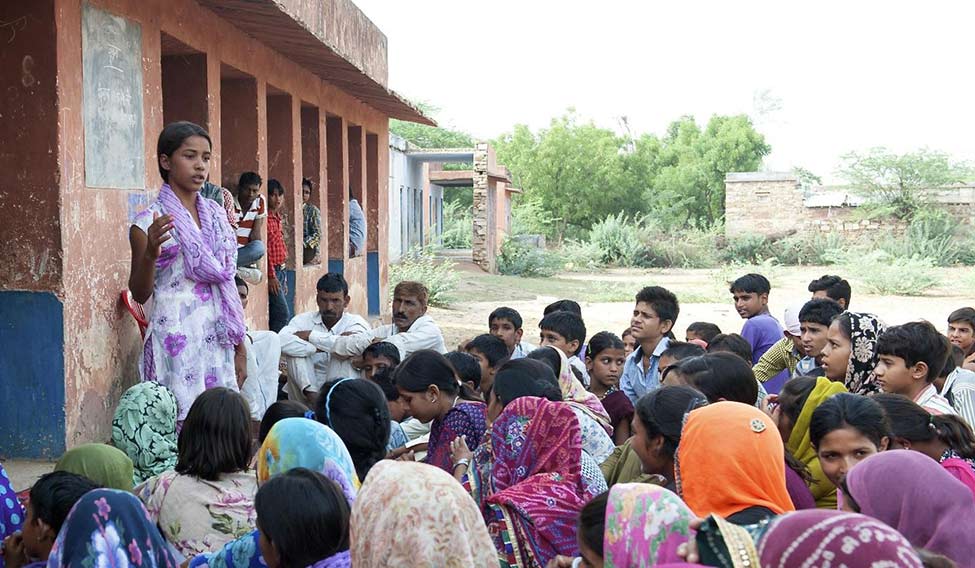
In 2012, we adopted a village in Rajasthan called Hinsla as a Bal Mitra Gram (BMG). A BMG is essentially a child-friendly village where children are free from all forms of exploitation and are enrolled in schools. Central to this idea is the concept of child engagement in matters involving the community. Knowledge and training are provided to help them identify and analyse the root causes of social inequalities. Children’s rights are protected with the active involvement of and dialogue between the villagers, the Bal Panchayat (Children’s Council), the village panchayat and the local administration.
A girl named Payal began protesting the evils of child marriage and ghunghat pratha—an age-old tradition which requires women to cover their faces with a veil at all times. This tradition reinforces man’s supremacy over woman and perpetuates patriarchy. Instead of succumbing to family pressure, she went to school and refused to get married young. Her commitment brought her to the forefront of the fight for social equality, and Payal was elected as the head of the Bal Panchayat in Hinsla. Her continued efforts led her to be a jury member of the International Children’s Peace Prize at the age of 13.
Similarly, Amar Lal who was rescued from a stone quarry in Rajasthan at the age of five is now an activist for the rights of children worldwide. He chaired one of the sessions of the World Congress for Education, where delegates from all Indian states and from 45 other countries participated. Amar even represented the voice of child labourers in UNESCO’s high level group meeting at Dakar, Senegal, in December 2007. Chosen as a child representative to speak alongside world leaders in a high profile meeting of education ministers, Amar Lal highlighted the need for education to the assembled policy makers.
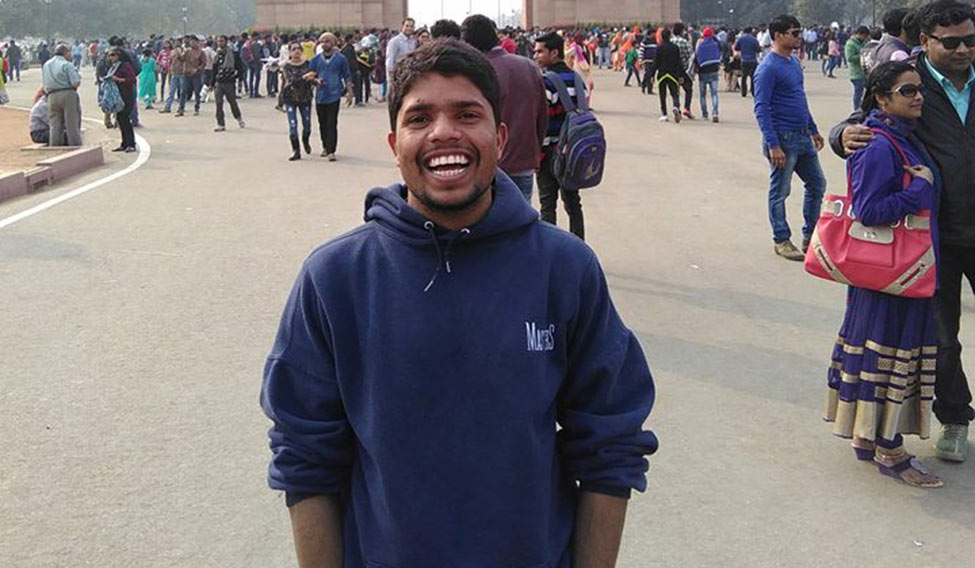 Amar Lal, who represented the voice of child labourers in UNESCO’S high-level group meeting in 2007.
Like Payal, Amar Lal also rose to the occasion. It is in these moments that one realises the power of youth. Their voice is critical to this work, and their efforts are unmatched. If given a chance to advocate for themselves, their humanity will cut across inequalities, categories of class and caste, economic disparity and political borders, and strive towards finding solutions with a human soul. Violence is not only manifested externally, but it has its roots in the multiple facades of structural inequality. To achieve peace and spread compassion, we need the sanctity of children—clean and untarnished by adult prejudice—to decide our fates.
We need to believe in the strength and ability of youth to be change makers. Even more, we need to make them aware of the power they possess, and the capacity to not think of themselves as powerless but as central to the solution. The stories of Amar Lal and Payal are a testimony to such exemplary leadership and strength.
In the struggle against slavery, I have witnessed innumerable times children take charge and lead their families, other children, villages and societies out of the darkness.
Many people have asked me, “What is your inspiration, Kailash ji?”
My inspiration is these young people. I feel tremendously empowered and inspired meeting young people who are hungry to bring real change. The youth is not only a prized demographic dividend but also our strongest moral force.
Therefore, I intend to launch history’s most ambitious campaign for the rights of children with the youth at its driving seat. My belief is that if 100 million young boys and girls stand up and protect the rights of the marginalised and left-behind 100 million children, then the arc of history will change forever.
The conditions of the present haunt us because for long we have neglected the power of our children. Their compassion and will to change circumstances is the key to sustainable peace and development. We have ignored them in our policies and programmes till now. For once, let us get inspired by them. Let us enable the youth to take over the world and let us start by giving them a platform to do so.
I am determined to march forward firmly in the full assurance of the youth’s ability and sense of idealism, and the cause that we stand for.
The writer is a Nobel Peace Laureate and founder of Kailash Satyarthi Children’s Foundation.