


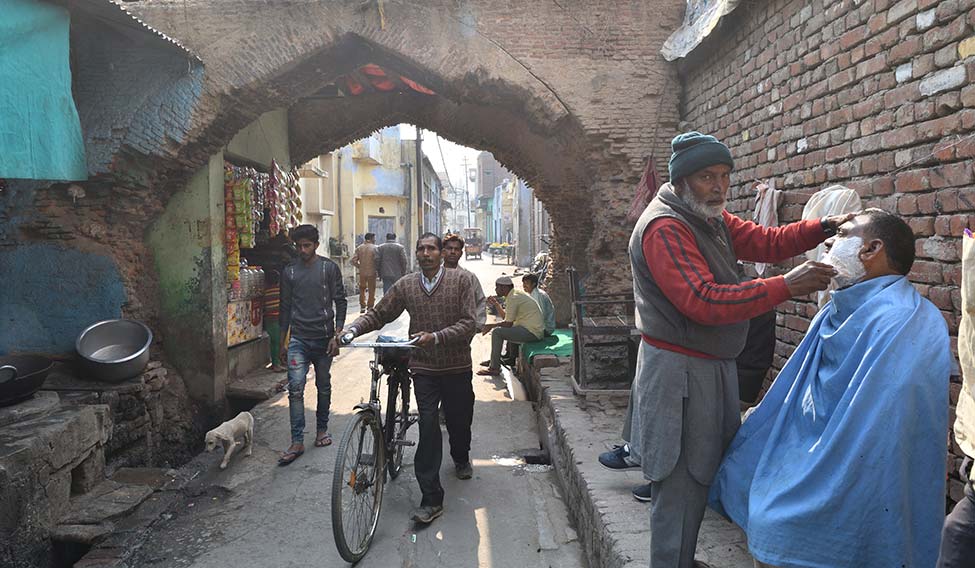
Zaheer Ahmed belongs to a family of award-winning potters. His father won a state award and his uncle a national award in ceramics, which has put Khurja on national map for the eponymous blue pottery.
However, Ahmed and his ilk have been experiencing the blues over the past three months, thanks to the demonetisation. Work and payments have come to a standstill.
But, the angst will not influence his vote, says Ahmed. “We have nothing against the BJP; we will decide based on the candidates fielded by the parties,” he says.
His son, Tanveer, however, is certain that he would vote against the BJP. But, he does not say which party he would vote for.
“There is still some confusion on how Muslims would vote,” says former vice chancellor of Aligarh Muslim University Mahmoodur Rehman, a retired IAS officer. “The Samajwadi Party and the BSP use Muslims as pawns.”
The demonetisation hit Muslims and dalits hard, as most of them survived on small-scale industry and daily wages.
It is not just about notes. The Muslims view the demonetisation as a polarising exercise. “The note ban was hailed as attack on terror funding,” says Sajid Ahmed Khan, a businessman in Aligarh. “This was interpreted by many as tarnishing the Muslim community.” Most Muslims are likely to vote for candidates who can give the BJP a tough fight. Though traditionally inclined towards the Samajwadi Party, Muslims, this time, are likely to vote on a seat-to-seat basis.
This sentiment could benefit the BSP, which has fielded strong Muslim candidates. The traditional votes of dalits and significant chunks of Muslim votes could give the BSP the upper hand in regions where these communities are numerically strong.
Notably, not a single Muslim candidate in Uttar Pradesh won in the 2014 general elections. The Muslim votes were divided between the Samajwadi Party, the BSP, and the Congress. “However, the Bihar assembly elections in 2015 showed that, if the community chooses carefully, it can make a difference,” says Prof Mujahid Beg, president of the Aligarh Muslim University Teachers’ Association.
In the 2012 Uttar Pradesh assembly election, it was the strong Muslim support that helped the Yadav-dominated Samajwadi Party win.
Anwar Khan, who runs a business of frozen foods in Khurja, has been active in the daily chaupal conversations of ordinary people. “There is concern that the BJP could emerge strong in the polls,” he says. “It will lead to change in the Rajya Sabha numbers, thus helping the BJP push its agendas. This fear stems from irresponsible statements made by some local BJP leaders.”
The only options available for the Muslims are the Samajwadi Party and the BSP, says Anwar, whose elder brother and uncle are former MPs. “The Yadavs filled all the administrative posts despite their relatively small population under the Akhilesh Yadav government, just as the Jatavs [a dalit community] had done during Mayawati’s rule,” he alleges. “Yet, the Muslims have no other choice.”

Jasim Mohammad, director of the Muslim Chamber of Commerce and Industry in Aligarh, says 476 riots have occurred during Akhilesh’s rule. He claims that the Samajwadi Party and the Congress have never fulfilled any of the promises made to the community.
“Muslims are intelligent now. I think they would move towards the BSP,” he says.
But the general mood one gets among the Muslims is to vote for the Congress-Samajwadi Party alliance. “Muslims are comfortable with the Congress-Samajwadi Party alliance,” says A.K. Verma, director of Kanpur-based Centre for the Study of Society and Politics. “During the 2014 elections, most Muslims voted for the Samajwadi Party. Our studies show that Muslim support for the Samajwadi Party has gone up.”
He also notes that the BJP, which used to get 3-4 per cent of Muslim votes, managed to notch up 10 per cent in 2014. “This time, it will get only 1 or 2 per cent,” says Verma.
However, the sentiment of keeping the BJP away may not translate into reality. “The BJP may win majority,” says Aftab Ahmed of Aligarh. “The Muslim vote could get split between the BSP and the SP-Congress alliance. Also, parties such as Asaduddin Owaisi’s MIM, too, are fielding candidates.”
The BJP has not fielded any Muslim candidate. The party counts on non-Yadav OBCs, non-Jatav dalits, and upper castes such as Brahmins, Thakurs and Vaishyas.
Rameshwar Chaurasiya, the BJP’s co-in-charge of Uttar Pradesh, begs to differ. “The Modi government believes in sabka saath, sabka vikas (collective efforts, inclusive growth). The BJP’s constituency has changed,” he says.
The BJP has high hopes of getting a significant chunk of the dalit votes, which was clear with the Union government invoking B.R. Ambedkar and naming its new payment app after him (BHIM).
The 2014 elections gave the BJP the maximum number of dalit MPs; it won all 17 reserved seats. But, subsequent issues such as cow vigilantism cracked the party’s interface with dalits.
In Agra’s Kazipara area, most dalits say they would rally behind Mayawati’s BSP. “This [Akhilesh Yadav] government made many announcements, but there has been little for us,” says Narender Singh Sutail, a shoe manufacturer. “Whenever Mayawati comes to power, the dalits get their due.”
The BJP, however, hopes that the youth would rise above caste considerations like they did during the Lok Sabha elections. Its spokesperson G.V.L. Narasimha Rao says the BJP appeals to all communities alike. The party, he asserts, would pull off an encore of the 2014 elections, courtesy the performance and image of Modi.