



-
The BSP believes that a large section of Muslim voters who have traditionally sided with the SP may drift towards Mayawati to keep the BJP away.
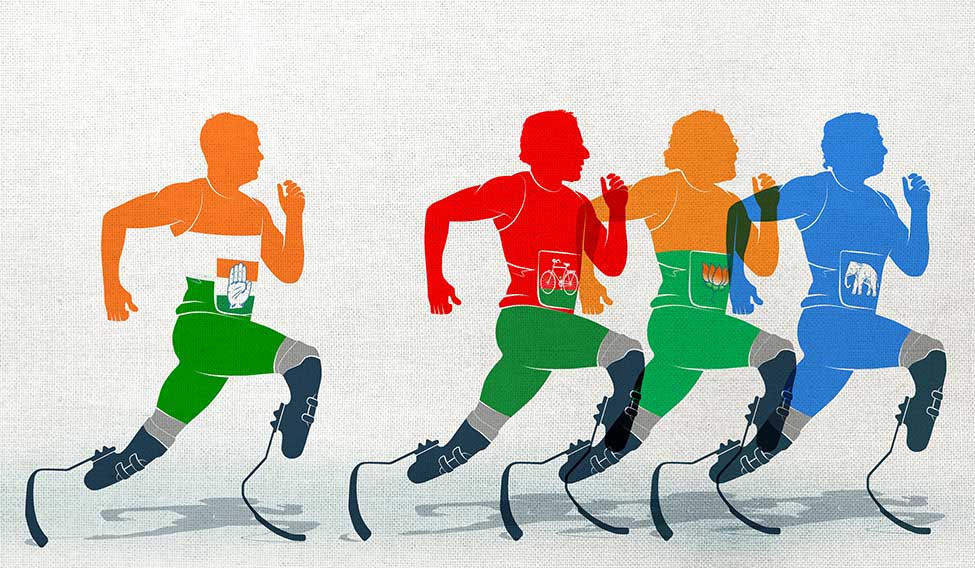
It is a race of four lame horses—the one that is unfolding in the Gangetic Plain. There are no clear winners, and none of the contestants is counting on his or her strengths. On the contrary, every one of the four racers is looking over the shoulders and checking who is the least lame among them.
The Bharatiya Janata Party, which had swept the state in the Lok Sabha elections two and a half years ago, is worried about the common man’s wrath over the note ban. The Samajwadi Party, which ruled the state for five years and acquitted itself creditably, is split down the middle in an ugly family feud. This should have been advantage to the third contender, the Bahujan Samaj Party of Mayawati, which was hoping to cash in on the dalit anger against the BJP and the Muslim anger against the SP. But the party is finding itself being deserted by leaders of those very same communities that are supposedly angry with the BJP and the SP. And the Congress, despite the early launch of an elderly Sheila Dikshit and talk of unleashing new poll tactics under an outsider, seems lost in the crowd.
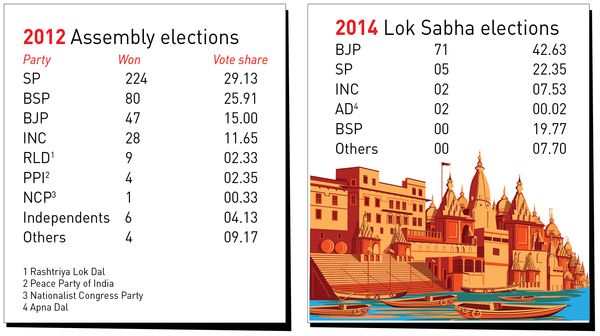
The picture was not so dismal till a few months ago. Every one of the four parties was looking forward to a good fight, one in which all of them had looked bright, shining, wiry and puissant. The BJP was riding high on the popularity of the 56-inch-chested Narendra Modi who has been supping with world leaders, talking of bullet-train projects, cleaning up the Ganga to its divine purity, and ordering surgical strikes at the badmashes across the borders. The party was hoping to make the Uttar Pradesh polls a mid-term appraisal of the Modi regime. Party chief Amit Shah, who engineered an impressive win in 2014, was looking for a repeat show, counting on the 300 assembly segments that his party had won in the 2014 Lok Sabha polls.
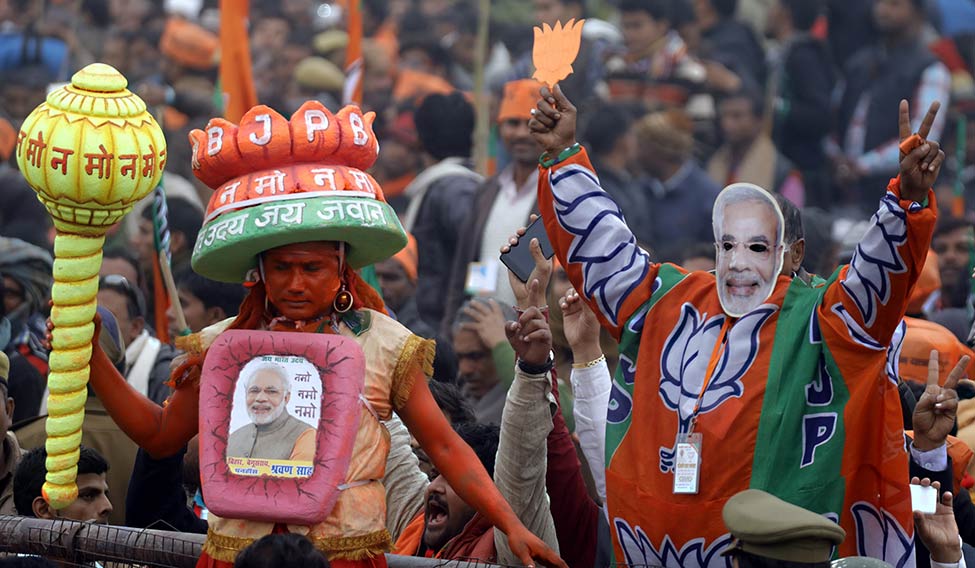 Great expectations: A BJP rally in Lucknow | Pawan Kumar
The BJP had also done good work to woo its Hindu vote bank. At its national executive meeting in Allahabad last June, it aggressively raised the issue of exodus of Hindus from Kairana, a familiar script in creating a polarised atmosphere. The gau rakshak (cow vigilante) violence against the dalits worried a few, but Modi in his speech invoked the upper castes and OBCs, indicating that he was banking on them in the event of the dalits voting against him. In September, the party strategists rejoiced at the surgical strike across the Line of Control, which established Modi as a strong Hindu nationalist leader.
Modi’s second surgical strike against home-grown black money, however, hit his supporters hard, as reports of farm distress and middle class inconvenience poured in. The party had always drawn on the votes of the middle and lower middle classes, especially in small towns, and it was this section that was affected the most. With no cash available, both merchants and shoppers have been hit, and so have casual workers and their job givers. The desperation can be gauged from the increasing frequency and pitch of Modi’s and other BJP leaders’ accusation that the opposition is in cahoots with black money hoarders.
That is not all. The party is organisationally handicapped. “We have too many local leaders, but no big name who could be acceptable across the castes and communities in the state,” said a party functionary. “We have Modi and Modi alone.”
Shah and the party’s state in-charge Om Mathur decided against naming a chief minister candidate fearing it would evoke disenchantment among the other claimants in the caste-ridden state. At one point, the party had tried to project Union Home Minister Rajnath Singh, a former chief minister of the state. However, sources close to Rajnath told THE WEEK that he was not willing to stake his political career in a battle with too many uncertainties. Even Shah’s persuasion did not move Rajnath.
Modi has been aware of the worries. The party’s state leaders are now told to talk about the sops that Modi announced in his New Year eve speech and the more sops expected in the budget on February 1. In his January 7 address to the party national executive, the prime minister reminded them that he had been born in poverty and had lived through it. He asked the partymen to welcome criticism and not to worry about allegations. “Hamari sarkar gareeb ke liye hai (our government is for the poor),” he said.
The BJP knows that, more than the anger over the note ban, its nemesis could be a dalit-Muslim consolidation in favour of Mayawati. Another concern is the prospect of the Akhilesh Yadav-led Samajwadi Party aligning with the Congress, which could bring together Yadavs, Muslims, OBCs and Brahmins and other upper castes. If Ajit Singh of the Rashtriya Lok Dal joins forces with them, that could be the undoing of all the caste castles that the BJP has been building.
Akhilesh, meanwhile, is worried about bigger problems at home, literally. He has got to establish, against the machinations of a well-entrenched old guard led by his father, Mulayam Singh, and aided by uncle Shivpal, that he is the real Samajwadi Party. Advised by another uncle Ramgopal, Akhilesh has held a party convention and declared himself the party boss.
On January 8, when Lucknow was reeling under a cold wave, Mulayam raised the political temperature in the state. Postponing a trip to Delhi, the old wrestler stayed put in his party office and directed party workers to start preparations for the polls. “Don’t indulge in slogan shouting, go and prepare for polls,” he told them. “Everything will be OK in the party. I am the president.” In the evening, he reached Delhi and declared, “I’m the president. Ramgopal’s convention was fake.”
But the paternal fondness overcame him when he returned to Lucknow. “Akhilesh Yadav will be the chief minister of the state again,” he declared. Now one joke doing the rounds is, who has made more U-turns and conflicting statements—Mulayam Singh Yadav or the Reserve Bank of India?
Both factions admit that the party is passing through the most turbulent phase of its political existence. Both camps have approached the Election Commission for retaining its election symbol—the bicycle—which the party has been riding to electoral wins and defeats over the decades. Ramgopal Yadav has submitted truck-loads of proof to the EC—more than 1.5 lakh pages of documents which had affidavits signed by some 4,000 SP delegates. This includes papers supporting Akhilesh, signed by 15 MPs, 206 MLAs, 56 MLCs and 30 members of the national executive.
Akhilesh has a clear numerical edge over his father. Mulayam, despite announcing rallies in various divisions of the state, could not address more than two, owing to the ongoing family feud. And, Akhilesh’s vijay rath yatra has not been attracting crowds.
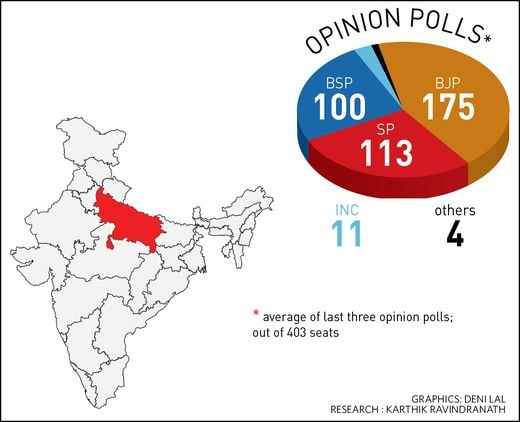
Adding to the confusion are the two lists of candidates announced by the feuding factions. About 75 per cent of the names are common in both lists, blurring loyalty lines. Admitted an Akhilesh aide: “The fight between the father and the son has spoiled everything. Before it broke out, we were emerging as the largest party in various poll surveys, but now it is doubtful if we will be able to touch 130.” All the same, there is no sign of any compromise. “Now the possibility of any compromise is very feeble,” said Ramgopal. “Akhilesh’s opponents are my opponents.”
The feud has crippled both factions in another manner, too. The bank accounts of the party have been frozen—a second cash crunch after the Modi-ordered demonetisation.
It should have gladdened the heart of Mayawati. The BSP believes that a large section of Muslim voters who have traditionally sided with the SP may drift towards Mayawati to keep the BJP away. The party is also working on its strategy in the event of the Akhilesh group aligning with the Congress. Its candidate list of 403 has 97 Muslims, 87 dalits, 106 OBCs and 113 upper castes (Brahmins 66, Kshatriyas 36 and others 11). Mayawati’s calculation is that 21 per cent dalits and 19 per cent Muslims together should give her a comfortable majority.
But she is faced with troubles even in working out such a combination. Her whimsical ways have alienated several party leaders and most of them have found their way into the BJP. Her trusted national secretary, Swami Prasad Maurya, who had been an MLA for more than 20 years, is now in the BJP. R.K Chaudhary, another founding member, quit the party accusing Mayawati of selling tickets. Party leaders Param Dev Yadav, Sitaram Verma, Ramdev Arya, Amarnath Prajapati, Lalji Rai, Upendra Singh, Harvinder Sahani and Brijesh Verma also left her. “Mayawati is taking money and selling tickets,” said Maurya. “Dalits have no place in the BSP. The BSP president pretends to be an Ambedkarwadi; in reality she is selling the dreams of Ambedkar.”
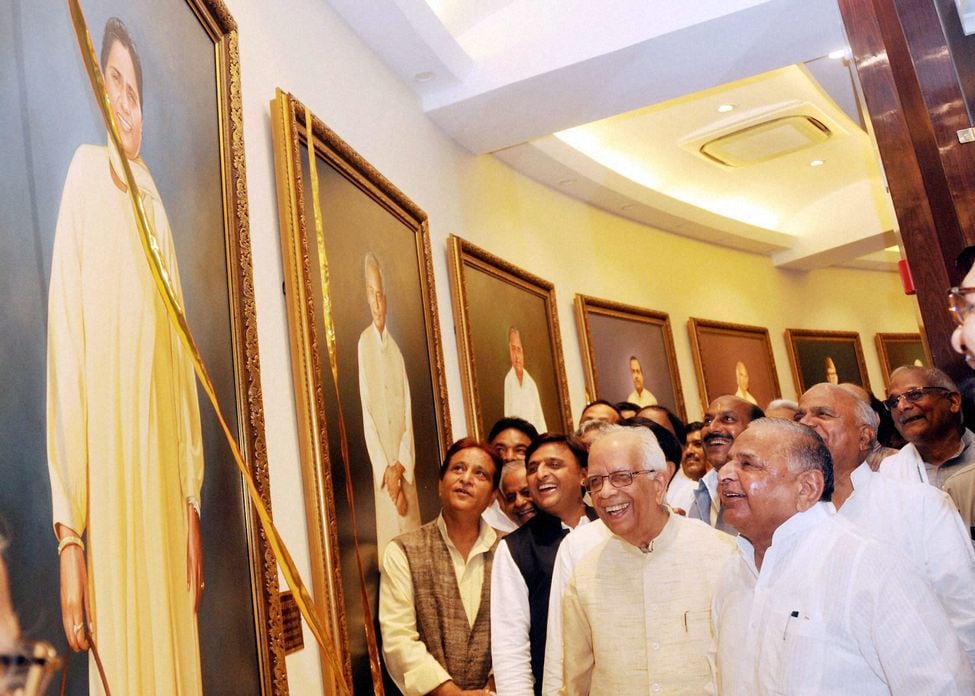 Who will have the last laugh? Uttar Pradesh Chief Minister Akhilesh Yadav, Samajwadi Party chief Mulayam Singh Yadav and other leaders watch an oil painting of BSP chief Mayawati at the assembly | PTI
This is the first time that the BSP has faced such a rebellion since the party was founded by Kanshi Ram more than three decades ago. But the seeds of the revolt were sown in 2012. Detractors allege that Mayawati lost power in the 2012 assembly polls because she sold tickets, ignoring the claims of some 130 deserving candidates.
The Kshatriyas, too, are upset with the BSP, after the humiliation that the BJP leader Dayashankar Singh’s family was subjected to after his derogatory remarks against her. The BSP’s Ramachal Rajbhar, however, put up a brave face, saying the exodus would not affect the party. “The party has a large number of committed grassroots workers and leaders, who will fetch the votes,” he said.
The Congress appears to have conceded defeat even before the polls. It had hired strategist Prashant Kishor several months ago and launched a campaign projecting Sheila Dikshit as its chief minister candidate. Dikshit and the party’s state president Raj Babbar took off on a much publicised bus yatra, which was flagged off by party president Sonia Gandhi and vice president Rahul Gandhi. Dikshit’s name was announced with the hope of garnering the Brahmin vote. While a buzz around Priyanka Vadra joining the campaign added to the excitement, Rahul launched a kisan yatra across the state, delivering aggressive speeches.
Yet, in the end, the party looks lost, and stunned by the fast-paced developments all around it—the surgical strike, the demonetisation, the split in the SP and its own lack of any agenda or programme. Kishor had run-ins with the local leaders who did not like him getting into issues such as selection of candidates and alliance talks. Kishor had left strategising in the state to his team at the Indian Political Action Committee, but when the Congress launched its outreach programme for dalits, IPAC was kept away.
Originally, the Congress launched a campaign harping on the slogan of ‘27 Saal, UP Behaal’, which was an attack on the BJP, the BSP and the SP, which have been ruling the state for 27 years. But it was quietly dropped as prospects of an alliance with the Akhilesh faction of the SP emerged. The anti-climax came when Dikshit finally offered to step down, offering to smoothen the way for Akhilesh!
WITH R. PRASANNAN