


It's November end, but Panjim has been bright and sunny. Last week, its streets were lit with strings of fairy lights and huge blue-green peacocks with plumage made of rolls of film. Colourful cutouts of old-fashioned windows hang from the trees, some of them spelling out the letters ‘I F F I’ in bold. On November 20, Goa warmly welcomed filmmakers, film enthusiasts, movie goers, film students, actors, celebrities and pretty much everybody who loved film to the 48th International Film Festival of India. With over five screening venues, and one separate venue for the opening and closing ceremonies, Panjim was alive with people travelling from all over the country to partake in all that IFFI 2017 promised—great films from all around the word, masterclasses and panel discussions with experienced professionals, conversations about cinema and of course, glimpses of celebrities! Throw in the beautiful beaches of Goa, delicious seafood and affordable alcohol—who wouldn’t want to?
As students of media and communication, my friends and I received free entry passes under the ‘student delegate’ category. We walked into Kala Academy, one of the main screening venues, feeling rather smug. The only down side was that although we got free entry passes, we didn't get the goodie bag that other delegates who paid for the passes got. Once we got the passes, we rushed to book tickets for movie screenings. Most masterclasses and panel discussions were open to all. The Kala Academy was beautifully decked up with the signature IFFI peacocks and tree hangings. The Kala Academy also had a poster exhibition titled 'Stree: A tribute to Womanhood in Indian Cinema’, showcasing posters of Indian films based on women, through the ages and across languages.
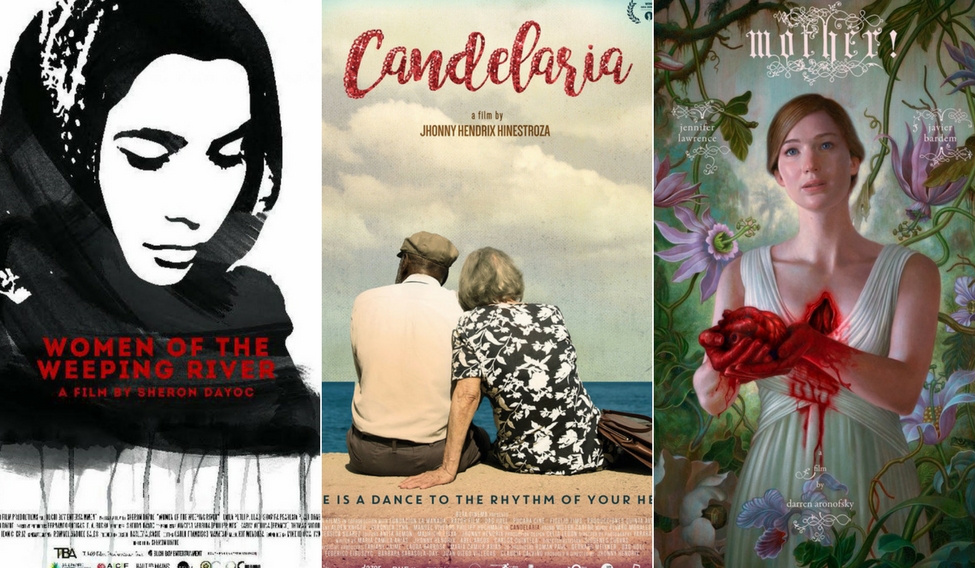
At the Kala Academy, the first film we watched was Candelaria, featured under the Cinema of the World category, directed by Jhonny Hendrix. It was a delightful little film with stunning cinematography, great acting and a very simple and well-crafted story line. Over the next few days, we watched many films, and it was evident that IFFI 2017 had set the bar high in terms of quality of the films they chose to screen. Almost every film showcased spectacular cinematography and each film had its own residual taste that lingered in our minds and hearts, long after watching it. It was then, sitting in a dark theatre after another dark theatre, getting pulled into the different worlds of films we watched, that I truly understood the meaning of the word ‘catharsis’.
At INOX, we watched Women of the Weeping River by director Sheron Dayoc—a film set in the Philippines. In an interaction with the director, he told us how women are often held back from participating in decision-making process due to cultural and religious expectations. Through Women of the Weeping River, which highlighted the roles of women in resolving a generation-long family feud between two separate families, he tried to show how society would benefit from giving women a chance to take part in making these decisions.
Another film that stood out was Mother! by Darren Aronofsky, which ran full house for almost every screening. Mother! turned out to be an absolutely bizarre, yet a wonderful film, leaving the audience hooting and clapping as the last scene cuts to black. It was truly an experience. Another film that had crowd queuing up at the ticket counters was the Malayalam movie Take Off, directed by Mahesh Narayanan, featured under the Indian Panorama category.
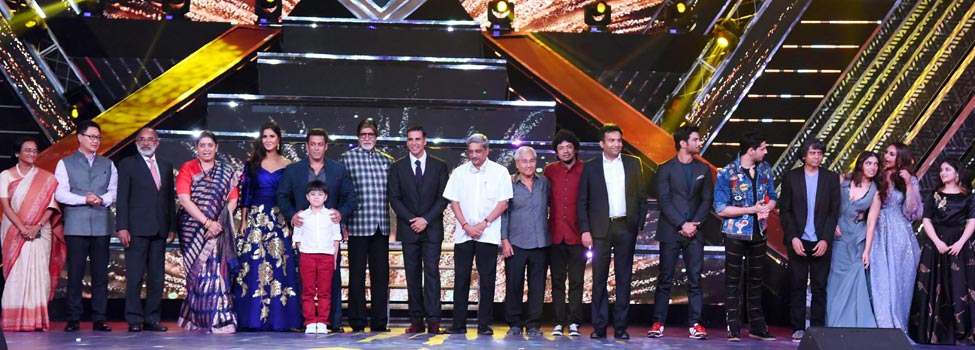 I&B Minister Smriti Irani, Goa Chief Minister Manohar Parrikar, MoS (Home) Shri Kiren Rijiju, actors Amitabh Bachchan, Salman Khan, Akshay Kumar and others at the closing ceremony of the IFFI 2017 in Panaji, Goa on Tuesday | PTI
Among countries, IFFI focused on Canada this year. It showcased eight excellent Canadian films. Films featured under the World Cinema category included not just award-winning and Oscar-nominated foreign films by popular filmmakers, but also the works of debutant filmmakers. Seven films that won the BRICS Film Awards this year were also screened. This year, the tradition of having at least one retrospective section at IFFI was honoured by the Bond Retrospective category, celebrating James Bond films that stood the test of time. Two audio-described cinematic works were also presented for the visually impaired film lovers.
Actor Bhumi Pednekar of Dum Laga Ke Haisha fame took a masterclass on breaking stereotypes, casting director Mukesh Chhabra on characterisation and casting for cinema, and filmmaker Atom Egoyan on 'making drama’. The panel discussions too saw packed audiences. IFFI 2017 closed with the screening of Thinking Of Him, an Indo-Argentine film by Pablo César, on the relationship of legendary poet Rabindranath Tagore and Argentine feminist and writer Victoria Ocampo. This was of course, followed by the star-studded closing ceremony at the Shyama Prasad Mukherjee Stadium.
Also Read: How do two poets fall in love?
There was a feeling of something truly magical in the streets of Panjim during the film festival. The films not only gave people a moment to escape from reality and live in someone else’s world for a little while, but also brought us in close contact with people from other parts of the world. There’s a subtle difference between watching a film in the good, old usual way and watching a movie at a film festival. One can really sense the enthusiasm emanating from the audience at a film festival—something that’s probably not so palpable during any other movie screening experience. Perhaps it is so because the audience comprises people who love cinema and everything to do with it. They are there to watch and pick up every little detail, every underlying subtext and the message that the filmmaker is trying to send out into the world through his/her film. And that was something special to be a part of.