The home of Lalchand, 35, a daily wage earner, who lives with his family of four just outside the Dera Sacha Sauda sect in Sirsa, Haryana, has a poster of the film-in-the-news, Messenger of God, on its outside wall. But Lalchand has nothing to do with the message or its glamorous messenger, Gurmeet Ram Rahim Singh Insan. "I have never been inside [the Dera] or felt the need to learn about him," he says. His neighbour, Dholna, 43, on the other hand, attends evening satsang and does sewa (service).
Dholna is one of the supposedly 50 million followers of the chief of the spiritual sect that was formed in 1948. In September 1990, Gurmeet Singh took over from Shah Satnam Singh, who was the second head after its founder Beparawah Mastana Balochistani. Gurmeet Singh was born to a Jat Sikh family in 1967 in Sri Gurusar Modia village in Rajasthan. An only child, legend has it that he was born 18 years after his parents' marriage. A saint supposedly told them that Gurmeet Singh would only live with them till the age of 23 and then renounce it all to make a difference in the world. The sect he heads has been involved in social service such as blood donations and disaster relief and, of late, has taken up women's issues. In early 2000s, Singh was accused in two murders and a rape case, but his popularity has increased. Recently, he set up a Twitter account which got nearly 70,000 followers in more than three months. The film, which was due for release on January 16, has been banned in Punjab for fear of law and order problems; Section 144 has been imposed in Sirsa.
In a press conference in Mumbai, Singh claimed he hasn't projected himself as God or intended to hurt religious sentiments. "The Film Certification Appellate Tribunal, a superior body, has cleared the film. It is ridiculous that the censor board should have a problem," says his spokesperson Dr Aditya Insan of the All India Institute of Medical Sciences.
The Dera is headquartered in Sirsa, and is spread over 700 acres. The entrance comprises a large arch-like structure in the form of fruits stacked over each other. The headquarters has four schools, including two internationally affiliated ones, two colleges, a speciality hospital shaped like a large heart, an elephant-themed hotel with three restaurants, a resort with seven wonders of the world as its theme, a huge cricket stadium and factories that make biscuits, candles, pickles and spices. Next to the entrance of the large hall where satsangs and rock shows are held, is a large board listing 104 social works that the sect carries out—from health checkups to rehabilitating prostitutes and acid attack victims by getting followers to marry them. The newest activity is 'kul ka crown (taking the lineage forward)' in which the bride takes the baraat to the bridegroom's house and brings him home to live with her family. "It is a good idea for those families who only have girls and no one to carry the name forward," says a follower whose sister, a PhD student, was asked to marry a physically challenged man.
The sect's media department has a range of certificates from Guinness World Records on its wall. These range from being awarded for holding mega blood camps for the armed forces to maximum number of people tossing a coin (12,013 in 2011), finger painting and most number of people sanitising their hands (7,675 in 2012). Every wall has a framed photograph of Singh in a different avatar—from leopard print attire in a yoga pose against the backdrop of hills to blingy costumes and jewellery atop his gigantic motorbike. The Dera chief is considered to be a man of many talents. He remodels his motorcycles from the engines of junked cars (for his film poster, a Maruti 800 engine was fitted onto a motorcycle shaped like a big fish). He plays 32 sports and designs his costumes and jewellery and the Dera's buildings and interiors (a huge bat-pen-racket shaped arch and airplane facade for one of the schools), besides acting, directing and penning lyrics for his film in which he apparently cast 13 lakh followers. Singh's brand of'religious rock' with songs like 'love charger' has been a hit among his followers.
"Now people are bored with satsangs, so guruji decided to preach in the modes they are engaging with, which is pop, rock and films," says Ravindra Insan, a young journalist and follower. Most followers wear a pendant in the shape of the numeral 1 around their necks. The pendant carries symbols of different faiths as well as the one-line mantra of the sect. They have affixed 'insan' (human) to their names, and their mobile numbers carry at least one 'seven' digit in it. "Guruji's name starts with G, the seventh letter of the English alphabet, so we all have made sure we have 'seven' in our numbers," says Poonam Insan, 31, principal of one of the schools. She says the sect's mantra saved her from a fatal accident in Leh-Ladakh some years ago. "India is a democratic country, we can follow any faith. The prime minister won't get the kind of crowd our guruji does," she says. Some of the top administrative staff also gets to travel with their guru on all-paid vacations abroad, where they stay in five and seven star hotels. Shobha Insan, another member of the staff, calls the chief a 'powerhouse' and the 'main source'. "We address him as 'papa guruji'. When the criminal allegations hit him, one would imagine that the Dera would have shut down. But it is thriving more than ever before." Another follower alleges political motivation behind the cases. "Parts of North India are a hub of drugs and smuggling," he says. "Some political bigwigs are bedfellows managing these cartels and they hijacked the media narrative. If the Dera is preaching to its followers to be free of drugs and alcohol, it hurts their business obviously. The Dera also does away with caste or gotra distinctions, and this hits the parties' vote banks."
Over the years, reports of vast property and wealth amassed by the chief have emerged. These include 700 acres of agricultural land in Sirsa that houses the various institutions, a hospital in Rajasthan, gas stations and 250 ashrams across the world. Some estimates the Dera to be worth Rs 250 to Rs 300 crore. "He owns ancestral land and is a patron of the trust. There are no properties in his name. These are separate companies that exist within the ambit of law," says Aditya. How does the Dera fund so many charitable activities?
"The money comes from agriculture [it is said the Dera 'miraculously' cultivates up to 12 varieties of crops like aloe vera, wheat and fruits on a single piece of land], his music albums and car design units," he says. "There is a separate body to run the institution that operates a bank account to which people send in contributions."

FROM THE ARCHIVES
Being Insan
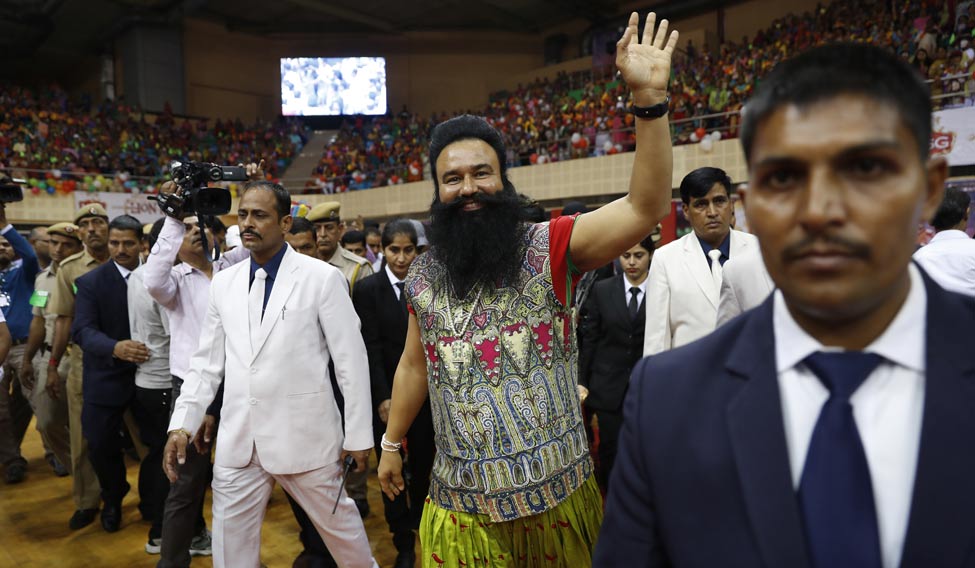 File- Dr. Saint Gurmeet Singh Ram Rahim Insan | AP
Like his clothes, Gurmeet Ram Rahim Singh's life isn't a drab one. Criminal charges and controversies keep him busy when he is not rocking out at his satsangs
This browser settings will not support to add bookmarks programmatically. Please press Ctrl+D or change settings to bookmark this page.

THE WEEK
Select your subscription
Please select subscription.
Select payment method
Please select payment method.
Confirm your subscription
Recharge E-Wallet
Enter recharge amount:
Topics :
#Gurmeet Ram Rahim