


“The new generation is moving away from tradition, does that worry you?” I asked Chief Chitwere Chaambiru of Itanga, leader of the Himba Tribe in Namibia. The paramount chief sat back in his chair and rocked in consternation. The answer lay on his quivering lips yet he found it difficult to put forth a response that could be translated without losing its essence. He knew it would be a difficult path ahead. A week earlier I had asked the very same question to Chief Wapenga and his response had been the same. These two supreme leaders, magnificent in their ware had sat on our dining table and debated their fast changing world well into the night.
“Religion is the bane of mankind!” exclaimed Chief Chitwere finally. His outspoken sister shook her head, cautioning him. Unable to extract the true wisdom of his words I asked for more. He said nothing but I was invited to visit the school the following morning. On our way out of Orupembe in Kunene, Namibia, we stopped at the pre-primary education centre as ordered. There, as part of a daily curriculum sat books on Christianity. I had got my answer. Here was a whole nation that was being brainwashed into believing that the road to salvation lay in foreign belief, in forgoing traditions, relinquishing a culture, abandoning their God, deserting their Chief. “Has Lengai let you down that you need another God?” I had once asked our Maasai pastor. His response had been a spear, its unflinching point looking me in the eye. He had no other answer. It was easiest for him not to ask that question leave alone try and answer it. The spear was his only response.
 Saad bin Jung
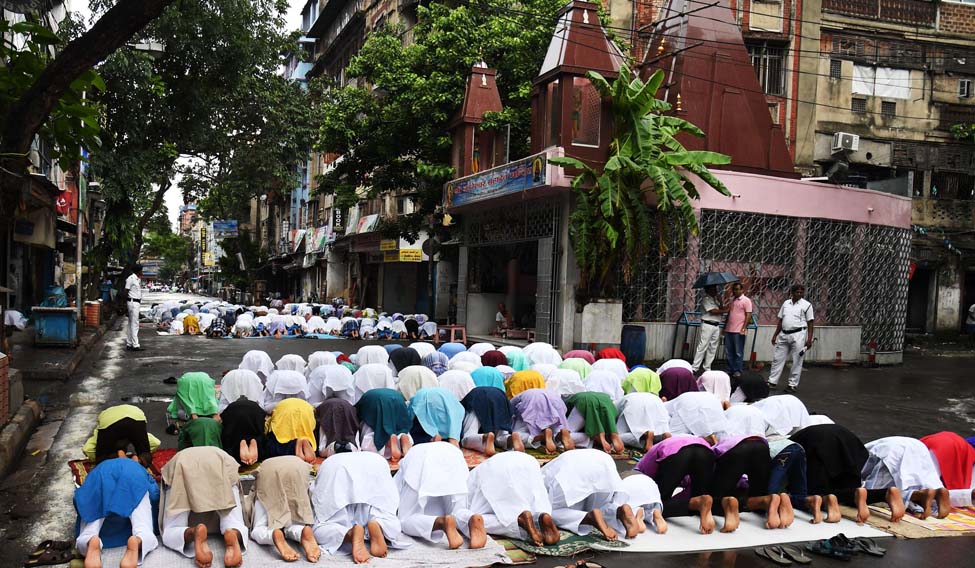
I have no intention of hurting anyone’s sentiment but I must say what I have to say in order for us to conquer prevalent global challenges. Irrespective of what the scriptures say, the peace and wisdom they preach, people who embrace monotheism make one basic mistake, they most often engrave a line drawn solely on personal belief; on one side of which sit devout followers. Fundamental and blinded devotees incompetent of asking questions that would open their minds to worldly happenings, afraid to question their belief, unable to accept the sagacity of their own scripture and powerless to tolerate that of another. On the other sat the damned; people bound for hell. The accursed, in many instances, were cleansed in a quest for purification. Such scorn and hatred have laid bare many lands till date, each story etched in the blood of the disbeliever.
It was on the sands of the Namib, having been shaken out of my slumber by a lion roaring in the distance, that I saw the light. I realised why India had remained such a super power through the ages. It was because the then prevalent pluralistic belief had never permitted such divisive lines to be drawn whilst celebrating its gods. Hinduism in its journey through the ages has absorbed many diverse beliefs and ideologies; even a myriad gods as they evolved through the years. Caste would damn a fellow countryman in order to control him, not his religion; it was easy as long as the populace remained part of the same religious credence. And so Hinduism became a numinous and powerful binder of people in a large and mystical country and as long as the Hindu remained peace loving and all accommodative, his belief engulfed all other peoples making India the envy of the world, a true diverse yet secular juggernaut. This is how polytheistic Hinduism scored over monotheistic Christianity and Islam without much ado. Then came democracy and vote bank politics and everything changed, sadly for the worse. According to Professor Seervai, Mohandas K. Gandhi bought religion into politics (Partition of India - Legend & Reality by H.M. Seervai). That one act, in hindsight, many claim, would end up threatening the very secular footing on which India had separated from Pakistan. The father of the nation had realised his mistake and even tried to make amends. Nonetheless he paid for it with his life. In any case it was too late as divisive politics of hatred had, by then, taken a stranglehold on India.
Not to say that a transformation was not needed. The need for change in the very foundation of Hindu thinking was part of natural progression; the threat from right-wing fundamental monotheists plundering and reshaping India since 1100 AD had to have a reaction, retribution, a correction. Karma demanded that. Many Hindus were forced to change to accommodate this force that touched upon the very core of their being; forcing them to transform, to convert even. Initially, it was Islam under the Muslim rulers, later under the British there was huge emphasis to convert many to Christianity. Fundamental Hindu organisations took birth to offset this monotheistic crusade finally coming of age in the last decade. Meanwhile, the monotheists, blinded by faith and too frightened to introspect on their belief, erected unfathomable and indestructible barriers that thrust them into secluded groups separating them from the majority in India. For many centuries, extreme power vested with such padlocked societies who remained unable to embrace people from other beliefs, led to the exclusion of the majority. Veils deterred the non-believer from filtering within. The inability to break through this harsh barricade, a daunting and unrelenting obstacle of the monotheist, forced the majority pluralist to transform and evolve. They developed their own survival tools. This eventually led to a reaction driven by frustration within the polytheistic community. The ever-present sword of the monotheist hidden behind every veil forced the Hindu to start drawing his own lines, segregating their lot, gathering them in separate flocks. Sadly, these lines lure the all embracing peaceful polytheistic believer into the fundamental and exclusionary realm of the monotheist, making him, the all-accepting polytheist, engrave his own line of exclusion; on one side of which would sit devout yet fundamental Hindu followers and on the other the damned—the non-believers. As I have said earlier, scorn and hatred have laid bare many lands, each story etched in the blood of the disbeliever and now, yet again, India stands on such a threshold where our very secular existence is being questioned. Will we succumb yet again, as we did in 1947, to fundamentalism born from excluding each other over our gods? Time will tell whether a similar faith will unfold in India as it has unfolded in the world of Chief Chitwere Chaambiru. Will the quest for domination through religion, divide and kill us again? Will this cycle never stop?
My learning at the end of my Namib safari has been harsh and I believe that immediate steps need to be taken by each one of us, if we are to remain the true free spirited force that has helped us dominate the world in more ways than one, over the ages. Both the solutions mentioned below have to take place at the same time if we need to retain our sanity and retain our original glory of which the whole world has forever stood in awe. To me, we Indians are a special people, diverse yet all embracing and must remain so. To me, both the monotheistic, Christian and the Muslim, in India must necessarily lower the veil and drop our barriers. We must become Indian first and embrace all other people of all other beliefs not just within our hearts but also within our homes. At the very same time, above all, the Hindu must remain Indian first and stop erecting exactly these very same destructive and exclusionary barriers that hinder others of monotheistic belief from remaining ensconced safely within their pluralistic hearts, souls mingling freely as they have done for so many thousands of years. We are Indians above all. We are truly magnificent people and it's time to erase the imaginary lines and unite as one. It's time to be Indian. Jai Hind.
A member of the erstwhile Pataudi royal family, Jung is now a conservationist based in Bengaluru.