



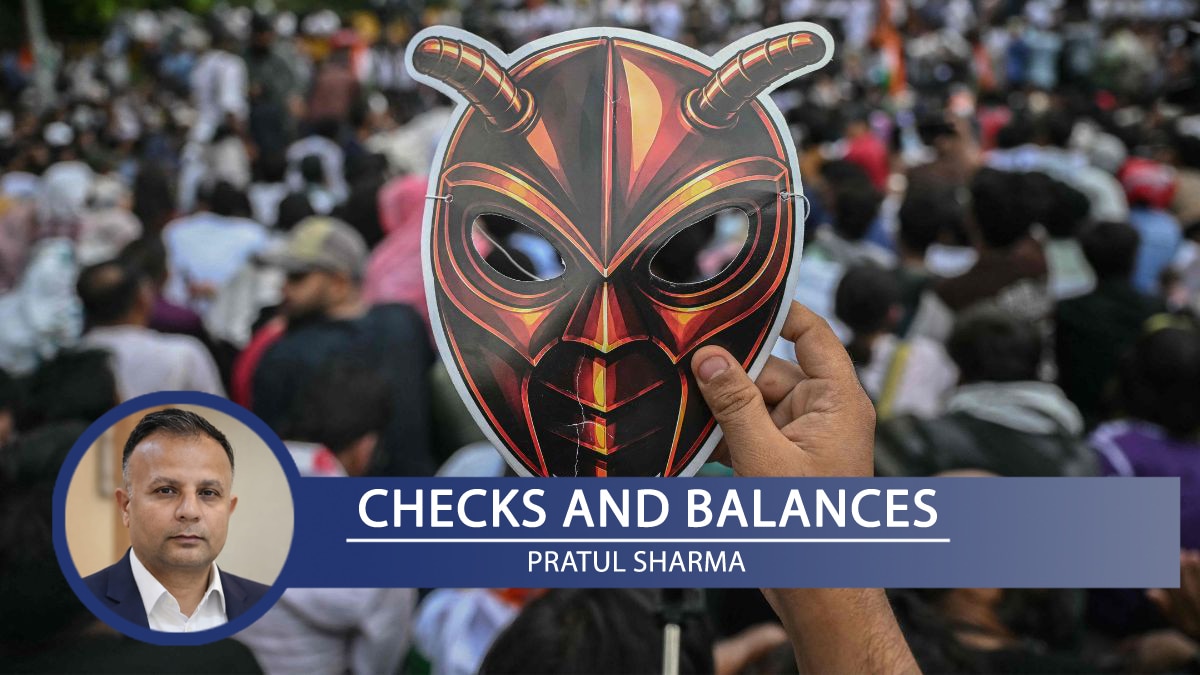
The governments of the day often learn to manage public anger when the problems behind it take longer to resolve. The emergence of the Cockroach Janta Party (CJP) is the latest example of Gen Z angst, presently directed against the establishment.
It was born in May after Chief Justice Surya Kant compared unemployed youth to "cockroaches" and "parasites of society." The remarks triggered a backlash and within days the CJP's social media presence exploded, attracting millions of followers and turning an online joke into a national talking point. Its first major protest at Delhi's Jantar Mantar on June 6 drew mostly students, parents and some curious onlookers.
Delhi Police granted permission quickly, likely on the government's insistence, after concluding that a refusal could escalate into something bigger. The government had already seen that attempts to curb the CJP’s social media presence only gave it more traction. A controlled protest was safer than denying one, as students and their families were already angry over several paper leaks. The CJP had taken up their cause, demanding the education minister's resignation.
Much of the anger driving the movement stems from examination irregularities and paper leaks. These are real grievances, but they are also tied to specific events. Once examinations are conducted, some of the immediate pressure may ease, some political observers claimed.
The bigger question is why a ‘movement’ built around satire and a cockroach symbol was able to attract so much attention so quickly. The answer lies partly in the failure of India's opposition parties. Gen Z — those born roughly between 1997 and 2012 — has grown up in a world shaped by internet and social media, pandemic disrupting lives during their learning years, intense competition for jobs, a weak formal employment market and escalating economic anxieties despite official growth numbers, and to growing dominance of one single party. Yet opposition parties have struggled to organise this frustration into a sustained political movement. They have been visible online but far less effective on the ground.
The comparison with Anna Hazare's anti-corruption movement is unavoidable. That campaign also began as a public expression of anger before eventually creating space for the Aam Aadmi Party. The CJP is nowhere near that stage. Its founder Abhijeet Dipke understands social media mobilisation, and the movement's ironic style has helped it gain attention. Whether that attention can be converted into organisation is another matter entirely. Anna Hazare and Arvind Kejriwal had come from years of experience in public mobilisation and engaging with institutions. The CJP has come from social media.
The BJP has taken note and is attempting to signal that it has its ear to the ground. Its leaders argue that the movement does not represent India's youth. They point to rising entrepreneurship, startup growth and national achievements as evidence that young Indians remain broadly optimistic about the country's direction. During a recent interaction in Dehradun, BJP chief Nitin Nabin put the case directly, arguing that the generation building two lakh startups and contributing to India's manufacturing ambitions is the real Gen Z — not the one being defined, in his words, by anti-establishment sentiment.
But the message emerging from conversations from the Gen Z is that it can be proud of the country's achievements while remaining frustrated by failures in education and employment. Economic aspiration and political dissatisfaction are not mutually exclusive. That is the more difficult challenge facing the BJP. India's Gen Z has known only BJP governments at the Centre. The party which has been in power for 12 years at the Centre, and has been repeating governments in the state may have to address youth aspirations through nuanced public projection, new faces, fresher idioms and themes which resonate the young and restless and not only the cultural themes which moved the previous generations.
On the other hand, many young voters may be sceptical of governments, but that scepticism does not automatically translate into opposition politics. A more significant development may be the rise of new political formations such as Vijay's Tamilaga Vettri Kazhagam in Tamil Nadu, which rose quickly by demolishing existing mainstream parties that had failed to offer anything new.
Something similar happened when AAP stormed Delhi with the imagery of an iconoclast — the broom as election symbol was pointer enough — decimating the established parties. It then used the same appeal to break into Punjab, ending the long dominance of the Congress and the Akali Dal. But when AAP itself became the mainstream party after three terms in Delhi, people began looking for an alternative.
What the CJP has done, for now, is give expression to a sentiment that had been simmering below the surface. All eyes will be on Dipke and his team in the coming months to see whether this is more than a safety valve. Whether it remains one depends less on the movement itself and more on whether the problems that created it get resolved, or it can channelise the angst where the Opposition parties have not succeeded.
