



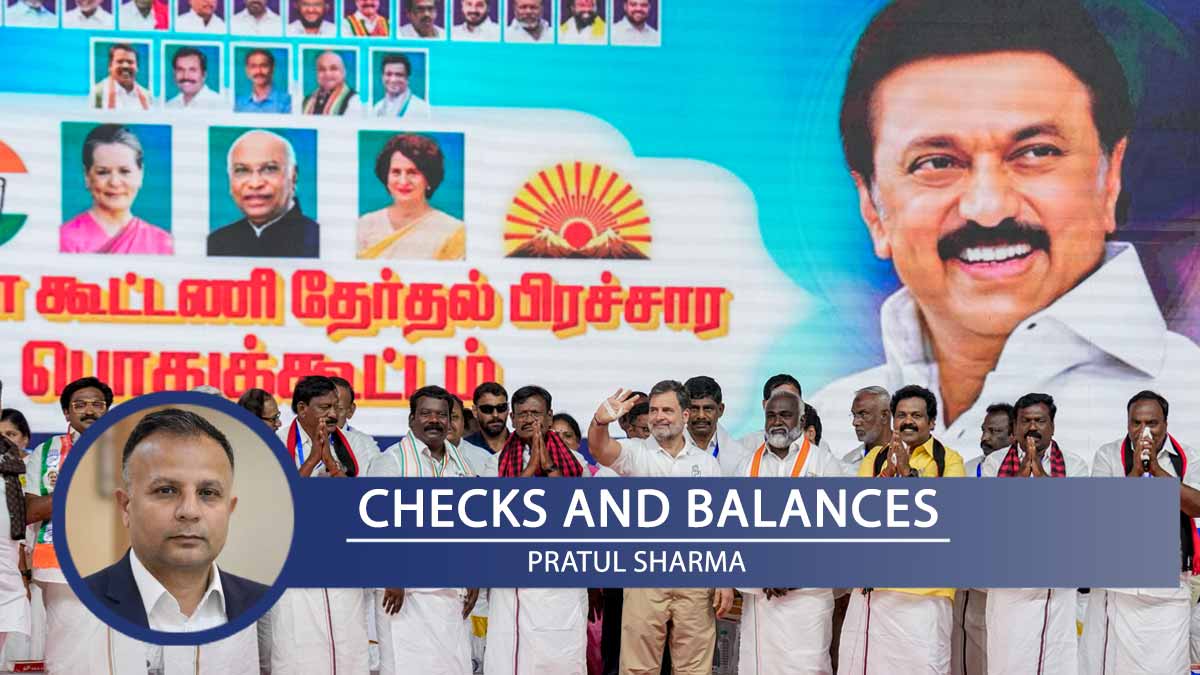
Some moments in Opposition politics get lost in the noise of numbers and calculations. One such moment is when leaders show up for each other. Not in Delhi, not at joint press events, but in another party’s state.
That has been seen ahead of the Tamil Nadu Assembly elections. Tejashwi Yadav and Arvind Kejriwal travelled to campaign for M.K. Stalin and the DMK.
For Tejashwi Yadav, this was a return gesture. Stalin had addressed a rally in Bihar last year for the Grand Alliance, where Tejashwi was the chief ministerial face. Such exchanges may seem small, but they help keep coordination alive in a divided Opposition.
Kejriwal’s visit had a different purpose. After his recent legal relief, he has been more active politically. His party does not have a strong base everywhere, so campaigning with regional leaders gives him visibility without much risk. It also shows that he is part of a wider Opposition space.
West Bengal presents a different picture. Leaders supported Mamata Banerjee in statements but did not campaign there. The Congress is fighting the Trinamool Congress in the state. Parties like the RJD and Samajwadi Party, which work with Congress elsewhere, cannot step in without creating confusion. Mamata Banerjee also does not depend on outside help. The absence of joint campaigning reflects these limits.
These actions — rallies in Tamil Nadu, earlier support in Bihar, and distance in Bengal — are small steps. There is no common programme or shared strategy. Still, they matter over time.
This was visible in Parliament during the debate on the women’s reservation law, especially on the issue of delimitation. Opposition parties managed to hold a common line, and when the votes were counted, the constitutional amendment bill fell. This was a first in 12 years of the Narendra Modi government. That did not happen suddenly. It came from repeated efforts to work together and find a common adversary.
The Opposition has shown it can come together at key moments. But unity alone is not enough. Politics is decided by results.
There is also a basic challenge. Regional parties focus on their own states. Their cooperation at the national level is often limited and based on need. This makes long-term unity difficult.
Even so, these exchanges are not just transactions. They are an attempt to build working relationships. The Opposition is slowly building a network through these small steps.
The first test will come when votes are counted.
Both Tamil Nadu and West Bengal have recorded very high turnout. In normal times, this would suggest a close contest or a possible shift in power. But this time, the picture is not so simple.
The voter lists were revised before the elections. A cleaner list can push up turnout percentages because inactive names are removed. So, a high turnout on a smaller list does not mean the same thing as before.
The results will be read in two ways. One is about whether the Opposition can challenge the BJP’s stronger campaign machinery. The other is about how changes in election processes affect outcomes.
For the Opposition, a good result will support its effort to work together. A poor result will raise questions about whether coordination without wins is enough.
Either way, the counting will send a signal. Not just about who wins, but about what that win represents now.
