



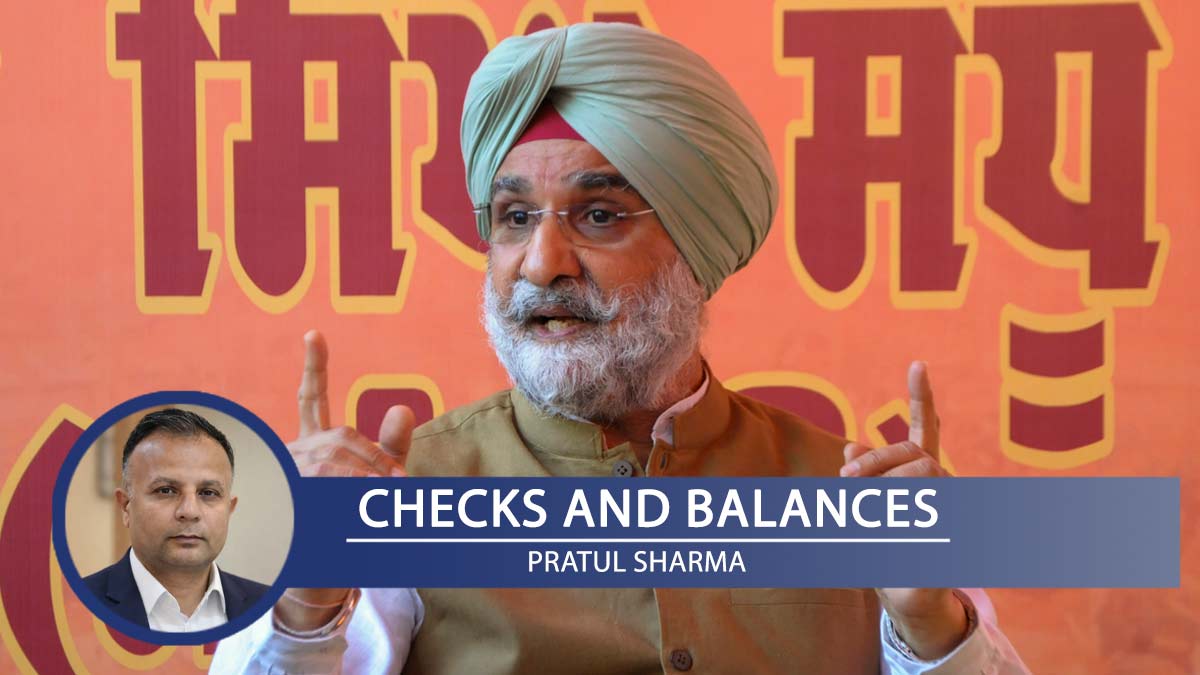
Taranjit Singh Sandhu entered the 2024 Lok Sabha election with plans to transform Amritsar, the holy city from where he chose to begin his political career. After a long career in the Indian Foreign Service, capped by his stint as India’s Ambassador to the United States, Sandhu joined the BJP and contested the parliamentary seat. Politics, however, can be unforgiving. With the BJP fighting the election without its long-time ally Shiromani Akali Dal, the Congress retained the constituency.
Sandhu comes from a prominent Sikh family that played a role in the formation of the Shiromani Gurdwara Parbandhak Committee, the elected body that manages gurdwaras, and the state-run Guru Nanak Dev University. His defeat in Amritsar may have closed one political door, but another has opened in the national capital.
Prime Minister Narendra Modi has now entrusted Sandhu with a key administrative role in Delhi. Despite having an elected government, the Lieutenant Governor remains central to the functioning of the capital. The post requires political judgement as well as administrative experience, qualities the government believes Sandhu brings after decades in diplomacy.
The choice also reflects a broader trend. Modi has often turned to technocrats and former officials for Raj Bhavans. Alongside Sandhu, Lieutenant General Syed Ata Hasnain (retired) has been appointed Governor of Bihar, replacing Arif Mohammad Khan. The change comes at a moment of transition in the state, where the chief minister and speaker have also changed. The appointments suggest the BJP is keen not only to strengthen its administrative presence in Bihar, a state where it has often depended on alliances, but also to move with greater speed so that the impact is visible, otherwise the Bihari electorate can be unforgiving.
Another shift saw R.N. Ravi, a former IPS officer, moved to a new gubernatorial assignment in West Bengal after serving in Tamil Nadu. Several other Raj Bhavans have also seen new occupants, many of them senior BJP leaders.
Unlike the President, who is elected, governors are appointed by the Union government. The office has always carried political weight, but its role has become more visible in recent years. Governors are now more active in engaging with state issues and highlighting the policies of the Union government. A change was also reflected as Raj Bhavans were rechristened as Lok Bhavans by the Union government.
In Punjab, Governor Gulab Chand Kataria, a veteran BJP leader from Rajasthan, recently undertook a state-wide campaign against the drug menace. The initiative addressed a serious social problem but also carried political undertones in a state where the BJP is trying to rebuild its base.
This assertiveness has often led to friction with elected state governments, particularly those run by Opposition parties. When R.N. Ravi was appointed to West Bengal, Chief Minister Mamata Banerjee publicly objected to the move. The governor and the Tamil Nadu government were also at loggerheads over several issues. With crucial assembly elections approaching in the state, many in the BJP argue that a firm administrator is needed to ensure peaceful and fair polls.
The reshuffle of governors may also signal changes at the Centre. Political circles in Delhi expect a Cabinet reshuffle in the Modi government in the coming weeks, especially with the election of a new BJP president.
The appointments could also have longer-term significance. In recent years, the offices of President and Vice-President have both been filled by leaders who had earlier served as governors—both Ram Nath Kovind and Droupadi Murmu were governors when they were picked for the highest office. The next presidential election is due in 2027, when the question of who will succeed President Murmu will arise. Even the last two vice-presidents were also governors.
It may be too early to draw conclusions. Yet in Delhi’s political circles, the roles played by the newly appointed governors in the coming months will be watched closely. In a system where constitutional offices often intersect with political calculations, today’s gubernatorial appointment can sometimes become tomorrow’s national elevation.
