



For a town coveted by heroes, raiders and rulers, including Adolf Hitler, it is ironic that when freedom finally dawned on August 15, 1947, Firozpur was left high and dry.
The town, on the banks of the Sutlej, did not know whether it was part of India or Pakistan. And while freedom took time to arrive, people waited for days before news trickled down that Firozpur would be part of India. Meanwhile, bloodshed had already begun on the streets and railway tracks. Genocidal terror and a complete breakdown of law and order took over its alleyways and countryside, marking one of the darkest chapters in modern Indian history.

This calamitous turn of events, shaped by miscalculations and power plays, resulted from a combination of British bureaucratic nonchalance and strategic manoeuvring. Sir Cyril Radcliffe, tasked with dividing British India into India and Pakistan, was given just five weeks to complete the job. His solution was to go by religious majority figures.
Thus, Firozpur found itself in Pakistan in the provisional Partition plan, as the main town had a slight Muslim majority. However, unbeknown to its residents, a series of moves was under way in the corridors of power in Delhi, Lahore and even London that would forever alter its fate.
At the centre of it all were the headworks, a strategic irrigation system on the Sutlej in Firozpur. They supplied water not only to southwest Punjab but also to the neighbouring desert kingdom of Bikaner, in present-day Rajasthan. Its feeder canals, one of which was named the Ganga or Gang Canal after Bikaner’s Maharaja Ganga Singh, carried Himalayan water into what had until then been arid land.
Understandably, the Maharaja was furious on hearing of the Partition plan. He reportedly threatened to accede to Pakistan if control of the water supply system, the lifeline of his princely state, went to the new dominion.
Jawaharlal Nehru immediately recognised the danger. Legend has it that, following his lobbying of Viceroy Lord Mountbatten, they managed to persuade Radcliffe to redraw the boundary, arguing that the larger Firozpur district had a Hindu majority and should therefore remain with India.
This was not the first time the town had found itself at the centre of a conflict that shaped history. It was associated with the Anglo-Sikh Wars, including the bloody Battle of Ferozeshah, fought just outside the town in 1845. Then there was the legendary Battle of Saragarhi, in which 21 Sikh soldiers fought to the death against thousands of Afghan tribesmen. Immortalised in the Bollywood hit Kesari, the 21 heroes hailed from Firozpur, where the Punjab government recently opened a museum memorial in their honour. And who could forget the Indo-Pak wars of 1965 and 1971, when Firozpur, particularly its border village of Hussainiwala, witnessed intense infantry and armoured attacks? Operation Sindoor last year saw this border town come under intense drone attacks from across the border, resulting in at least two civilian deaths.
But perhaps the most dangerous battle was the one plotted in a faraway land, when Hitler trained his crosshairs on Firozpur. The attack, if it was ever contemplated, never happened.
This is one of history’s intriguing, little-known, ‘what ifs’: Hitler’s alleged plans to bring World War II to India. And it all comes down to a star-shaped fortress in the middle of Firozpur town.
“The British had converted it into one of their most important garrisons in the Raj, considering the location’s strategic position,” said Anirudh Gupta, entrepreneur and convener of the local chapter of the Indian National Trust for Art and Cultural Heritage (INTACH). “There were thousands of horses, elephants, guns, cannons and ammunition, not only manufactured but stored there.”
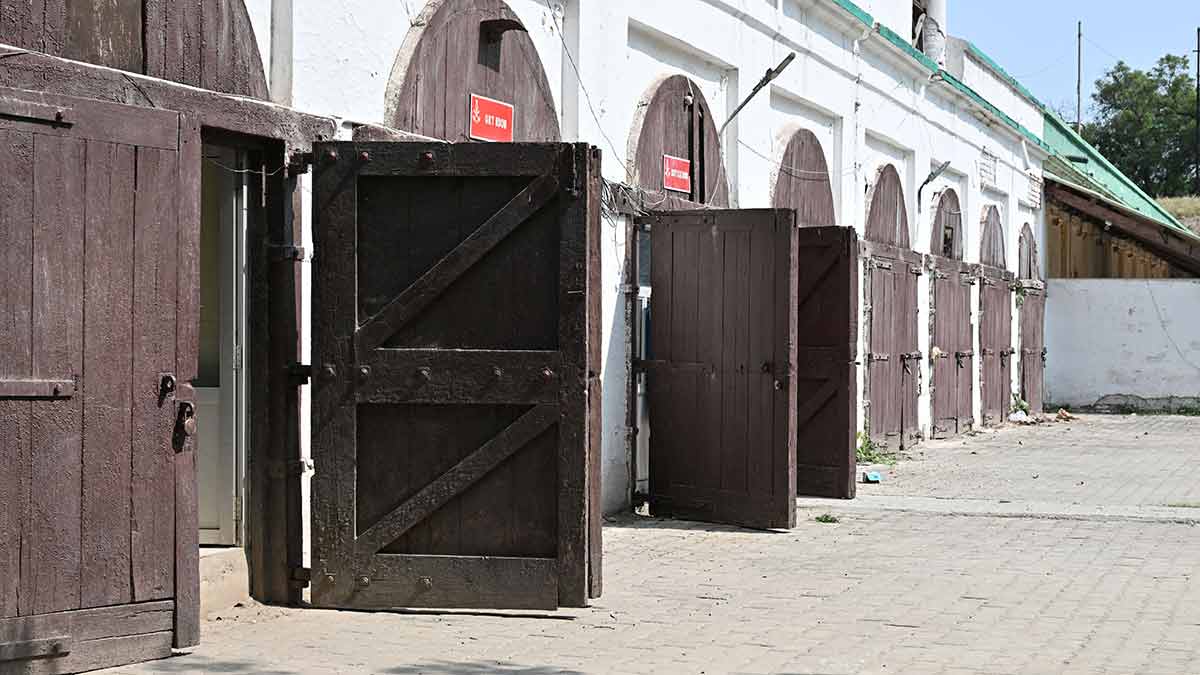
The fort's origins remain uncertain, with some accounts tracing it to the reign of Firoz Shah Tughlaq and others associating it with the Sikh period. The British took it over in the 1830s and developed it into a major garrison and arsenal. It eventually became the main depot for supplying guns, ammunition, trained horses and bullocks across northern India. The principal ammunition depot of the British East India Company was in Kolkata, with Firozpur ranking second in importance and Allahabad completing the trio. Firozpur’s strategic location was important because of its proximity to the Sikh Empire and later because of its position relative to the North-West Frontier provinces and Afghanistan.
During World War II, this significance almost cost Firozpur its existence. As part of the war effort, a substantial quantity of arms and ammunition was sent from the fort to battlefields in Europe and possibly North Africa. Legend has it that, in the early years of the war, some consignments seized by the armies of the Third Reich, bearing the words ‘Made in Ferozpur’, brought the town to the Führer’s attention. “When Hitler realised that the ammunition the Britishers were using had ‘Made in Ferozpur’ written [on it], he was very inquisitive about where this ammunition was coming from and where Firozpur was,” said Gupta. “So Hitler said, ‘Let us find out and destroy this place’.”
Of course, this is where the story diverges. While some claim that Hitler mentioned Firozpur and his intention to bomb it in his autobiography, Mein Kampf, others dispute the assertion. “This is more of an urban legend and, you know, something interesting to talk about, rather than an actual historical fact that can be proven documentarily,” said Rana T.S. Chhina, military historian and director of the USI Centre for Military History and Conflict Studies.
Interestingly, at least one government source lends support to the Hitler connection. The Firozpur district court states on its website that the town is mentioned in German literature from the war era. However, the account clarifies that the reference is not in Hitler’s autobiography but in that of his propaganda minister, Joseph Goebbels.
“During the war between Allies and Axis, the Allies used cartridges which were made in Ferozepur,” the note on the town’s history states. “When [the] Axis were losing the battle, Hitler noted that on the said cartridges, ‘Made in Ferozepur’ was inscribed and at that time he enquired as to where this city was, because he wanted to destroy it.”
No British document supporting the claim has surfaced so far. Yet there is one curious historical development that might tempt one to connect the dots. After serving as a major ammunition depot for decades, Firozpur Fort began to see its arsenal moved elsewhere around 1941-42, right in the middle of the war. The new destination was an obscure village outside Firozpur called Kasubegu.
Did the British receive intelligence about Hitler’s interest in their strategic ammunition depot?
We may never know the veracity of these claims. But even if Hitler had contemplated destroying one of the Allies’ major sources of armaments, the Indian subcontinent would have remained logistically far beyond the reach of even the most intrepid Luftwaffe bombers.
By land, the easternmost point reached by Nazi forces during World War II was near Mount Elbrus in present-day Russia, thousands of kilometres from Firozpur, with the formidable Hindu Kush and Karakoram mountain ranges standing in the way.
After Independence, Firozpur regained its strategic importance when the Radcliffe boundary placed it right on the border with Pakistan. Today, the fort is under the control of the Indian Army’s Golden Arrow Division. It might have remained an off-limits military installation were it not for the efforts of heritage enthusiasts and the tourism ministry in recent years, which led to a section of the historic fort being opened to the public as a museum.
It is an impassioned bid to give the town a new lease of life as a tourist destination. Despite its epithet—‘Land of Martyrs’—this is where some of India’s best-known revolutionaries, Bhagat Singh, Rajguru and Sukhdev, lie in eternal rest.
“Firozpur is a sensitive border town, and by virtue of that, no big business or industry is going to come here,” said Gupta. “And if the youth here are not getting jobs, they will be sitting ducks for the ISI and other anti-national elements.”
His solution? Not just better roads or border facilities but a sustainable, tourism-focused economy that can help the city prosper. The opening of a section of Firozpur Fort as a museum adds to existing attractions such as the memorials to Bhagat Singh and his comrades, as well as the one dedicated to the 21 Saragarhi heroes.
“We need to revive the economy, we need to generate employment, we need to highlight the sacrifices of our gallant sons of the soil, the freedom fighters. Children in metropolitan cities and other places have no idea how Partition took place, how many freedom fighters embraced the gallows, what our border guarding forces are, what Operation Sindoor is….” He has also proposed a full-fledged tourist itinerary beginning in Delhi and moving on to Amritsar, with its Golden Temple and street food, before taking in the wetlands of Harike Bird Sanctuary en route to Firozpur. The circuit would then cover the town’s border attractions and the fort before continuing to Jaisalmer and its desert attractions.
With Vande Bharat connectivity from Delhi and a compelling mix of history, heroism and humanity under the shadow of blood and bullets, Firozpur is waiting for a new lease of life as a tourist destination.
