



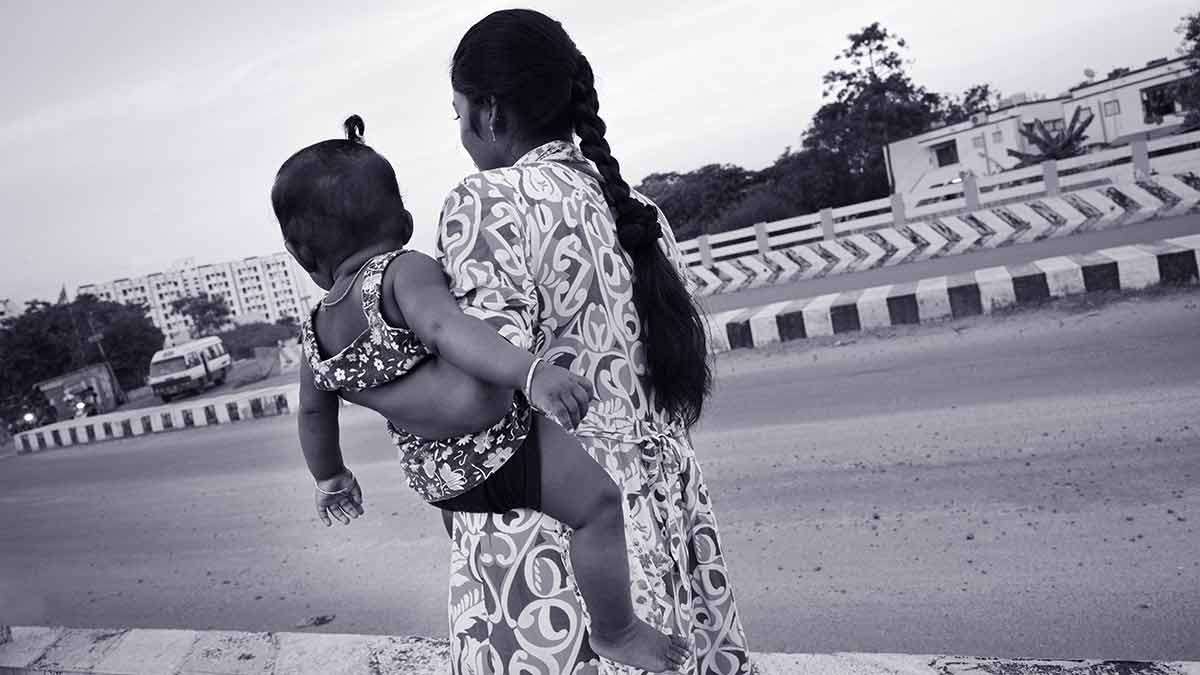
She has a baby in one hand and a science textbook in the other. A few hundred metres from the main bus station in Chemmencherry—a Chennai suburb—17-year-old Aishwarya Arumugam paces, a terrified look on her face, unable to console the crying child.
Aishwarya had dreamed of building a career in IT. Instead, her days now revolve around her eight-month-old daughter. When her daughter reaches out and grabs her textbook, her eyes well up.
Her story changed when she was 13. Her mother, who works as a domestic help, would leave home at 6am and return only at 8pm. Her father, an alcoholic, had died when she was a child. Her mother got into a relationship with a friend and moved into the second floor of the same building. Aishwarya was left to fend for herself and her younger sister, Sahana. She would wake up, cook and leave for school by 8.30am. Soon, a young boy on a motorcycle began following her. What started as attention gradually became an emotional attachment. After school, Aishwarya began spending her evenings with him. Then, as her class 10 exams approached, her body began sending signals she could not understand. She was low on sleep, had persistent nausea and her periods stopped. Quietly, she sought help at a nearby NGO where she attended evening classes. A test revealed that she was four months pregnant.
With support from the NGO, Aishwarya sat for her class 10 exams. After considerable pressure, the young man acknowledged that he was the father and was charged under the Protection of Children from Sexual Offences Act. His mother stayed by Aishwarya during the complicated delivery. She was anaemic and not strong enough to cope with labour—the answer was an emergency C-section, and the girl emerged from the hospital a mother.

It has been nearly a year since Aishwarya regularly attended school. A few months ago, she tried to return, but the taunts and her baby’s needs made it hard. She dropped out. Now, she hopes to complete her class 12 privately.
Clad in a T-shirt and pyjamas, with a dupatta around her neck, she holds Mithra on her hip, her eyes motionless as she talks. “My mother-in-law (sic) is helping me buy groceries and feed the baby,” she says. “I want to study. I have realised my mistake. But how do I correct this now?”
Aishwarya’s experience offers a glimpse into the complex realities of teenage pregnancy in Tamil Nadu. The state has one of India’s lowest fertility rates, its maternal mortality rate has fallen dramatically, and almost every woman gives birth in a facility that is part of an extensive public health network. There is also a long history of welfare interventions aimed at keeping girls in school and preventing child marriage, and the state has one of the higher female literacy rates. Yet, somewhere between adolescence and adulthood, a section of Tamil Nadu’s girls continue to disappear from the state’s social development story.
Like Parimala. The Chennai-based 16-year-old got pregnant when she was 14. She was in love with her friend Selvam, then 17, but he disappeared when he was told of the pregnancy. “I never knew that I got pregnant,” says Parimala. “I used to love him so much. He was my only solace when I was in school. He used to drop me at school and buy me everything.”
Selvam was tracked down and charged under POCSO; he was in jail for three months before making bail. Now a daily-wage worker and an alcoholic, Selvam is constantly suspicious of Parimala. “He gave me money, supported the baby and the family, but that was very little,” says Parimala. “No one can live with him. I live with my mother. She supports me these days.”
Says Devaneyan Arasu, founder of Thozhamai, a civil society organisation working on child rights: “Teenage pregnancy in Tamil Nadu remains a critical social and public health challenge. Thousands of teenage pregnancies are registered annually across the state.”
A study by the state’s Directorate of Public Health and Preventive Medicine, published in Tamil Nadu Journal of Public Health and Medical Research, examined nearly 50 lakh antenatal registrations recorded in the state’s Health Management Information System (HMIS) between April 2019 and March 2024. It found 62,870 teenage pregnancies. The proportion had increased from 1.1 per cent of antenatal registrations in 2019-20 to 1.5 per cent in 2023-24. The increase comes despite the total number of recorded pregnancies dropping from 10.26 lakh in 2019-20 to 9.55 lakh in 2023-24. “This is the paradox,” says activist Kanchana, who works for the uplift of young mothers like Aishwarya.
The problem is not simply teenage pregnancy. It is child marriages, school dropout rates, relationships that lead to police cases, families that conceal pregnancies, health workers who discover them late and teens who often have little control over their reproductive choices.
Adolescent mothers face exponentially higher risks of eclampsia, anaemia and systemic infections. Their babies are 50 per cent more likely to be stillborn or die soon after birth compared with those born to mothers in their 20s. “The government is certainly working towards filling every gap to address the issue,” says Devaneyan, who is working with the health department to raise social awareness about teen pregnancies.
But gaps persist. Suja Devi, a police sub-inspector who runs a centre called Thalaratha Thalirgal (resilient youth) for children in Chennai, recently rescued a 17-year-old mother. Saranya had dropped out of school at 13 to “marry” a 15-year-old boy. They got married at a temple near her home and, within weeks, she became pregnant. The neighbours told the police and activists, who asked Saranya to get admitted in hospital. She refused, saying it was her right to bear a child and no one could question her. Her mother supported her, while her father was indifferent. The boy’s parents initially objected, but made peace as Saranya’s mother took care of her and the baby. “I did not know what was right or wrong,” she says. “My son was born out of a legal marriage.”
The boy, now an electrician, was charged under POCSO and spent three months in a correctional facility before being released. The couple now lives together, under close watch of the authorities, struggling to make ends meet.
Often, the issues are linked. Like dropout rates and child marriages. In Madurai, the parents of at least a dozen girls hurriedly married them off after their school headmaster had sexually abused them and the case went to court.
If forced marriage, because of the fear of girls eloping, is a reason in most rural areas, social media also plays a role. A few years ago, drawn in by a man’s fancy Instagram stories, 14-year-old N. Nandhini left her home in Tiruvannamalai to be with him. Her mother, a domestic worker, thought she had gone for evening tuition. Three days later, Nandhini was found near the Karnataka border. She believed that the guy was about her age, but he was actually a 32-year-old painter from north India. The man had abandoned her in a makeshift shed.
After a few months back home, her mother realised that Nandhini was pregnant. Because she was not in good health, an abortion was not possible. This is where the story gets more disturbing. Her mother took her to an illegal scanning centre to determine the gender of the baby. Through a broker at the centre, the mother made a deal with a couple that was looking to adopt a boy. She was promised Rs60,000 for the baby. She took care of her daughter and, after the delivery, sold the baby. Later, she found out that the broker had sold the baby for Rs1 lakh. After a few months, she tracked down the broker and a quarrel broke out, leading to a police case. The police registered a case under POCSO and the court ordered the couple to return the baby as the adoption was illegal. Nandhini, now 21, lives with her son and works as a housekeeping assistant. Her mother died last year.
Cases like these are a reminder that there are real lives behind the statistics, and they are increasingly slipping through the system.
Devaneyan, meanwhile, says the data itself is confusing, with no proper records in the state and Central registry. For teenage pregnancy, Tamil Nadu’s HMIS records those between ages 13 and 19. The National Family Health Survey uses a different measure. NFHS-5, conducted in 2019-21, found that 6.3 per cent of women aged 15-19 in Tamil Nadu had already had a child or had been pregnant.
As per the HMIS, teenage pregnancies made up 1.5 per cent of antenatal registrations in 2023-24. The two systems do not measure the same things. While the HMIS tracks pregnancies that are reported, the NFHS, being a survey, reaches out to people. Also, the NFHS counts from ages 15 to 19.
Importantly, one of the reasons for the rise in teen pregnancies in Tamil Nadu could be the strengthened pregnancy registration in the state. PICME (Pregnancy and Infant Cohort Monitoring and Evaluation) 3.0, launched in January 2024, has made pregnancy tracking more comprehensive, say doctors in public health centres in areas like Tiruchirappalli and Madurai, where teen pregnancies have gone up. “Every birth is registered. If the girl is below 18, we immediately inform the local police station and POCSO is invoked. Most girls coming here have married young and get pregnant early,” says Suganya Senthil Kumar, midwife at a government health centre in Madurai.
Adds Devaneyan: “The distinction between 17 and 18 is particularly important. A 17 year old being pregnant can involve a child marriage or POCSO investigation, depending on the circumstances. An 18- or 19-year-old is legally an adult, although still an adolescent from a public health perspective.”
It differs across regions, too. In Krishnagiri, once a centre of child marriages, the number of reported teenage pregnancies has come down from 627 in 2021-22 to 165 in 2022-23, according to HMIS data. “This is because of awareness programmes and action against child marriage,” says Dr Rajeswari Sathyaraj, who works in Krishnagiri.
NFHS data shows that girls in rural areas are more affected than those in urban centres, thanks to forced child marriages. Among ages 15 to 19, 8.1 per cent of rural respondents got pregnant compared with 4.2 per cent in urban areas.
“Tamil Nadu does not have one teenage pregnancy problem. It has several,” says Suja Devi. “In some places, the dominant issue might be child marriage. In others, it might be school dropouts. In some urban pockets, adolescent relationships and sexual abuse might be more important. In tribal and migrant communities, access and social vulnerability might play a larger role. So we cannot just say that teen pregnancies are increasing. And more importantly, a single statewide campaign cannot address all of these issues.”
(Names of the teen mothers have been changed in the story and photo captions.)
