


 Add as a preferred source on Google

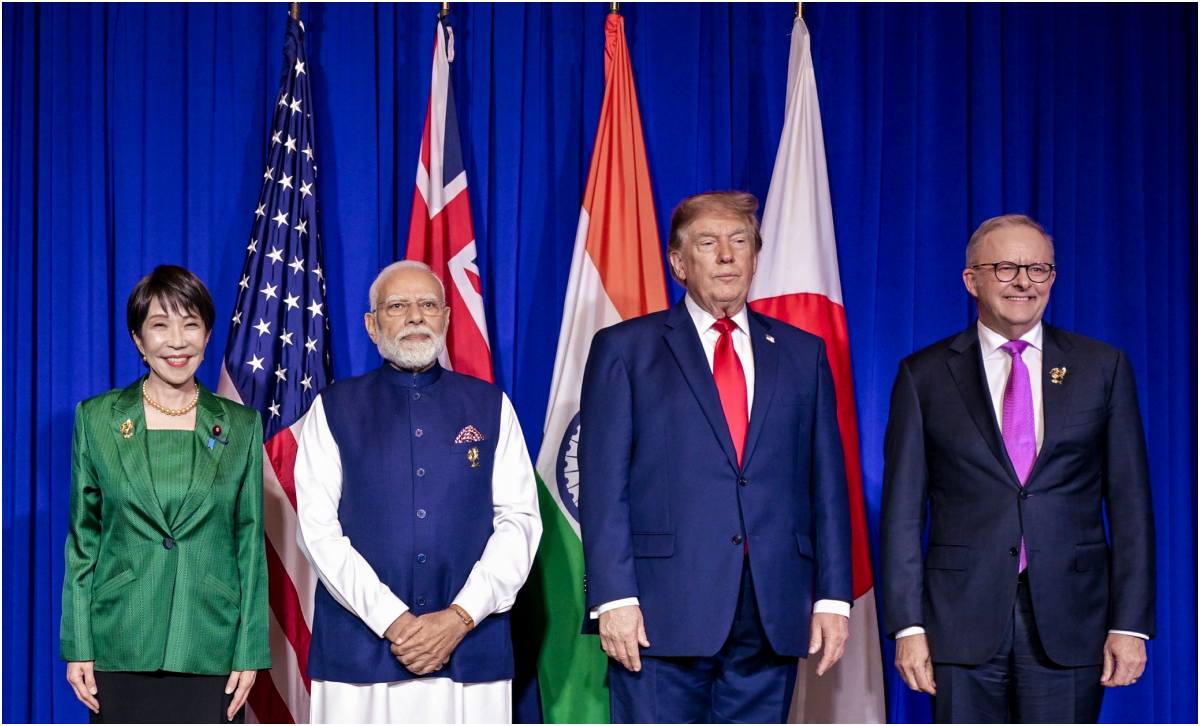
There must have been a sense of deja vu at Manila's Solaire Resort on November 17.
It was in May 2007, on the sidelines of the ASEAN Regional Forum, that the idea of a Quadrilateral Security Dialogue — the Quad — was born. It was the brainchild of the then Japanese prime minister Shinzo Abe.
More than 19 years later, at the same venue — on the sidelines of the 49th ASEAN Summit — the Quad has got a big lease of life. If 2007 was the germination of an idea, November 17 was the operationalisation of it.
The Manila Summit — attended by Prime Minister Narendra Modi, US President Donald Trump, Japanese Prime Minister Sanae Takaichi and Australian Prime Minister Anthony Albanese — was not plain vanilla. It was not another declaration of intent. It put signatures to six concrete points. And each one has teeth.
First, the military core, finally visible.
An active Indo-Pacific Maritime Surveillance Collaboration, under which P-8 and P-3C aircraft of the four countries will fly together in a maritime exercise in 2027 to make the "seas safer".
The P-8 Poseidon, built by Boeing, is a long-range, multi-mission maritime patrol and anti-submarine warfare aircraft operated by India, the US and Australia. The Lockheed P-3C Orion is its older cousin — a long-range submarine hunter for surface surveillance and reconnaissance, operated by Japan and Australia.
The subtext is unmistakable: shared tracking and exchange of information on the movement of Chinese submarines.
If that is not the military aspect of the Quad, what is?
True, the Malabar naval exercise of the four countries has been taking place with regularity. But adding an air exercise with submarine hunters is a big step up. Ships exercise. Aircraft hunt.
Second, cables.
The Quad Partnership for Cable Connectivity and Resilience is aimed at securing undersea cables. This is about de-risking from Chinese cable firms.
Undersea cables carry over 95 per cent of the world's data. Whoever controls them, or can tap them, controls the nervous system of the Indo-Pacific. Quad has decided it will not leave that to Beijing.
Third, business, not just government.
A strategic economic agreement to engage in a business-to-business format, not just government-to-government. This will be operationalised by the inaugural Quad Business Leaders' Forum in Mumbai in early 2027.
This is India's biggest win in Manila. Modi pitched it himself: "As four major market economies, we have a shared responsibility to create greater trade opportunities and build stronger supply chains."
Quad is no longer just diplomats talking. It is CEOs dealing.
Fourth, AI.
A 'Super' Intelligence and AI Accelerator effort to coordinate and fund trusted AI access, deployment and technical assistance across the Indo-Pacific. More than $85 million is being spent to expand access to trusted AI ecosystems.
The amount is modest. The signal is not. Quad wants the Indo-Pacific's AI future to be built on trusted systems, not on Chinese models and Chinese standards.
Fifth, cyber.
Enhanced Quad Cybersecurity Cooperation, as a response to the "rapid increase in the number and scale of cyber incidents in the region."
Again, no country is named. None needs to be.
Sixth, terrorism — India's line, in Quad ink.
A pact on counter-terrorism, including cross-border terrorism. India managed to get its agenda included when the joint statement unequivocally condemned "terrorism and violent extremism in all its forms and manifestations, including cross-border terrorism."
This language was missing from the Quad Foreign Ministers' statement in Atlanta just last month. Its return at leaders' level, after the Pahalgam attack, is no accident.
Truth be told, the Quad's military aspect was never overtly stated. But China was never entirely convinced. At one time, Beijing even labelled the Quad a "mini-NATO".
Quad also suffered from a structural defect. Its fortunes swung with the mood of the US President. It depended on the POTUS to what extent the military agenda would be espoused.
In his first term, Trump began on a bellicose note on Quad, then struck a conciliatory tone in his second term. Midway through Trump 2.0, Manila is a return to Trump 1.0 policy.
Significantly, China has not been named in the Manila agreement. After all, Trump is now in Shenzhen for a meeting with Chinese President Xi Jinping and Russian President Vladimir Putin.
That is the paradox of Manila.
What happened in Manila is to India's advantage. But if the temperamental Trump signs a big pact with China in Shenzhen, the loss would be India's.
Understandably, New Delhi will be watching the Shenzhen proceedings with more keenness than at any other time.
Manila showed the Quad can walk the talk. Shenzhen will show whether the walk will be allowed to continue.
