



In ‘The Revolution Will Not Be Gamified’, published in the British Journal of Chinese Studies, Hugh Davies argues that video games are political spaces coopted by activists across the world to “organise protests in amorphous, organic, and rhizomatic assemblages”. A 2022 Turkish-language study, ‘Dijital Oyunlarda Toplumsal Hafıza Insasının Gostergebilimsel Analizi’, by Asiye Ceren Basal Yıldız, asserts that digital games, as media products, contribute to the construction of social memory.
Between coopting video games and treating them as carriers of memory, we often forget why they exist. They are an art form, a creative expression that lets both the creator (the developer) and the audience (the gamer) partake in entertainment. But like every good piece of art, games are inherently political. Grand Theft Auto, Cyberpunk 2077, The Witcher and Red Dead Redemption, all explore some kind of power struggle. Unlike most art forms, though, many games let you pick a side, pro-establishment or anti-establishment, which makes the medium more accessible.
Against the backdrop of the CJP protests, the rise of student activists such as Neha Bora and the developing situation in New Delhi, the internet is flooding with browser-based games, thanks to the creativity of a few developers and, in some cases, AI. This week, I tried four trending minigames based on the current political climate, a far cry from the 220+ FPS experience of Cyberpunk 2077 and Death Stranding 2 on an RTX 4080 rig the week before.

Bhaag Neha Bhaag
The one making waves is Bhaag Neha Bhaag (bhaagnehabhaag.netlify.app), better known as Run Neha Run, so I tried it first. On a phone, it recalls Mario Bros and Contra, with the punishing difficulty of Flappy Bird. This satirical game by brothers Anav and Akshay Nayar is an endless runner: your score depends on how far you get by jumping over or ducking under obstacles while collecting “democracy” coins. You play a character modelled on AISA national president Neha Bora, chased by figures in khaki and orange who carry lathis and shout “pakdo!”. Despite the satire, it turns monotonous, and the difficulty owes more to game design than to gameplay. There is no character progression or levelling up. After a while, it resembles the Chrome dinosaur game you get when your internet conks out.
Jantar Mantar Chalo
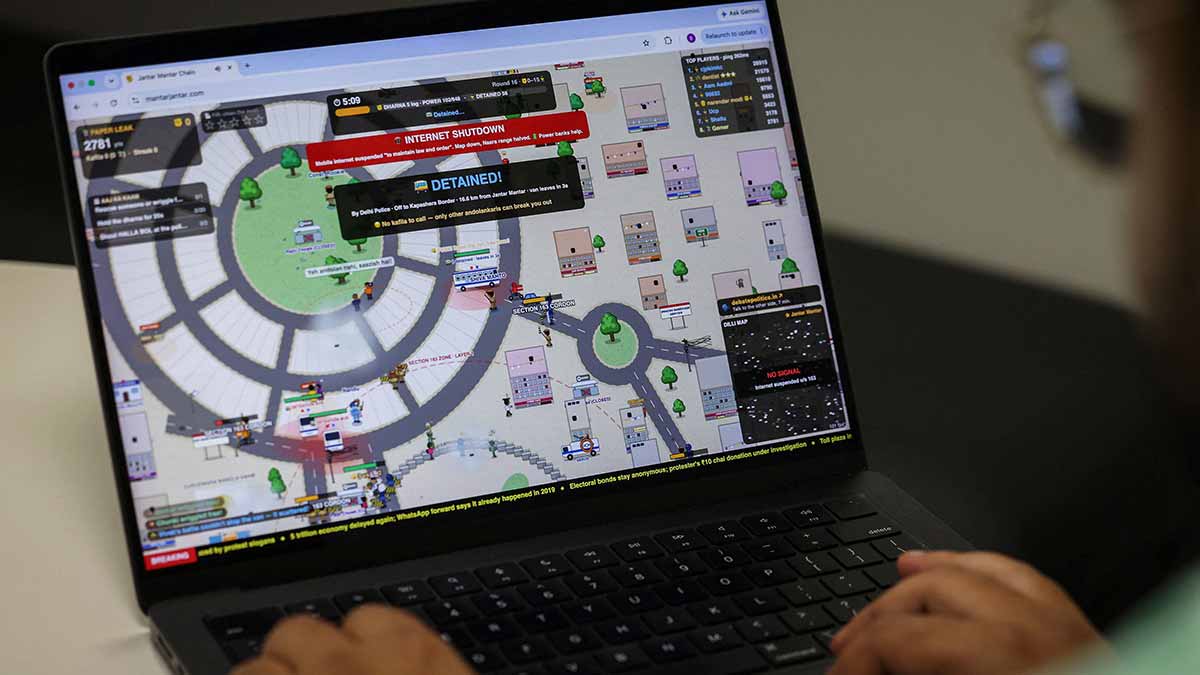
Jantar Mantar Chalo (mantarjantar.com) is the craziest of the lot in terms of mechanics. In this browser-based game by Suraj Kushwaha, you play either an Andolankari or Dilli Police. As the former, your aim is to reach Jantar Mantar. You can walk, run, shout slogans and push, scoring through micro-actions and on reaching Jantar Mantar, alone or as a group. As the latter, you catch protestors with lathis and tear gas. Once an Andolankari’s health is depleted, constables carry them to a police van bound for a temporary detention centre such as Kapashera Border, Burari Compound or Narela Stadium. It is a proper player-versus-player game, in the mould of Counter-Strike and Unreal Tournament, set in a 2D, Pokemon-esque rendition of New Delhi.
It has nothing going for it graphically, but makes up for it with features and detailing. All in all, the game gives both sides what they want: a respite from the actual protest, with a generous dose of satire. It is a gamer’s game, best played on a touchscreen.
CJP, It’s Done, Bro
Best played on an iPad or an Android tablet, CJP, It’s Done, Bro (cjpitisdonebro.com) is by far the cleanest of the microgames. This pro-establishment game, with better graphics and stellar UX that loads locally into your browser cache, is also the most misleading. It has four levels: Delulu, Delulu Pro Max, Propaganda Final Boss and Anarchymaxxing.
Delulu is the basic level. Balloons carrying supposedly delusional allegations rise up the screen, in colours ranging from black to different shades of red. Pop them for points, and a “fact check” box appears. These are usually run-of-the-mill, and most hold up. Once you pop ten and reach a high score, you move to Delulu Pro Max, where the screen fills with targets you throw darts at to destroy the “lie”. No skill is needed, much like the copy, which seemed AI-generated: tap any edge of a target and a dart swooshes to the bullseye. This is where the fact checks go off the hinges.
The best thing about CJP, It’s Done, Bro is that it presents a compelling argument on how right-wing discourse against student movements is created. I would urge you to try it. Gameplay is mostly linear, the only winning option is the pro-CEC, pro-BJP one, and the receipts let you see how media coverage works in far-right circles. It pushes you beyond the safe circles where the left wing often finds itself of late, where discourse means agreeing with each other rather than understanding the opposing thought process. Much of today’s political discourse is like a doctor treating only the obvious symptoms. In gaming, you have to delve into the mechanics. This game forces you to read the opposing viewpoint instead of dismissing it as bias, understand it, and confront the disease itself, if we are staying with the metaphor.
Desi Dangal
Desi Dangal and CJP Protest vs Modi Ji are two browser-based games on the CJP Game website (cjpgame.online). The latter is a Subway Surfers copy where you run as a character resembling the prime minister; there is little to do, and it looks poorly developed. The former is a fighting game that tries to take you back to the early days of Street Fighter and Mortal Kombat, and fails miserably. By early days, I mean the DOS era. It has standard punch, kick, block and special-attack buttons, but they are not intuitive. The satire is on the nose, with characters such as “Chaiwala Chintu” and “Netaji Bakwas”, and at times you even play “Modiji”. The visuals are basic, the delay hampers gameplay, and it feels made to drive views to the website. Instructions in Hinglish do not help. This one is a bust.
