



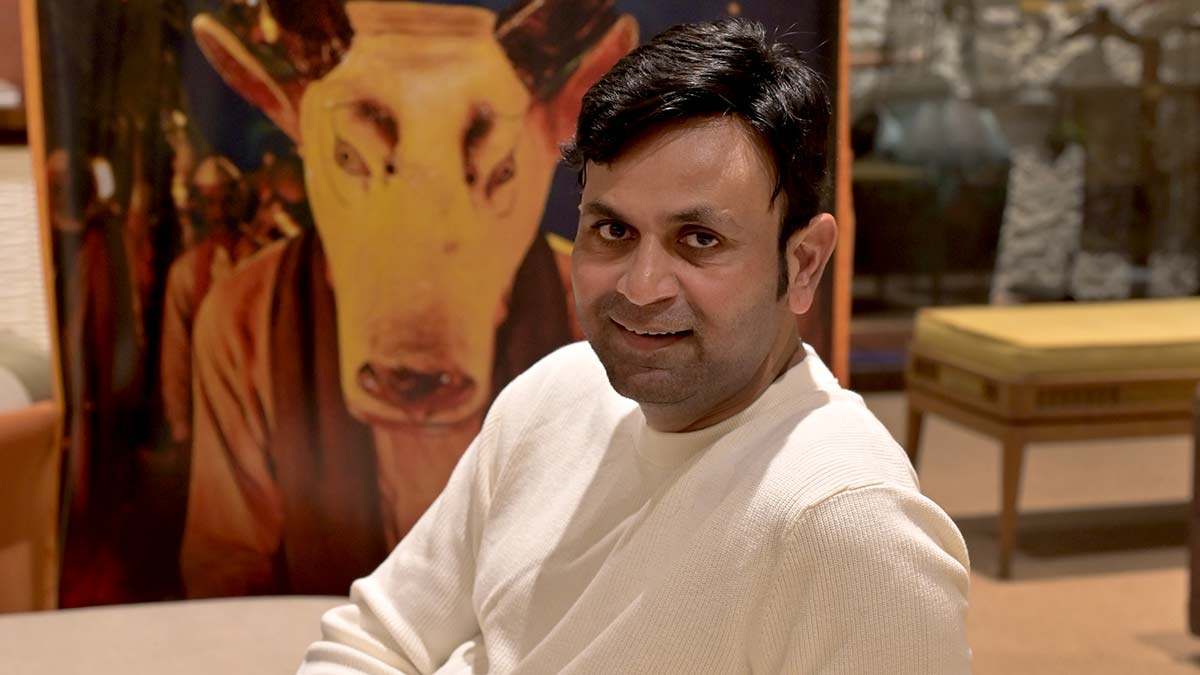
Interview/ Santosh Davakhar, filmmaker
At Santosh Davakhar's palatial duplex in Thane the first thing that catches the eye is a larger-than-life mural of Chhatrapati Shivaji Maharaj. The interiors are lavish and richly detailed, more reminiscent of a business magnate's residence than a filmmaker's home. A plaque at the entrance lists his diverse business interests, from infrastructure and rentals to education and petroleum.
The centre table offers a more intimate glimpse into his world: a miniature set from Gondhal, painstakingly recreated from the actual set used for the film's shoot in Thane.
Dressed in a pink sweatshirt and blue denims, Davakhar has the air of a taskmaster. Congratulations have been pouring in after Gondhal was selected as India's official entry in the Best International Feature Film category at the 99th Academy Awards. He is now working against a deadline, preparing a submission to the Maharashtra chief minister seeking government support for the film's Oscar campaign. “We have already started working on our campaign and we are on track,” he says.
Gondhal is rooted in rural Maharashtra and unfolds over a single night, around a traditional ritual centred around a newly married couple. The film draws on Gondhal, a centuries-old folk art and ritual tradition invoking deities.
The film marks a turning point for Davakhar, whose career began with the short film Party in 2012. It won international awards and was followed by Adnya, which went on to win a National Award. Two more short films followed, before Davakhar made his feature debut with Gondhal, whichhad its world premiere at the 56th International Film Festival of India in Goa last year. He won the Silver Peacock for Best Director at the festival.
Davakhar is not, by his own admission, a Bollywood buff. His cinematic influences are largely international, with films such as The Revenant, Birdman, Roma and Life Is Beautiful among his favourites. This sensibility informed his approach to Gondhal. “What also worked for me is that I roped in some of the best technicians in the industry,” he says.

His next film is a raw, rustic story centred on Shahaji Raje, the father of Shivaji. He cites Schindler's List as an inspiration, hoping to approach the story through a grounded cinematic lens rather than as a conventional historical film.
Filmmaking is only one part of Davakhar's unusual life. Over two decades, he and his team have released nearly 18,000 snakes into the wild, an effort that reflects his longstanding connection to the natural world.
His own journey has been unusual. He grew up in the chawls of Kalyan in a modest family; his father held a service job, while Davakhar and his mother supplemented the family income through private tuitions. “I have even distributed pamphlets outside my college for Rs50 a day,” he says. “Today, my businesses support me in pursuing my passion for filmmaking.”
Excerpts from an interview:
Q/ How did the idea for Gondhol come about?
A/ I had travelled to several international film festivals, realising that the global perception of Indian cinema was often centred around subjects such as poverty and casteism. These are important issues, but India also has an incredibly rich and diverse cultural heritage. I felt that there are so many Indian cultures and traditions that deserve to be told in the cinematic language.
That is what made me decide to make Gondhal. During my film studies, I became fascinated by world cinema. I did a short course at the Film and Television Institute of India and attended a film appreciation course at K.J. Somaiya [Institute of Management]. There were lecturers such as [screenwriter] Anjum Rajabali. I was there for about 15 days in 2017. I watched more than 40 films—three or four films a day. That experience really developed my taste in cinema. I decided that if I wanted to make a film that could stand out internationally, I needed to approach filmmaking differently.
Q/ What does this “international approach” to filmmaking mean?
A/ I see it like kushti. If you wrestle in Maharashtra, there are certain ways of doing it. But when you compete at an international level, you have to understand a different set of rules.
Similarly, international cinematic language and Indian cinematic language can be quite different. I consciously tried to approach Gondhal with an international cinematic language.
Q/ What were some of the technical choices you made to achieve that?
A/ Sound was one of them. In regional cinema, you may generally use five or six microphones—one for the main character, one for a side character, one for the instrumentalist and so on.
For Gondhal, we used more than 28 microphones at different locations to capture the ambience. I wanted the audience to feel that they were actually in that village experiencing Gondhal. The 25-minute one-take sequence was also not designed simply to make the film look technically impressive. When the film begins, you see the grandfather and his grandson. As they walk, the camera moves with them and eventually sits with them. The idea was to make the audience feel present in that world. You have seen films such as Birdman and 1917 using similar techniques. The purpose of a long take is not merely to show off the camera movement; it is to transport the audience into that world.
Q/ Would you ever want to do a mainstream Bollywood film?
A/ No, never. Right now my expenses are so high that I am paying an EMI of Rs60-70 lakh per month. Bollywood cannot help me pay these [hefty sums]. For that I need to work—I am running my own business with 200 employees.
