



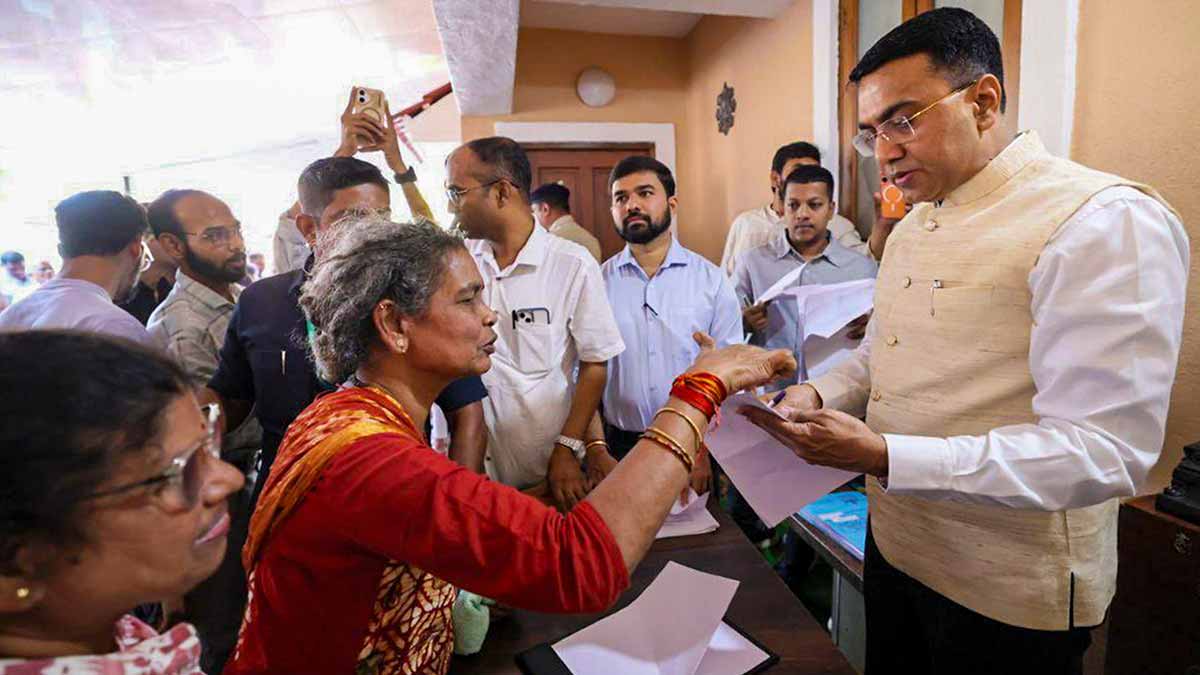
Though Goa is one of the smaller states in India, its politics has become increasingly similar to that of bigger Hindi heartland states, where the BJP has retained power in successive elections. The party is expecting an encore in Goa, too, despite the inherent anti-incumbency associated with a long spell in power.
Chief Minister Pramod Sawant—the BJP’s longest-serving chief minister in the state—is banking on his government’s record of development and welfare. The BJP has set a target of winning 30 of 40 seats.
In the 2022 assembly elections, the BJP had won 20 seats with 33.31 per cent of the votes. The Congress had won 11 seats. Currently, the BJP has 26 MLAs after welcoming Congress defectors, while its ally, the Maharashtrawadi Gomantak Party (MGP), has two.
What gives the BJP comfort is that, in the 2024 Lok Sabha elections, it had won nearly 51 per cent of the votes and was leading in 27 assembly segments.
In an interview with THE WEEK, Sawant did not commit to a seat target. “Our aim is to form the government once again and continue serving the people of Goa,” he said.
The BJP has an organisational advantage. It has a booth-level network, a presence across constituencies and the resources available to a party in government. As in other states, the BJP has continued to reach voters throughout its term, explaining government schemes and building support. Sawant, 53, has steadily built his profile as an administrator since he was picked as chief minister following Manohar Parrikar’s death in 2019. An ayurvedic doctor with RSS roots, he also holds a master’s degree in social work and has practical experience.
It was Parrikar who had asked him to contest an assembly byelection in 2008 after he left his government job as a doctor. Though he lost in his first attempt, he became an MLA in 2012.
Now looking for another term, Sawant has built his campaign around governance, infrastructure and welfare. He described ‘Swayampurna (self-reliant) Goa’—which takes government services to villages—as an initiative close to his heart. “Goa’s progress should be visible in its infrastructure, experienced through its governance, and felt in the everyday lives of every Goan family,” he said.
The main challenge to the BJP comes from the Congress, which has been trying to make the protection of Goa’s land, environment and identity a central election issue, apart from alleging corruption in the government. Its Goy Rakhon (save Goa) yatra began on September 22 and covered all 40 constituencies. During the campaign, Congress leader Rahul Gandhi raised the issues of corruption, unemployment, public safety and land conversion.
The yatra built on people’s anger over Section 39A of the Town and Country Planning (Amendment) Act of 2024, which allows changes to land use following individual applications. Critics argue that the process can allow zoning changes without adequate public consultation.
“For us, the main issue is the sale of land and public resources through the PPP model, which is harming the state,” said Congress state president Girish Chodankar. “We are going to people with this issue, apart from different scams. The yatra resonated with people as it is aimed at protecting Goa’s resources and cultural identity.”
The BJP disagrees. State party president Damodar Naik said the Congress was only trying to preserve its existence through the yatra. He argued that it was the Congress leaders who had been selling land and claimed that the BJP had documents relating to transactions and properties.
The BJP faces another challenge: these will be the first major elections after the Gen Z protests across the country, including in Goa. How much the opposition parties can build on this sentiment would depend on how they campaign, pick candidates and manage alliances.
Other issues that might resonate are employment and voter identity. The state has seen protests against the revision of voter rolls, the doubling of railway lines and zoning amendment.
Sawant said his vision is to ensure that sufficient job opportunities are available locally, while diversifying the economy into sectors such as pharmaceuticals, biotechnology and IT. He said he put his faith in the “maturity, awareness and independent judgment” of Goan youth. “Elections will ultimately be decided by the people of Goa on the basis of their own assessment,” he said.
And this assessment would include alliances. In September, within days of former Delhi chief minister Arvind Kejriwal announcing an alliance between his AAP and the Goa Forward Party (GFP), calling it Goa First, there were reports that the latter was in talks with the Congress, too. It added uncertainty over the opposition’s plans.
The Congress is yet to recover from its 2017 experience—it had won 17 seats compared with the BJP’s 13, but the latter formed the government as the Congress was slower to cobble together a post-poll alliance.
The AAP, which is also up against the Congress in Punjab, has been mocking the latter’s record of losing legislators to the BJP. It has also challenged the Congress to protect its MLAs.
Such confusion over alliance arrangements tends to help the ruling party, given Goa’s small constituencies—the more the opposition parties, the more the anti-government votes get divided.
But Sawant said the BJP was not basing its preparations on divisions among its opponents. “Our focus is not on deciding whether the Congress or the AAP is our bigger opponent,” he said. “Our focus is on the people of Goa and the responsibility they have entrusted to us. We are confident about forming the government once again.”
