



On August 31, an FIR was registered against Rahul Gandhi at a police station in Haldwani, Uttarakhand, after he demanded an FIR against those who conducted a "purification" ritual at the venue where Congress president Mallikarjun Kharge had addressed a rally three weeks earlier. While Rahul called the episode a modern form of untouchability, the state government said his interpretation was politically motivated.
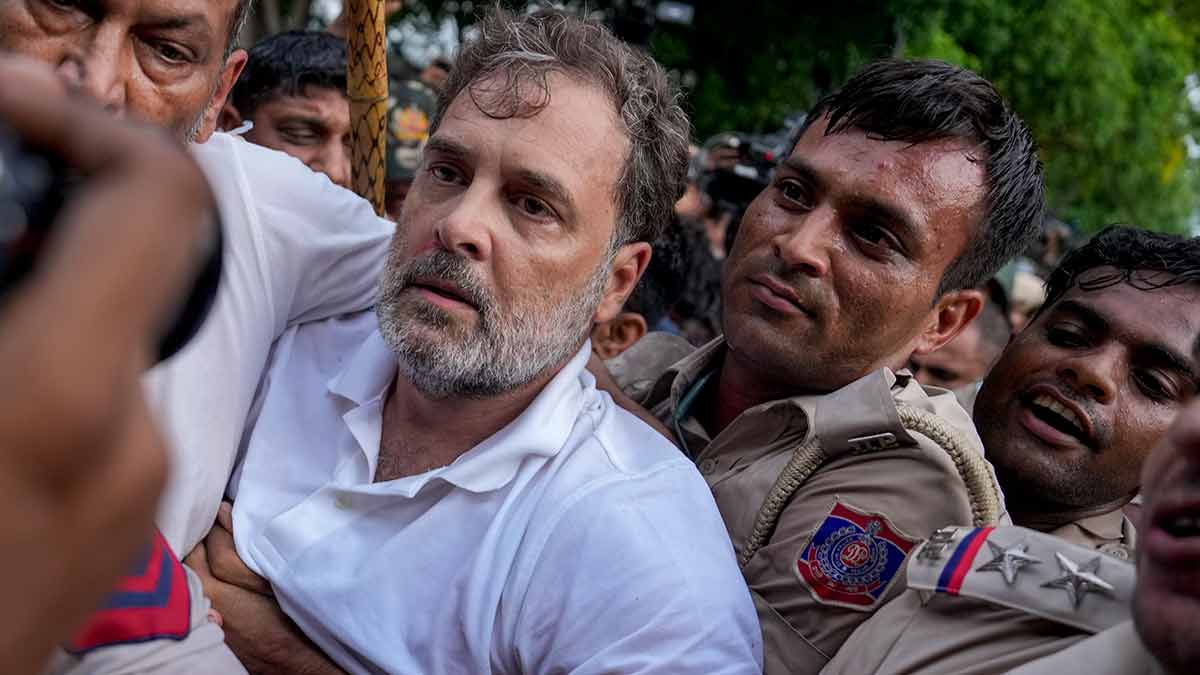
The Haldwani case is the latest flashpoint in a renewed bout of agitational politics that began in earnest on July 21, when Rahul led fellow opposition parliamentarians—assembled and briefed only minutes earlier—on an unscheduled march to Prime Minister Narendra Modi's residence at 7, Lok Kalyan Marg. Photographs of a bloodied Rahul being taken away by police did more for the party's messaging than any press conference could. It was a signal that the Congress was prepared to do the hard grind.
Since the 2024 general election, the Congress and the wider opposition bloc have lost ground in Haryana and Maharashtra, then Bihar and, most recently, Assam, despite visible anti-incumbency against the BJP. Campaigns built around "vote theft" and local grievances have yielded less than the party expected. One explanation recurs across these defeats: a weak grassroots cadre that has left the Congress disconnected from voters. The party now believes it is beginning to repair that structural weakness.
The Congress has responded by treating the district, rather than the state, as its basic operational unit. It has revived 900 of the 1,054 district Congress committees. A newer layer of mandal committees, each covering 10 to 15 booths, has been designed to translate central mobilisation into local pockets.
"Structural problems and communication were the two major impediments in mass public outreach. We needed a level from which we could operate effectively. The booth is not an appropriate level because we cannot control every booth individually," said a Congress Lok Sabha MP. "We need a level slightly above the booth to do ground politics."
The new architecture will take time to mesh with the party's national apparatus, but its willingness to show up physically has already given it some momentum. Manindra Nath Thakur, who teaches political science at Jawaharlal Nehru University, New Delhi, said the Congress read the moment well. "First, it kept the distance from the non-political Cockroach Janta Party and engaged with people, giving the BJP less space to hit it back politically," he said. "Then Congress has also tried to sustain the campaign by committing to people and picking up their issues."

The party's only significant breakthrough against the BJP in recent years came in the 2024 general election, when it helped prevent the saffron party from crossing the simple-majority mark on its own. A rare consolidation of dalit votes around the "Constitution is in danger" message helped. Many voters were worried that the BJP would rewrite the Constitution if the National Democratic Alliance won a supermajority. This time, the Congress is seeking to make that social coalition more durable, binding dalits and Other Backward Classes through a ground campaign ahead of the assembly elections due next year.
Outside Punjab, where it remains the principal challenger to the Aam Aadmi Party, the Congress is the main opposition force in Uttarakhand, Goa and Manipur. Goa looks difficult, whereas Uttarakhand and Manipur, where there is visible anti-incumbency, appear more winnable. But to seriously challenge the BJP, it also needs to perform in Uttar Pradesh, where it will contest the polls in alliance with the Samajwadi Party. A strong showing there would help shape the opposition's terms of engagement heading into the 2029 general election.
The Haldwani episode has given the dalit outreach an unplanned but useful hook. Kharge had addressed a rally at the Ramlila ground on August 8. Two days later, members of the Shri Ram Sena Dharmarth Seva Nyas carried out what they described as a purification ritual. The organisers denied any caste motive, saying they were merely clearing the filth left behind after the rally. Congress leaders were not impressed. It took Rahul nearly three weeks to turn the episode into a national issue, framing it as untouchability by another name. "Justice to Kharge ji is not a possibility, that will surely happen," he said at a press conference. The FIR against him subsequently turned the episode into something larger.
The politics of that anger extend well beyond Uttarakhand. Dalits make up around 21 per cent of Uttar Pradesh's population, 32 per cent in Punjab and 18 per cent in Uttarakhand, all states central to the Congress's plans. The party is also looking beyond its traditional base. It has signalled that it could bring Chandrashekhar Azad's Azad Samaj Party into the fold in Uttar Pradesh, hoping to draw dalit voters who, even after moving towards the Samajwadi Party-Congress alliance in 2024, never fully abandoned Mayawati's Bahujan Samaj Party.
But what could really tip the scales is a bigger slice of the OBC vote. According to data from the Centre for the Study of Developing Societies, the BJP's share of the OBC vote in Lok Sabha and assembly polls has been roughly twice that of the Congress, with about 44 per cent of the community backing the BJP in 2024 against 20 per cent for the Congress.
The Congress is now building a nationwide street campaign around OBC issues, prompted by the government's caste census notification on August 14, which left OBCs off the list of separate categories. Party workers are training organisers to carry the campaign into every district, betting that resentment over the omission will deepen. "Street protests will be held in every district three months before the elections," a party insider said, with the Congress demanding that OBCs be listed explicitly in the census.
"If we look at BJP's voters, a large section is OBC. Narendra Modi has strategically framed himself as an OBC, helping him add this voting bloc because there is identity politics in India," said Anil Jaihind, head of the Congress's OBC wing. "Now they feel cheated. And this will have a considerable impact in Uttar Pradesh, Uttarakhand and Punjab. We have already seen several non-political organisations joining us."
That leaves the BJP with an awkward choice. Naming OBCs separately in the census risks alienating upper castes, who form the core of its support and account for more than 15 per cent of the population. Leaving them out risks OBC anger, amplified by a Congress campaign built precisely for that purpose.
There is an irony here. Mandal politics helped erode the Congress's dominance through the 1980s. Four decades later, it is becoming one of the routes the party has chosen back to remain relevant. The Congress frames the shift as a moral project of inclusion, set against what it portrays as the BJP's politics of polarisation.
"There are so many things that have added up over the years and have made an impact in Congress's favour," said political analyst Avinash Singh. "When Congress was down in the dumps, Rahul did the Bharat Jodo Yatra, the first large street campaign which pulled the Congress up. His hard work fought the propaganda of him being called a pappu. Then people started realising that he talks a lot of sense. With that backstory, its future street campaigns should drive more audience and give the party more electoral benefits."
Congress leaders sense that the BJP is anxious, and hence have upped the ante. After being accused of not singing Vande Mataram in full, it did not back down. Instead, it passed a Working Committee resolution invoking the party's own 1937 resolution from the freedom struggle. Rahul has also attacked a verse in the Manusmriti, which, in his view, says that a woman should remain under the authority of male relatives at every stage of her life. He called it shameful.
"The Congress views the changing dynamics as a major churn in India's polity. What you see as restlessness among people is actually a revolt against the Modi brand and his political imagination," said Congress general secretary Randeep Singh Surjewala. "In Modi's view, it is simple to concentrate resources in the hands of five or six industrialists and then run the entire structure of government through them, making everyone subservient to them." Surjewala added that Rahul had become an instrument of that churn, someone who had exposed what the party calls the falsehoods and divisive character of the Modi model of governance.
The youth wing of the Congress is running its own parallel effort. "We started working through student centres across 28 cities in June under the banner of Chatron ki Goonj. In 30 days, we got nearly 25 lakh registrations. The key demands were an inquiry into paper leaks, larger changes in the education system and making the employment calendar public," said Manish Sharma, All India Congress Committee in-charge of the Youth Congress. "Now we are expanding to 100 more cities. The second aspect is hyperlocal outreach, taking up issues such as pending government jobs, filling vacancies and improving education infrastructure."
The party's social media operation has adopted the same posture, meeting every BJP narrative with a counter of its own. The difference this time is that the Congress is trying to connect the national message to a physical organisation that can carry it into neighbourhoods, districts and booths.
That is the real test. The Congress has tried converting political momentum into electoral gains before and failed. Street protests can create visibility, caste campaigns can generate attention and a revived cadre can put workers back among voters. But none of them guarantees votes. The question is whether Rahul's street politics can travel beyond national headlines, connect with critical electoral pockets and, finally, turn the Congress into a credible alternative to the BJP.
