



STREET POLITICS IS often misunderstood as the politics of numbers. A large crowd, a dramatic slogan, a long march or a prolonged sit-in can create the appearance of political power, but numbers alone rarely explain why some movements change governments, alter laws or reshape political alignments while others disappear after a few days.

The more useful question is: what converts public anger into political power? India's history offers a particularly rich answer. From the freedom movement to the JP movement, from Navnirman and Mandal to Anna Hazare, Nirbhaya and the farmers' agitation, successful mass mobilisation has generally depended on the same combination: a grievance that people can understand, a moral argument that gives the grievance legitimacy, an organisational structure capable of sustaining participation and political leadership or symbolism capable of connecting different groups.
The street matters because it changes the relationship between the citizen and the state. An individual complaint can be ignored. A constituency can be managed. A crowd occupying public space, repeatedly returning to it and attracting wider public attention is much harder to dismiss.
The Indian national movement established this logic long before independence. The Non-cooperation and Civil Disobedience movements demonstrated that political authority could be challenged through mass participation outside formal institutions. The Quit India Movement went further. After the Congress leadership was arrested almost immediately after the call was issued, the movement developed through spontaneous and decentralised action. The British response was severe, with tens of thousands arrested.
The clearest post-independence example of how street politics acquires political meaning is the movement associated with Jayaprakash Narayan. The Bihar agitation of 1974 began with students protesting against inflation, unemployment, corruption and problems in education and governance. The Bihar Chhatra Sangharsh Samiti became the principal organisational vehicle. The students then approached Jayaprakash Narayan, a veteran of the freedom struggle who had withdrawn from conventional electoral politics.
JP's contribution was not to manufacture the anger. It was to give that anger a political vocabulary. On June 5, 1974, speaking at Gandhi Maidan in Patna, he called for Sampoorna Kranti, or Total Revolution. He argued that the problem went beyond a particular government or a particular administrative failure. The movement, in his formulation, was about political, social and economic transformation and about completing the democratic promise of independence. He also insisted that the movement remain non-violent and expand beyond Bihar.
That distinction is central to understanding street politics. A grievance creates participation; a larger political narrative creates a movement. JP also possessed something that most political leaders cannot manufacture: distance from the immediate competition for office. His credibility came partly from his history in the freedom struggle and his later Sarvodaya work. That allowed him to bring together students, socialists and opposition forces that otherwise had little reason to share a platform. The movement eventually became part of the larger political confrontation with Indira Gandhi and the politics that culminated in the Emergency. Therefore, the lesson from JP is that street politics becomes powerful when a leader can connect scattered grievances to a question of legitimacy.
The same mechanism appeared in Gujarat's Navnirman movement in 1974. It began with student protests over hostel fee increases and quickly widened into an agitation against inflation and corruption. What made it consequential was the transition from a student issue to a public issue. This is one of the hardest things for any movement to achieve. People will come onto the street for a grievance that directly affects them. They stay, however, when they believe the grievance represents something larger.
The Mandal protests of 1990 illustrate the opposite possibility. Here the central issue was already national policy: the implementation of reservations for Other Backward Classes following the recommendations of the Mandal Commission. The protests, particularly among students and sections of the urban middle class, were intense. They did not succeed in stopping the policy. Yet Mandal permanently altered Indian politics by making caste representation, backward-class mobilisation and social justice central to electoral competition.
This is why the success of street politics cannot always be measured by whether the immediate demand is accepted. A movement can fail to reverse a policy and still change the political system around it. The Anna Hazare anti-corruption movement of 2011 provides another important case because it demonstrated how street politics had changed in the age of television and social media. The movement succeeded in forcing corruption to the centre of national political debate and contributed to the political pressure that preceded the eventual passage of the Lokpal and Lokayuktas Act in 2013. It also produced a more direct political consequence: leaders emerging from the movement went on to establish the Aam Aadmi Party.
But Anna's movement also demonstrated the difference between a protest coalition and a political organisation. It was relatively easy to unite people around the proposition that corruption was unacceptable. It was much harder to agree on what should replace the existing political system.
The 2012 Nirbhaya protests were different again. They were not initiated by an established political organisation and did not have a conventional leadership structure. The immediate trigger was the brutal sexual assault in Delhi, but the protests quickly became a broader expression of anger over women's safety, policing, criminal justice and the perceived failure of the state.
Their significance lay in the conversion of private fear into public political pressure. The protests helped create the political conditions for the Justice Verma Committee's recommendations and the subsequent Criminal Law (Amendment) Act, 2013. The episode demonstrated that a street movement need not begin with an ideological programme. Sometimes a single event becomes politically explosive because it is recognised as evidence of a systemic failure.
The farmers' mobilisation of 2020-21 showed perhaps the clearest modern example of organisation sustaining street pressure over time. The protests against the three farm laws were not simply a sequence of rallies. Protesters established long-duration camps around Delhi, maintained food and medical arrangements, developed communication networks and sustained participation through an extended confrontation with the government. In November 2021, the government announced that it would repeal the three laws.
This points to a distinction that is often missed: mobilisation and organisation are not the same thing. Mobilisation can bring one lakh people onto a street. Organisation can keep 10,000 people there for months. The second is politically more consequential.
The other major transformation has been technological. JP's movement depended heavily on student organisations, public meetings, pamphlets and physical networks. The Anna movement operated simultaneously through television and social media. The farmers' agitation used social platforms, digital communication and conventional organisation together.
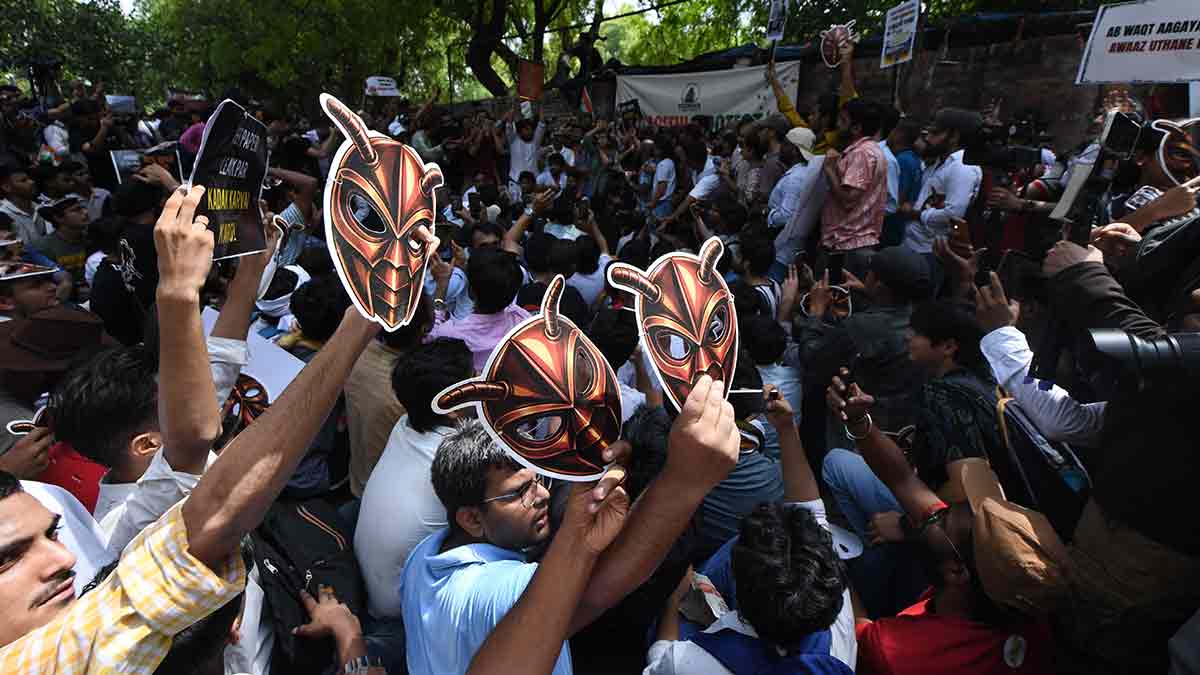
The recent protest by the Cockroach Janta Party is perhaps the clearest example of how street politics is changing in the age of the mobile phone. The movement began with anger over the NEET paper leak, but very quickly became much bigger than NEET. Young students who had spent years preparing for competitive examinations, only to see papers leaked, exams cancelled or recruitment delayed, found in the CJP movement a language through which they could express their frustration.
They shot videos, made reels, circulated photographs, recorded police action, shared speeches and brought every moment of the protest directly to millions of other young people. What began as a meme and a response to NEET gradually turned into a street movement, drawing thousands to Jantar Mantar and eventually into a march towards Parliament. The CJP episode tells us something much larger about the politics of today: the gatekeepers of information have changed. A generation that once waited for television cameras to arrive has discovered that it carries its own camera, its own newsroom and its own distribution network in its pocket, and the result was seen in Union education minister Dharmendra Pradhan's resignation.
The contemporary street is, therefore, both physical and digital. A protest photograph can become a television image. A television image can become a social media campaign. A social media campaign can bring people onto the street. The physical protest then generates another cycle of images and narratives.
But digital visibility also creates a weakness. A movement can become enormous online without acquiring organisational depth. Virality produces attention; it does not necessarily produce staying power.
That brings us to the central question: what makes street politics work?
First, the grievance has to be intelligible. "Corruption", "unemployment", "justice", "withdraw the law" or "protect our livelihood" can travel quickly because they can be understood without a briefing paper.
Second, the grievance has to be framed as a question of legitimacy. The strongest movements do not merely say that a government has made a bad decision. They argue that something fundamental is unfair, corrupt, unjust or contrary to the public interest.
Third, the movement has to cross its original constituency. A student movement that remains a student movement has a natural ceiling. A farmers' protest that becomes a national question has a much higher ceiling. JP understood this when he insisted that the Bihar movement should not remain confined to Bihar.
Fourth, there has to be endurance. Governments can wait out a one-day demonstration. They have a much harder political calculation when protesters return tomorrow, next week and next month.
Fifth, there must be some form of organisation. Leaders, volunteers, logistics, communication, fundraising, legal support and local networks are rarely visible in the iconic images of a movement, but they are what allow the image to be repeated.
Finally, the movement needs a route from public pressure to political consequence. That consequence may be a law, a policy reversal, a government resignation, an electoral realignment or a permanent change in public opinion. Without such a route, street politics risks becoming performance rather than power.
This is also why not every large protest succeeds. A crowd can be large but politically isolated. A slogan can be emotionally powerful but too narrow to build a coalition. A movement can have public sympathy but no organisation. It can have organisation but lack legitimacy. It can achieve enormous media attention but fail to convert attention into sustained pressure.
The street is powerful precisely because it sits outside the formal machinery of the state. But its ultimate test is what happens when it encounters that machinery.
The JP Movement eventually helped produce a political realignment that broke Congress's monopoly at the Centre in 1977. The Anna movement produced a new political party. Mandal transformed the structure of electoral politics. Nirbhaya contributed to changes in criminal law. The farmers' agitation secured repeal of the three farm laws.
These outcomes were different, but the underlying mechanism was similar. A private or sectional grievance became a public cause, the public cause acquired legitimacy, legitimacy produced participation, participation created pressure, and sustained pressure eventually forced institutions to respond.
That is what makes street politics work. Not the crowd by itself. Not disruption by itself. Not even anger by itself. Street politics works when people begin to believe that their individual grievance is actually evidence of a larger political problem, and when enough of them are willing to occupy public space, repeatedly and visibly, until the institutions of power can no longer treat that problem as marginal.
The most successful movements do not merely fill the street. They change what the political system has to answer for.
The author is a former Lok Sabha member and political commentator.
