



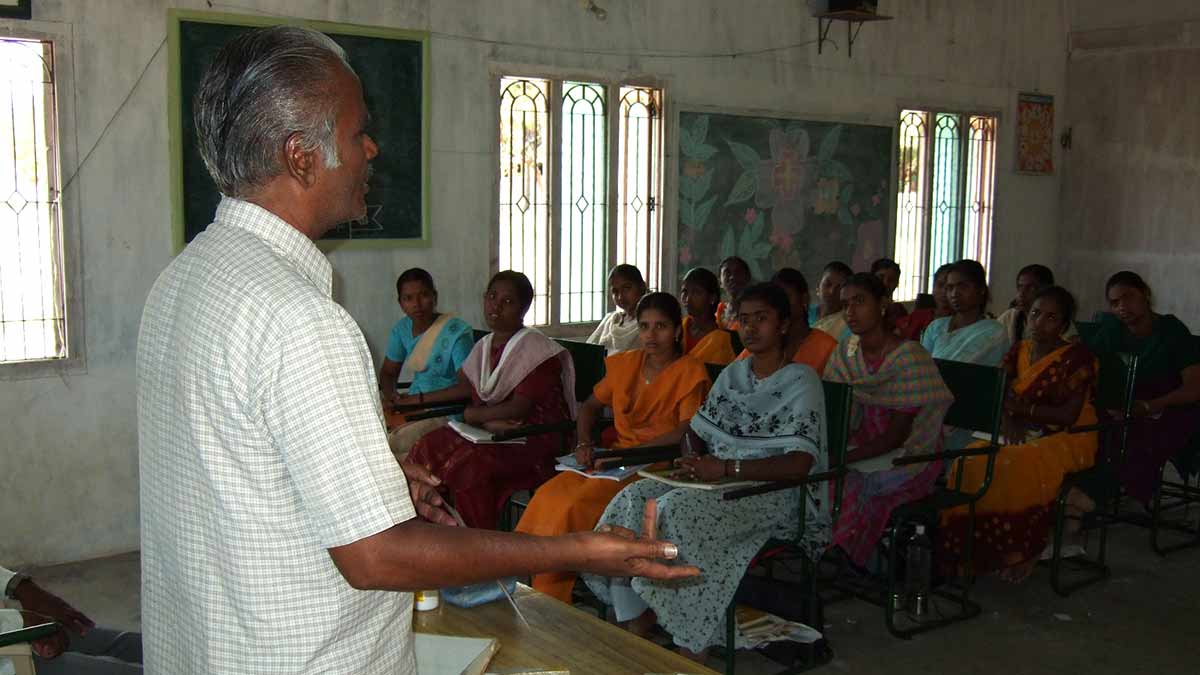
As a boy, M. Raja watched his father leave home on a bicycle, travelling from one place to another to help people affected by leprosy. India was grappling with the monumental challenge of bringing down the prevalence of leprosy, which stood at 57.2 per 10,000 people in 1981. The goal was ambitious—to bring the prevalence down to a single digit by the end of the century.
Born in Madurai, Raja recalls the days when he would see leprosy patients at bus stands and railway stations, many of them abandoned by their families. At that time, he did not fully understand his father’s work.
His father, Dr Maria Xavier Turtius, now 78, had begun his career as a leprosy inspector in 1966. He worked as a non-medical supervisor at Sacred Heart Hospital in Kumbakonam and, after completing a course in leprosy health education at the Gandhi Memorial Leprosy Foundation in Wardha, he moved to Mar Themotheous Memorial Leprosy Centre Hospital in Kerala in 1974. He worked there for six years before returning to Tamil Nadu.
Those years convinced Turtius that leprosy was not just a medical condition but a social problem. Patients needed not just treatment but rehabilitation and help in rebuilding their lives. In 1991, he established the Madurai Health and Leprosy Relief Centre, an NGO registered under the Tamil Nadu Societies Registration Act, 1961. The organisation began with very little money, and Turtius continued working with patients while his wife took up tailoring to support the family.
In 1996, when global efforts to target leprosy-endemic hotspots started taking shape, the organisation began receiving small amounts from well-wishers in the US and Europe. In 2006, it obtained registration under the Foreign Contribution Regulation Act (FCRA), allowing it to receive contributions from abroad. But its own struggles have continued. “Though the organisation is FCRA registered and never faced problems with renewal, there is hardly any money coming in,” said Raja.
His father has graduated from a bicycle to a mobile medical unit. The van enables the team to reach patients in local communities, conduct surveys and provide rehabilitation and palliative care. Some of the people once treated by the organisation have now become part of its workforce.
The organisation’s FCRA registration is due for renewal next year. Raja is aware of the increasing scrutiny. But that is not what he is worried about. “Many NGOs providing grass-root services to the community are actually struggling even if they are FCRA compliant. This is the reality. I want to know if the FCRA Amendment bill 2026 will bring relief to NGOs in the country,” he said.
Parliamentarians in New Delhi have been engaged in heated debate over the Foreign Contribution (Regulation) Amendment Bill, 2026. Presented by the government as a measure to enhance transparency and accountability in the use of foreign funds, the legislation has provoked fierce criticism from opposition parties and legal experts, who warn that its provisions extend beyond regulation and risk concentrating sweeping discretionary powers in the hands of the state.

The bill has been sent to a Joint Parliamentary Committee, where legislators and experts will examine concerns about foreign funds influencing the country’s internal affairs, and whether the proposed safeguards to ensure funds are not misused for non-charitable purposes have been drafted properly in the revised legislation. Until then, non-profit organisations are waiting with bated breath, hoping that decades of work on the ground do not suffer and foreign contributions can continue to flow in a streamlined manner.
A wide range of activities across different sectors in India are eligible for foreign funding—education, health care, rural development, social welfare, environment, relief and rehabilitation, heritage and culture, faith-based welfare and scientific research. At the grassroots, workers like Raja want India not only to find a seat at the table where global advocacy battles are being fought to influence policies on health care, education, wildlife conservation and climate, but also to collaborate with international partners who can bring value to social work in India.
“This is possible when counterparts in different parts of the world come together and make joint efforts in understanding the common and unique challenges across India’s geography,” said Jose Louies, chief executive officer of Wildlife Trust of India. WTI started as a small team operating out of a tiny room in south Delhi in 1998 but has grown into a leading conservation organisation, recognised for its work in protecting India’s wildlife.
Take, for instance, the decades-long journey of Ganga, a rescued female rhino which became the first to be rehabilitated and released into the wild at Manas National Park in Assam. In 2004, Ganga was separated from her mother and was in dire need of rescue from the floods in Kaziranga National Park. The Assam Forest Department rescued her and brought her to the Centre for Wildlife Rehabilitation and Conservation (CWRC), a collaboration of the WTI, International Fund for Animal Welfare (IFAW) and the Assam forest department. She underwent three years of rehabilitation before being moved to Manas National Park, where she contributed to many generations of rhinos, earning widespread acclaim for domestic wildlife conservation efforts. The CWRC, set up in Borjuri in Assam in 2002, has since provided veterinary care to around 6,400 orphaned, injured and displaced wild animals. Nearly 4,000 of them have been successfully released back into the wild.
“When international collaborations to address conservation challenges come closer home and benefit the country in protecting its endangered species, it becomes all the more important to take a step back and examine how well policymaking can support such efforts rather than disrupt ongoing conservation activities,” said Jose.
At the same time, he agreed there was a need for strong checks and balances. “We cannot say every organisation is doing everything right. There have been instances of money coming into India and not being used for the intended purpose,” he said. “Controls are welcome if they are introduced with good intent, are transparent and are clearly defined. The problem is the grey areas.”
The fear is that the complexity of provisions in the law can result in misinterpretations, mistakes and diversions to avoid stepping into a grey zone.
“With so many clauses and conditions being introduced over the past four years, organisations are being forced to devote more energy and resources to FCRA compliance. There is always the fear of making a mistake,” said Jose.
Another point that is often overlooked is the number of jobs created by the non-profit sector. “At Wildlife Trust of India, we employ about 300 people as regular staff or consultants,” said Jose. “The organisation also supports communities and generates economic activity in rural areas. If such work is curtailed, these jobs and livelihoods will also be affected.”
Non-profit organisations worry about the bumps in the five-decade-long journey of the FCRA. This has resulted in some genuine welfare work being stalled, and questions about whose welfare is being safeguarded—the state or its people? Experts say the solution lies in bridging this gap and finding common ground for a shared goal.
“Successive governments have introduced amendments to strengthen oversight, plug loopholes, and ensure that foreign funds are used strictly for their stated purposes,” said Vaishali Basu Sharma, a security and economic affairs analyst. “Changes like mandatory Aadhaar and passport identification for office bearers, the requirement of a single SBI entry account for receiving foreign funds and restrictions on sub-granting to prevent siphoning of resources were introduced in 2020.”
Misuse such as diverting funds under the guise of administrative expenses was curbed by progressively reducing the permissible limit from 50 per cent to 20 per cent. Oversight was also strengthened after renewal of registration was made contingent on government inquiry.
The most recent changes were introduced in 2022, which permitted relatives to remit up to Rs10 lakh without notifying the government, while removing the requirement to publicly declare quarterly details of foreign donations. The proposed steps include creating a framework for supervision, management and disposal of foreign contributions and assets belonging to organisations that lose their FCRA registration. The reasons can vary from the certificate being cancelled or voluntarily surrendered to renewal being denied.
According to NGO workers, here lies the problem. The creation of a ‘designated authority’ in the 2026 amendment to manage or dispose of assets created by NGOs after the FCRA licence is cancelled is facing the strongest resistance. The process begins with provisional vesting and extends to permanent vesting if “fresh registration, renewal or restoration is not obtained within the prescribed period”. In such cases, the assets of the NGOs will be utilised for public purposes, while disposal proceeds and unutilised foreign contribution will go to the Consolidated Fund of India.
Organisations like the National Council of Churches feel that if legally registered trusts or organisations lose their registrations or assets to the government on flimsy or undisclosed grounds, it may defeat the purpose of “charity”, as it may not be utilised for the same cause.
“Christian organisations involved in charity work and receiving FCRA have been complying with the laws, including those relating to charity commissions in states,” says Reverend Asir Ebenezer, general secretary of the National Council of Churches in India.
The proposed law makes amply clear that religious activities such as construction or maintenance of places of worship, devotional music and religious education are permitted, but with a clear caveat that proselytisation is excluded. “The procedures and rationale may be explained when the rules are drafted,” said a government official.
When Ebenezer met Union Home Minister Amit Shah, he was assured that any flaws in the law—past and present—would be examined. “The issue was raised that some charity organisations lost their registrations without notice and he assured such cases would be re-examined.”
For nearly three decades, Dr Kamala Chiranjeevi and Dr J. Chiranjeevi, founders of the Letha Charitable Trust in Hyderabad, had been working to educate and build sustainable livelihoods for tribals and underprivileged families. “Our efforts began in 1996 with a simple belief that education was key to rural development, and should not stop at reading and writing,” said Dr Kamala, who has a PhD in education and economic development.
The organisation’s FCRA registration was suspended in 2023 for three years, with the authorities citing the staff family conference it conducted was for the welfare of the staff and their children but not the poor people, according to Dr Chiranjeevi. Despite the loss of foreign funding, the organisation has continued on a much smaller scale. “We run skill training in sewing and tailoring, self help training programme, computer education and spoken-English to marginalised women and men, and support small farmers in Telangana for organic cultivation initiatives,” he said.
While domestically supported initiatives like the Madurai Leprosy Centre and the Chiranjeevi family are waiting for a favourable policy environment before foreign funds flow in, there are others whose work extends beyond the country’s borders. “We need to attend conferences abroad, present our work internationally, bring in foreign experts or work with neighbouring countries such as Nepal, Bhutan, Bangladesh and Myanmar, particularly in border areas,” said Jose.
But at the moment, these FCRA-registered entities are focusing on keeping their books clean. “Our accountants are asking if we can use FCRA funds for travel in an international carrier,” said a climate activist.
The immediate challenge is the first World Congress on Snakes in Sri Lanka in October, where experts like a Chinese herpetologist, a Polish researcher, an American conservationist and an Indian reptile educator are among hundreds of invitees. With India often dubbed as the snakebite capital of the world, experts say there is no dearth of talented toxinologists, wildlife researchers and climate and conservation experts to talk on a range of subjects like snakebite mitigation, biodiversity conservation, climate change, venom research and public health.
However, at the moment, they are still debating whether a Snake Congress can pass the FCRA test or not.
FOREIGN FUNDS, TIGHTER RULES
1976: Foreign Contribution Regulation Act enacted to regulate the use of foreign contributions and hospitality
1984: Amendment makes registration with the home ministry mandatory for all NGOs receiving foreign funds, brings judges within the act, broadens the definitions of “foreign contribution” and “political party” and adds audit powers
2010: FCRA, 2010 replaces and consolidates the 1976 act with stronger compliance architecture. Mandatory renewal of registration every five years, elaborate and strict conditions of registration, suspension, cancellation, vesting of assets and compounding of offences
2011: Foreign Contribution (Regulation) Rules notified, operationalising registration, designated accounts and reporting formats
2020: Major Amendment Act: mandatory Aadhaar/ passport identification for office-bearers; foreign contributions confined to a single SBI, New Delhi account; sub-granting to other associations prohibited; administrative-expense ceiling cut from 50 per cent to 20 per cent; renewal subject to a government inquiry
2022: FCRA rules amended: the limit on contributions from relatives abroad raised from Rs1 lakh to Rs10 lakh a year, easing compliance for ordinary families; provisions for compounding certain offences introduced
2024-25: Amendments: unspent administrative-expense allocations may be carried forward; TDS-refund treatment clarified; application-stage documentation strengthened for faster processing of applications
2026 (proposed): A designated authority to safeguard foreign-funded assets when a registration lapses or is cancelled. Links registration to specified purposes and approved states/UTs, excludes proselytisation from permitted religious activity
What foreign funds can be used for:
Registered organisations can receive and utilise foreign contributions under education, health care, rural development, social welfare, environment, relief and rehabilitation, heritage and culture, faith based welfare and scientific research
How different countries regulate foreign influence and funding:
• US-Foreign Agents Registration Act (FARA), 1938
• Australia-Foreign Influence Transparency Scheme Act, 2018
• UK-Foreign Influence Registration Scheme, National Security Act 2023 (in force from July 1, 2025)
• Canada-Foreign Influence Transparency and Accountability Act, 2024
• European Union-Representation on Behalf of Third Countries (Defence of Democracy package, 2023–under negotiation)
source: Press Information Bureau
