



SOME OF INDIA’S oldest surviving manuscripts have endured for a millennium. Written on palm leaves, birch bark and later handmade paper, many have outlasted empires, surviving adverse climate, pests and neglect. Today, about 5.5 lakh manuscripts have been digitised under the Centre’s Gyan Bharatam Mission.
Digitisation might seem like the end step. But it poses a paradox. While digital copies make manuscripts easier to access, the technologies used to store them can become obsolete within years.
“Twenty years ago, people used floppy disks. Today, most computers don’t even have drives capable of reading them,” says Prof P.R. Mukund, a retired professor at Rochester Institute of Technology, New York. “The real question is: how do we ensure that a manuscript remains accessible hundreds of years from now, regardless of what happens to current technologies?”
It is this challenge that Mukund and his Bengaluru-based trust Tara Prakashana, with another centre in Udupi, have been trying to solve for the past two decades. His interest in manuscript preservation began in 2005, when his guru, the late Dr Bannanje Govindacharya, asked him to help preserve the original writings of Acharya Madhava. “Around 850 years old, it was literally falling apart and was unreadable,” he recalls.
Mukund and two scientists turned to multispectral imaging, a technique that captures manuscripts under different wavelengths of light. Since words in most palm-leaf manuscripts are engraved with a sharp stylus rather than written with ink, different wavelengths penetrate the material differently, revealing details invisible to the naked eye.
“We then combine all those images computationally to create a much clearer reconstruction of the manuscript. The results can be extraordinary,” says Mukund. “That was our first major project in manuscript preservation.”
But reconstructing a manuscript digitally was only part of the solution. “Long-term preservation is crucial,” says Mukund. “Ideally, it should be a physical artefact—something tangible that future generations can access without depending on today’s technology.”

His first answer was archival paper. His team cleans digital images, removes visual noise and prints them on 100 per cent acid-free archival paper, which has an estimated lifespan of 200 to 250 years. “Since 2006, we have digitised and processed more than 3,500 manuscripts. Of these, around 1,600 have already been converted into archival-paper editions,” says Mukund.
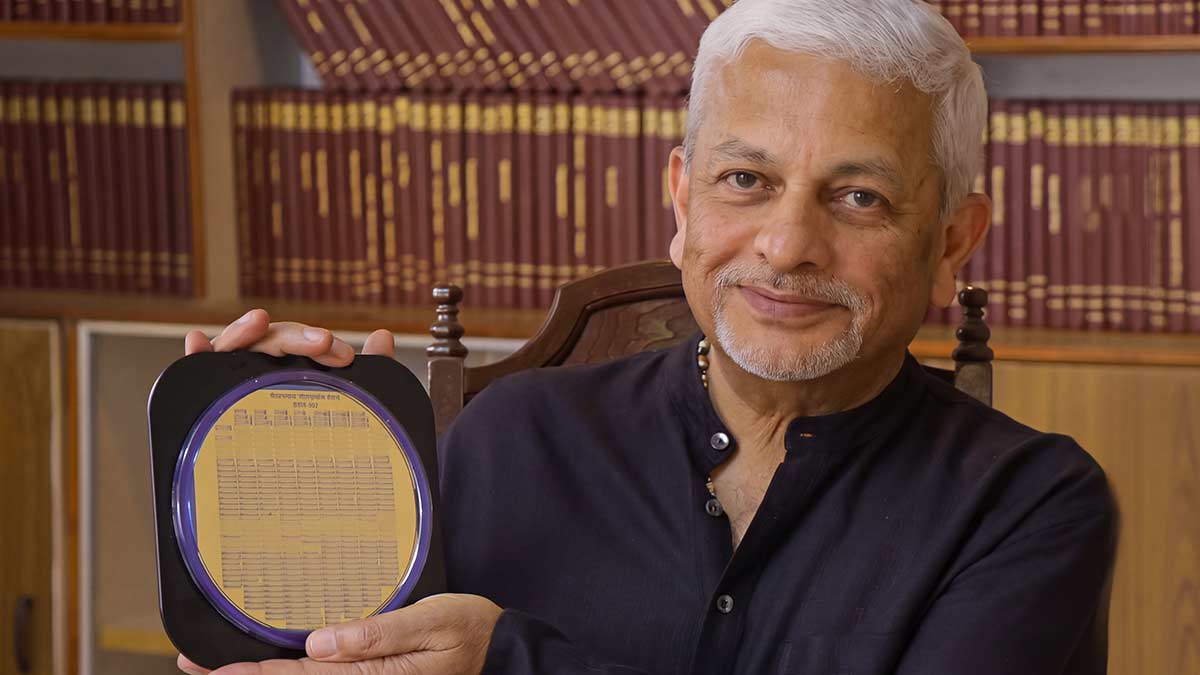
Cost, however, is a challenge. Hence, he turned to another method. Called Waferfiche, the technology uses silicon wafers and semiconductor fabrication techniques to physically preserve manuscripts. “Through a process called photolithography, we reduce manuscript images dramatically in size and permanently embed them on to a silicon wafer,” explains Mukund. “To read them, all you need is illumination and magnification, such as a microscope. The information exists physically on the wafer itself. It is extremely durable, waterproof, fire-resistant and highly stable.”
The idea was inspired by stone inscriptions that have survived for millennia, such as the edicts of Emperor Ashoka from the 3rd century BCE.
One of the manuscripts recreated using Waferfiche was the oldest known written manuscript of the Bhagavad Gita, dated 1492 CE and housed at the Bodleian Library, University of Oxford.
“I made two trips to Oxford in an effort to bring it back,” says Mukund. “Naturally, they were not willing to part with the original manuscript, but they did provide us with very high-resolution images. Using those images, we created a Waferfiche version of the manuscript.”
Copies were presented to the Prime Minister’s Office, the Krishna Matha in Udupi and the Union ministry of culture.
Waferfiche, however, is expensive. It requires sophisticated semiconductor fabrication facilities and clean-room environments, making it difficult to deploy widely.
Mukund’s team is now experimenting with another approach: 3D printing. “The trade-off is that it may not offer the same lifespan as Waferfiche,” he says. “But we are evaluating its long-term durability. It has tremendous potential because of its lower cost and ease of deployment.”
