



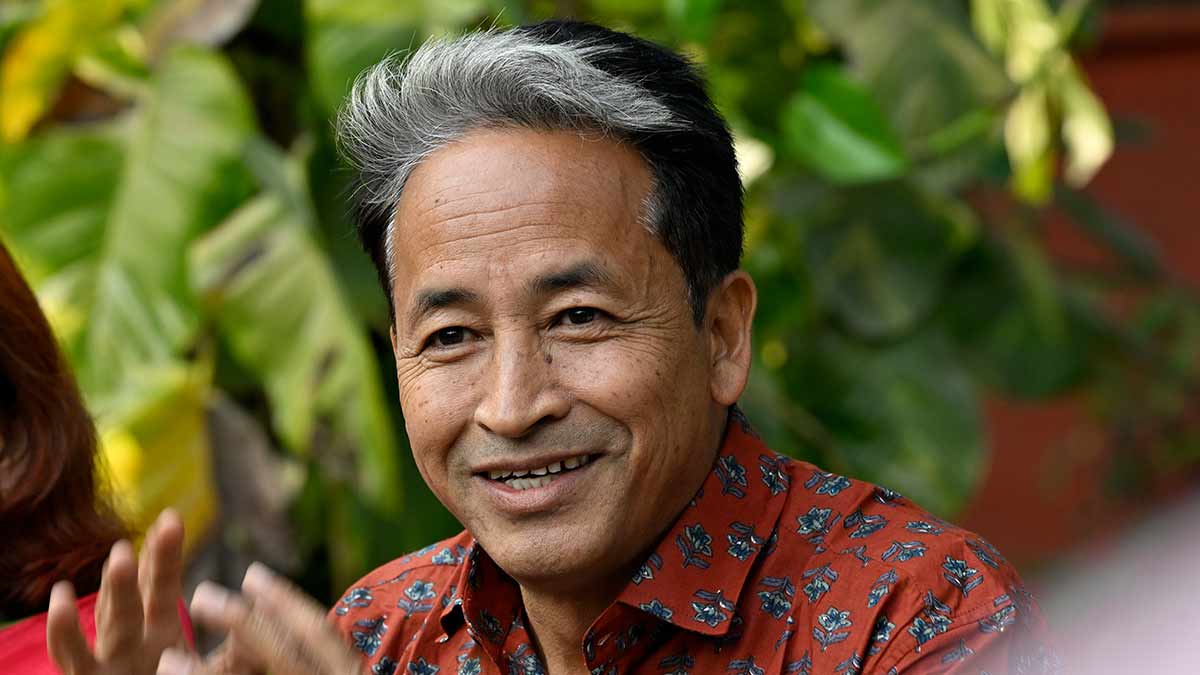
Interview/ Sonam Wangchuk, educator and activist
Q/ Successive governments have had to enact or change laws following mass protests—the anti-rape ordinance after the Nirbhaya protests, the repeal of the farm laws, and now education reforms. What does it say about the way governments engage with citizens?
Well, I’m happy that there is still a connect between sadak (the street) and sansad (Parliament). Our sansad is not totally awara (adrift)—it does listen to the sadak, to protest. But it shouldn’t take a rape and outrage to bring change in the system, nor should it take 700 farmers dying, nor the entire Gen Z coming out on the streets. I’m happy that our democracy is still alive in that sense, but ideally the government should be far more sensitive to public sentiment, and change should come more easily.
Q/ Safety valves are important for society to channel dissent and correct systemic failures. How can democratic institutions become more effective at performing that role?
Safety valves are definitely needed. There must be a protest site in every city that freely allows protests to take place—that is how the government senses the mood of the people. Instead, right now, these spaces of dissent are all controlled, and that only leads to bigger outbursts later. Apart from that, mainstream media should be a great instrument for sensing the mood of the nation. But with that, too, being controlled, there is no way for the government to sense unrest until it explodes. On top of that, we now have social media, which is a wonderful way for the system to sense what people are unhappy about. If given proper attention, these are amazing channels, and the country’s intelligence apparatus should be used to sense trouble before it takes an ugly shape, rather than repressing it and making things worse.
I hope the government learns from recent events and uses these channels to correct things before they escalate. As for how, let public institutions play their roles fully and freely: the judiciary, the media, intelligence. These are wonderful instruments available to the government to correct things rather than run into major crises, which carry a far bigger risk for the government than a story on media or social media. Maturity is needed to see that smaller outlets are far better than a collected, frustrated explosion.
Q/ You said the movement was about building an education system worthy of the country’s youth. How will Dharmendra Pradhan’s removal ensure that goal is met?
The education minister’s resignation is only the beginning, an acceptance of accountability. That’s important, like a patient accepting she is sick before treatment can begin. There should be reform not only of the examination system, but of the entire system that shapes today’s children and tomorrow’s citizens.

At the exam level, we may need to think out of the box—whether exams must remain the standard, identical multiple-choice sets for everyone, or whether we could have, say, four different sets of papers of equal difficulty, randomly assigned to students, making leaks harder. We should also bring reform to technical entrances—medical, engineering, administrative services—so they assess not just the ability to memorise answers through coaching, but aptitude and track record. For engineering, for instance, one random practical question—say, being asked to open and put back together a clock or a refrigerator—could reveal genuine aptitude. Not every one of the two million students would need to take that test; the mere possibility of getting such a question would push everyone to prepare for it. Those with real aptitude would rise to the top, and schools, too, would improve, because they would want their students to do well.
We need to align what we teach at the primary level today with what India—and the world—will need roughly 15 years from now; and at the secondary level, with needs closer to 10 years from now. This needs serious planning, so that we don’t end up training engineers we won’t need, leaving them unemployed, while under-training for fields the country actually requires, leaving those fields short-staffed.
Q/ How difficult was it to keep the movement issue-based when political parties were eager to claim or shape the narrative?
This was rather tricky. On one hand, I wanted every group, every ideology, every political outfit, to rally behind the students. At the same time, I didn’t want any of them to hijack it. Initially, the problem was not enough people coming on board, and later it became the opposite. It was important that all ideologies and political shades came together, including the ruling party, whom I kept appealing to because their children were suffering just as much, and they were as much a part of the problem as the solution. By and large, we succeeded in getting everyone on board, and that in turn made it harder for the government to ignore, since various political groups were gaining from supporting it and the government risked being the one left out, especially once a large number of intellectuals began supporting the movement.
Q/ Why do you think this movement resonated so deeply with India’s middle class, in a way many previous student protests did not?
Big revolutions normally come when even a single person gives up his or her life out of agony and pain—like Mohamed Bouazizi in the Arab Spring, or various movements where people self-immolated. In this case, more than 20 young lives were lost—driven to suicide—and yet it had all happened quietly. What I tried to do was present [them] as martyrs who had suffered because of the system. I think that resonated, because for students, it meant so many of their own giving up their lives; and for parents, it meant it could just as easily be their own child.
Q/ When you decided to end the hunger strike, you said you received written assurances on key demands. How did that come about? Sceptics were worried the government had put pressure on you.
Not just whether there was pressure, but also rumours about some Congress MPs mediating a deal between me and the government. These couldn’t be more baseless. If there was any pressure, it was from me on the government. There was no reason for the government to pressure me. As the movement grew, especially after my forceful removal from Jantar Mantar to hospital and the march on July 20, the government came under real pressure. The approach came not through any political party, but through agencies like the Intelligence Bureau, which acted as intermediaries. There was a whole security presence outside my hospital—at Safdarjung and later Medanta—and IB officers would come with messages from the government, very politely, asking if I would talk to certain people. I said I was open to talking to anyone. That’s when they said two ministers were coming, and I agreed.
In the first meeting, their opening appeal was about my health and breaking the fast. I clarified I was there for a reason, and they would have to hear my conditions. I put forward three: the education minister’s resignation, compensation for the affected students, and—with the treatment of CJP leaders in mind—an assurance that no legal or police cases would be filed against students. They showed reservations on the resignation, but were fairly open to the other two, especially compensation. On the legal cases, they were hesitant at first, offering only a verbal assurance, not a written one. I insisted on a written one.
By the second night, given how the movement was growing—with the CJP pushing hard on resignation—I decided I need not press so hard on it. Instead, I focused on ensuring there would be no legal action against the students, particularly those who had marched to Parliament, since I felt a personal responsibility for having called for that march. After several rounds of back and forth, by the night of July 23, the ministers agreed to a written assurance on the legal cases, along with compensation, and came to help me break the fast.
On the resignation, I could have pushed harder, but I saw it coming regardless, and—more importantly—I was genuinely alarmed by how things were developing that night. If you look back at social media from July 23, it looked frightening: influencers warning something big was coming, metro stations being covered up, battalions of forces being brought in from Bengal and Kashmir. It felt like a crackdown was imminent, and it reminded me of what happened on September 24 last year in Leh, when police and security forces opened fire—with live bullets, aimed to kill, not pellet guns. Only the skill of doctors kept the toll at four, though 10 to 15 were critical. That was the carnage I feared, at a national scale this time. So I chose to let go of the resignation demand and secure the written legal assurance instead. The draft was brought to me, I checked it, and then came the question of how to break the fast.
I had wanted to break it in the presence of leaders from different political parties and student leaders, along with the Ladakhi leaders who had come to Delhi. But the ministers arrived around 12:30 at night—by design, perhaps—when it wasn’t possible to gather everyone. The only people available were the Ladakhi leaders, so I insisted at least they be present, and I broke the fast with them there, alongside the ministers.
There was zero pressure from the government on me—if anything, the pressure ran the other way, because they were as keen to avoid violence as I was.
There were some [remarks] from political commentators about why I accepted soup from ministers of the very government we were protesting against. I wondered about this myself for a couple of days before I understood it was largely a cultural difference between Ladakh and the rest of India. In Ladakh, we have a long tradition of hunger strikes—from my father’s time and mine—where, when the government concedes to your demands, its representative comes and feeds you; that is considered a mark of victory. It is only when you fail in your protest that you break the fast with, say, a young girl or an elderly woman instead. In 2024,during protests outside Ladakh Bhawan in Delhi, when we succeeded in getting the government to the table, the home ministry secretary came and gave me a glass of juice—that was acceptance of victory. Earlier, when my 21-day fast in Leh did not lead to any government concession, I broke it with a young girl serving juice. My father’s (Sonam Wangyal) fast in the 1980s was broken by Indira Gandhi herself.
Beyond the cultural reason, there is also a personal one. I see no reason to hate government representatives. We are all citizens of the same nation; wanting change in government doesn’t mean hating every leader in it. Even coming out of Jodhpur jail (he was detained under the National Security Act in 2025), journalists asked me where my anger was—I told them I don’t carry that kind of anger. I see it as an objective struggle, without hatred, in the spirit of ‘hate the sin, not the sinner’, which is what we learn from Mahatma Gandhi.
Q/ Were there moments when you feared emotions could spill over and derail the movement?
My fears peaked on the night of July 23, because that felt like the night things were most likely to spiral into full-blown violence. People have told me since that I could have held out three or four days longer and become “the” reason for the outcome. Honestly, I’m happy things unfolded as they did—I didn’t want to hog the credit. I broke my fast before the resignation was even accepted, so that the credit would go to young people, making it a statement about an entire generation rather than one individual. I think that outcome serves the country far better.
Q/ Several young protesters described this as their generation’s first real political awakening. Do you think the movement can change the relationship between Gen Z and the Indian state?
I am glad the credit for this went entirely to Gen Z, which raises their standing in the eyes of the nation, the state, and their own parents. I hope this has a snowball effect—that it builds self-belief and self-worth in this generation about their own potential, and encourages them to behave as serious participants in nation-building. I believe it will lead to them taking on a more serious role, with the state and society treating them with greater respect.
Q/ If you were to advise the government on education reforms, what are three changes you would recommend?
My first recommendation is an out-of-the-box approach to making these exams leak-proof. Right now, the exam wags the education system, rather than the other way around. Introducing experiential or aptitude-based components could push schools to build hands-on capability.
Second, I think it’s an enormous waste of national resources to run two parallel systems—schools and coaching institutes—duplicating the same work, while schools charge high fees and become redundant, with the real preparation happening in expensive, exclusive coaching centres. This is deeply unequal: families must pay twice, which is nearly impossible for lower-middle-class and poor families.
To fix this, we should phase out the coaching culture. In the past, board exam results were themselves the basis for entrance into technical institutes; entrance exams came later, and coaching institutes grew around them, eventually making the board exams almost meaningless. If we combine the two again—a genuinely reformed board exam that also serves as the entrance exam—coaching institutes would lose their purpose, schools would once again take pride in their results, and children wouldn’t have to waste a year and a fortune in coaching hubs.
Coaching, where it remains, should be reserved for underprivileged and weaker students—perhaps from reserved categories—supported by the government, so it functions as remedial help to bring the left behind to equal ground, rather than as an edge for the already privileged.
Third, I would recommend reform within schools themselves—specifically, introducing far more experiential, student-led education. In Ladakh, the school we established runs largely on student self-governance—a student-formed “government” manages everything from cleaning, kitchens and libraries to assemblies, excursions and guest invitations. Younger children need adult care, but from the middle-school stage onward, students are far more capable than we give them credit. Given responsibility and respect, they grow into capable, responsible citizens; right now we do everything for them and are then surprised when they behave with the frustration and rebellion typical of neglected teenagers. Handing over real governance of the school to students—as practical application of leadership, civics and political science—could even reduce staffing needs and free up teachers for creative planning rather than day-to-day management.
Q/ Throughout the movement, your wife and family were by your side. Doesn’t the experience make them cynical or bitter?
No, because they understand it is for a larger, important cause. Before I begin such a protest, they caution me strongly, because it takes a toll on my health and on the whole family. But when it is necessary for a larger cause, everyone eventually comes around. This time, as before, there was a lot of disagreement; everyone felt I shouldn’t put my life at risk, since even if it doesn’t kill you, it can cause irreversible damage to the brain and organs. So they protest against my protests. But once I make the decision, they respect it.
Q/ Do you believe the movement has ended, or has it simply entered a new phase where citizens must now monitor whether promises are implemented?
I feel it has only just begun. The resignation is simply the acceptance, or diagnosis, of a disorder—the treatment still has to follow. That’s what we should all look forward to now: bills passed in Parliament, laws enacted, and real measures deliberated to bring reform. I hope the government now takes these issues seriously—not just paper leaks, but education as a whole, which I’ve always felt has received far less attention than things like subsidies on rice or gas.... In a democracy, leaders tend to follow what people prioritise. I hope this generation—backed by their parents—taking education seriously results in a real overhaul of the system, because this is central to India’s prosperity and its place in tomorrow’s world.
Q/ The disenchantment isn’t limited to education—there are concerns about jobs, environmental issues, delayed justice, and so on. Should we brace for more street protests?
My hope is that this movement leads to better governance overall—that it opens up the government’s willingness to engage with citizens, not only on education, but on employment, the economy, environmental issues and more. I hope it doesn’t take another protest each time. I’ve been advising the youth to keep platforms like the CJP as a clean, pure space for issues that need attention, rather than turning it into a conventional political party—though its members are free to join any party or start new ones. If this platform can retain the sanctity with which it began, it could play a huge role in shaping this country for the better. That’s my hope.
