



Moscow
RUSSIA
You cannot overstate the surprise of a Russian traveller landing in South India, only to hear names such as Lenin, Stalin, Brezhnev and Gagarin. Westerners find it even funnier, often assuming it is a joke. But take a short stroll through the towns of Kerala, where red communist flags still splash across walls, and any Russian over 50 feels a vivid jolt of memory.
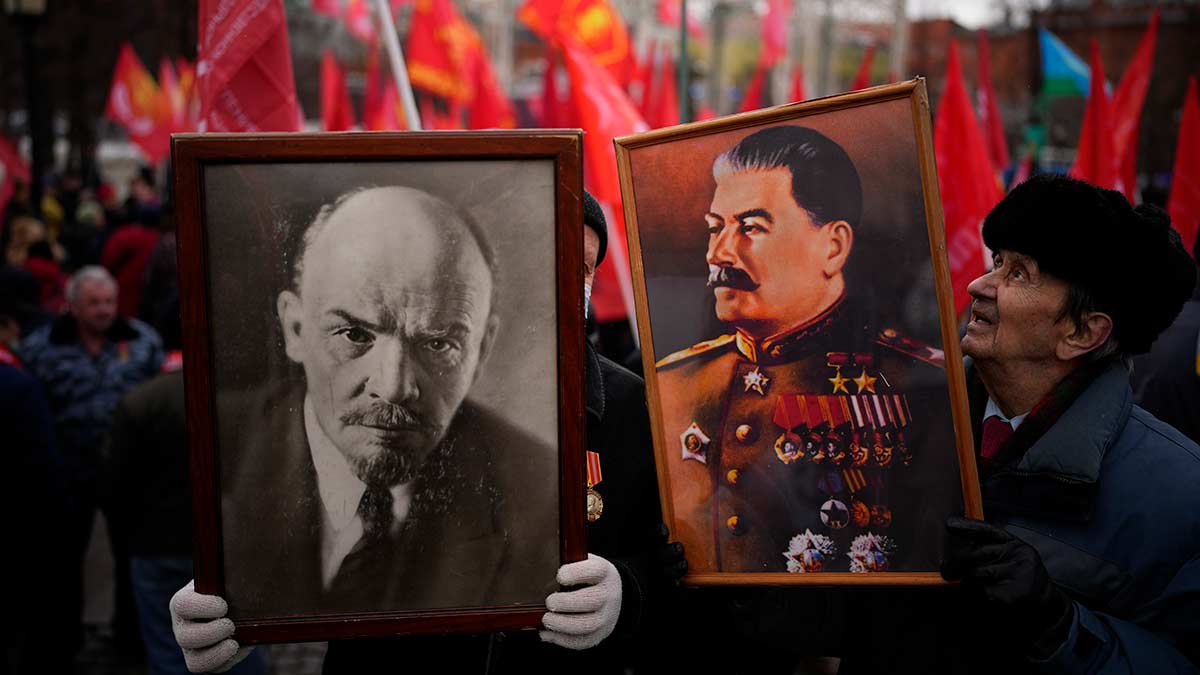
In Russia today, the Communist Party (CPRF) remains the second most popular political force, trailing only the ruling United Russia. Today's CPRF is Soviet-nostalgic but not Stalinist in the way the west understands the term. It resembles a moderately conservative party occupying a social-democratic niche and remains highly loyal to the Kremlin.
Russian communism emerged in the early 20th century as a response to the challenge of economic development. Before the revolution, Tsarist Russia lagged significantly behind its European rivals, with widespread poverty, low literacy rates and much of its modern industry under foreign control. Prime minister Sergei Witte famously warned that Russia had to "catch up with Europe" and accelerate its industrialisation or risk becoming a "second China", a country dominated and carved up by colonial powers.
In 1918, Lenin defined Russian communism as "Soviet power plus the electrification of the whole country". It was a formula that served the needs of development and consolidation more than any ideological doctrine. The USSR developed its own model and, for decades, one-third of humanity lived within its orbit. Soviet power stretched from the Elbe, the fault line of a divided Europe, to the mangrove swamps of Vietnam.
And yet, communism fell.
Today, the third generation since the collapse is graduating from school, people who have never lived a single day under the Soviet Union. Yet, subconsciously, the event still feels recent, unfinished and not fully processed. The entire Soviet period of Russian history, and the break-up of the USSR, conceal many uncomfortable truths on which consensus remains unlikely any time soon.
WAS THE SOVIET UNION DOOMED?
In the conventionally liberal camp, one often hears that the USSR was never going to survive in the long run. Its very design was flawed, especially its economy. From 1950 to 1980, the Soviet economy moved from rapid post-war growth to a deep slowdown that became stagnation by the early 1980s.
A comparison of Soviet and US economic growth shows that both expanded at similar rates, though from very different starting points. Western economies, thanks to their cyclical crises and the need for elected governments to respond to them, generally addressed problems as they arose.
In the USSR, however, problems accumulated and gradually became structural. The 1980s are particularly revealing. Soviet rhetoric constantly stressed the importance of scientific and technological progress. In practice, however, the economy grew not intensively but extensively, by pumping in more resources rather than through qualitative improvements.
The USSR's focus on the military-industrial complex, combined with the lack of competitiveness of its products, left little room for improving living standards. Moreover, the Kremlin's active foreign policy, a strategic necessity during the Cold War, directed substantial resources towards supporting allied countries. Billions of dollars' worth of energy, ammunition, weapons and equipment were supplied to friendly nations, often at subsidised prices.

Still, the Soviet economic system remained overregulated and increasingly inefficient. Soviet machine tools, engines and cars were often heavier and less efficient because of outdated designs, lower-quality alloys and a complete lack of incentives to economise. Resources were artificially cheap, so factories had no economic reason to conserve anything.
In the mid-1960s, prime minister Alexei Kosygin tried to push through a limited economic reform that would grant enterprises greater independence. But it faced powerful opponents who regarded the new ideas as ideologically dubious and dangerous. Then oil money came flooding in.
In the mid-1960s, the Soviet Union launched the development of the vast oil and gas fields of Western Siberia. Thanks to this project, the USSR became a global energy leader. In 1975, it extracted nearly 500 million tonnes of black gold, overtaking the long-time leader, the United States. Then came the 1973 energy crisis, which quadrupled oil prices and provided a huge boost to the Soviet economy. Revenue from oil increased fifteenfold in just one decade. Needless to say, the USSR was at least as dependent on oil exports in the early 1980s as Russia is today.
Under the influence of these new financial flows, the Soviet leadership developed a firm belief that acute economic and social problems could be solved not through greater efficiency but through rising oil and gas revenues. The path towards systemic renewal was abandoned.
The key problem was that while hard currency was being spent on food and consumer goods, Soviet leaders almost never used oil and gas revenues for large-scale technological modernisation. This is why historians describe the 1970s as an era of missed opportunities for the Soviet Union. While Western economies were restructuring and laying the foundations for a post-industrial society, reducing the role of raw materials, the USSR not only preserved its industrial model, missing out on technological development and the IT revolution of the 1980s, but also doubled down on a resource-based economy, becoming increasingly dependent on hydrocarbons and global price trends.
Could Mikhail Gorbachev, who came to power in 1985, have done anything differently?
Towards the end of its history, the Soviet Union underwent a silent revolution at the top. For 20 years, power had been held by one generational cohort, those born between 1904 and 1918: Leonid Brezhnev and his comrades. Many of these Stalin-forged figures clung to their posts well into their seventies and eighties. But in the early 1980s, nature took its course.
When the 54-year-old Gorbachev became general secretary, he was, by Kremlin standards, practically a teenager. A popular anecdote from the time illustrates this: Brezhnev and Chernenko are talking in the afterlife: "Konstantin, who's ruling in our place now?”
“Misha Gorbachev.”
“And who supports him?"
“What's there to support? He can still walk on his own.”
Gorbachev could have taken steps to streamline the economy and public spending, reduce military expenditure and begin a systematic transition away from the centrally planned economy. Instead, Gorbachev's team began with two classic Soviet missteps: the "acceleration" of heavy industry and the anti-alcohol campaign. Looking back, at a time of deep political and economic crisis, he chose a losing path. He aligned neither with the conservatives nor with the reformers. He remained somewhere in the middle, above the struggle, pursuing a compromise that constantly slipped out of reach.
Sociologist Yuri Levada observed that public disappointment with Gorbachev emerged when the country faced a severe economic crisis, shortages and falling living standards. The masses wanted the reformer to solve everyday problems, but all he could offer was political debate. By 1991, Levada wrote, Gorbachev had lost the trust of almost every social group.
In foreign policy, the USSR surrendered its positions in Eastern Europe. Moscow accepted the "unification" of Germany, or more accurately, the absorption of East Germany by West Germany on the latter's terms, clearly contrary to Moscow's interests. The dissolution of the Warsaw Pact followed, causing the USSR to lose control over its former allies and opening the way for NATO's eastward expansion. The positions the Soviet Union had secured in World War II were lost.
Perestroika backfired. Conditions worsened on every front. That was when Article 72 of the Constitution, the provision allowing republics to leave the USSR, began to be discussed seriously. Yet there was an even deeper trauma in people's hearts. On the one hand, many acknowledge the importance of glasnost, free speech and democratisation. On the other, most blame the first Soviet president for the country's collapse and the social upheaval that followed.
THE REAL COMMUNIST
In today's Russia, people increasingly talk about the return of the "Soviet system". Each generation understands it differently. Those who know communism only through history textbooks view the tightening of controls, driven by the fact that Russia has effectively been in a state of war for years, as a negative development. Others, usually a bit older, agree to accept it as a part of the country’s fight against those trying to destroy it, once again. A way to defend what they see as Russia’s national interests. They want their country to be as powerful and respected as the USSR once was and, with Russophobia spreading across the west, particularly in Europe, their voices are gaining strength.
In western discourse during the 1990s, the term "Homo Sovieticus", coined with scientific precision and heavy irony by philosopher Alexander Zinoviev, became popular. Even Zinoviev, a dissident who lived a turbulent and ambiguous life in the Soviet Union and eventually wrote a book about the uniqueness of its citizens, could not make up his mind: "My attitude toward this creature is ambivalent: I love and hate it at the same time, respect and despise it, admire and am horrified by it. I myself am Homo Sovieticus. That's why I am cruel and merciless in describing him."
Much of what the Soviet person left behind as an inheritance, however differently interpreted, remains visible in daily life, politics and culture.
Yuri Pivovarov, a prominent historian and political scientist at the Russian Academy of Sciences, argues in one of his lectures that while the communist idea and its practice "turned out to be short-lived, fragile", and communism is gradually being "outlived" not only in Russia but also in China and Cuba, what remains is Homo Sovieticus. "A person could be Russian, Uzbek, Ukrainian, Jewish, but in essence they were Soviet. A person who does not know their roots or history, or knows them selectively and one-sidedly. A person who has lost their connection to the religious world."
Generations were raised to believe that the Party and the communist idea were their only religion, family, law and history. They were taught to place their faith in a radiant future where today's suffering would be redeemed by tomorrow's paradise. At the same time, there was also a huge, and not unfounded, sense of pride. This was the nation that defeated fascism and sent the first cosmonaut into space.
Russia's modern realities are tied to the fact that Homo Sovieticus remains alive and thriving, in government, in factories and in offices. While many, especially outside the west, do not see this as entirely negative, the reality is that Russia will need several more decades to come to terms with its painful past, accept it and learn to love the country for what it is today.
In 2011, Sergei Karaganov, a prominent political scientist, foreign policy hawk and chairman of Russia's Council for Foreign and Defence Policy, proposed a programme called "On Perpetuating the Memory of Victims of the Totalitarian Regime and on National Reconciliation". Without implementing it, he argued, Russia would not move beyond its current condition. No modernisation, technological or political, would take place unless millions of "free, patriotic citizens" could take pride in their country, even if that pride remained bittersweet.
The project was immediately labelled in Russia as "de-Stalinisation". But Karaganov insisted it was actually about the "de-Sovietisation" of public consciousness, an attempt to "restore the self-respect of the people, the feeling of being masters of their own homeland".
That idea has yet to be realised.
The author is a Moscow-based journalist and India editor at RT.
