



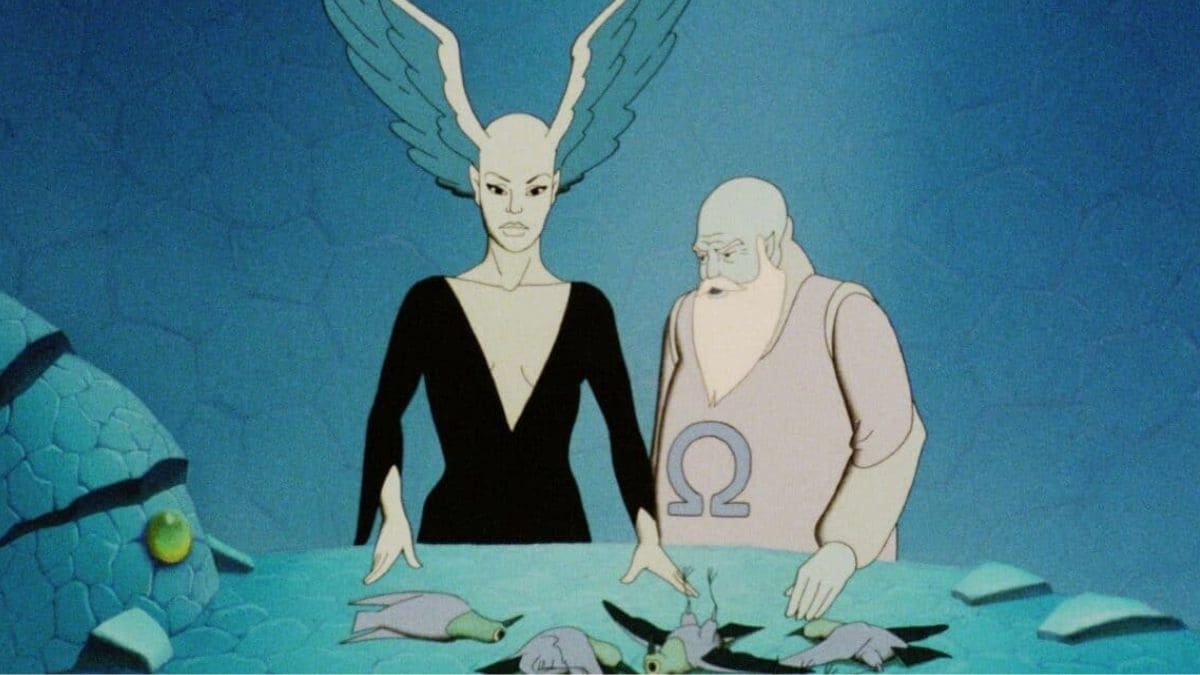
René Laloux’s cult science fiction animated film “Gandahar” is returning to cinemas in a stunning new 4K restoration, giving audiences a chance to experience the film as it was originally intended. Janus Films will release the restored version in theatres beginning on August 28, 2026, starting with an exclusive premiere at the IFC Center in New York City before expanding to cinemas across the United States.
The newly released official trailer highlights the film’s beautifully restored visuals, bringing fresh life to the colourful and imaginative animation first seen in 1987. For many fans, this release is especially important because it restores the complete French version of the film. American audiences originally saw a heavily edited and re-dubbed version in 1988 titled “Light Years”, released by Miramax. That version featured a revised script polished by science fiction writer Isaac Asimov, but removed scenes and altered parts of the original story. The new restoration presents “Gandahar” in uncut form and includes Gabriel Yared’s original musical score, allowing viewers to experience Laloux’s vision in full.
“Gandahar” tells the story of Sylvain, a young warrior sent by a council of wise matriarchs to investigate a growing threat to their peaceful world. A powerful army of metal machines is sweeping across the planet, turning people into stone wherever it goes. As Sylvain travels beyond the safety of his homeland, he meets a group known as “the Deformed,” mutated survivors of failed scientific experiments. Together, they embark on a journey through strange landscapes and even through time itself to confront the mysterious force behind the invasion — a giant, intelligent brain called Metamorphis.
The film is remembered not only for its imaginative story but also for its unforgettable visual style. The surreal creatures, landscapes, and futuristic designs were created by legendary French comic-book artist Philippe Caza, whose artwork gives the film a dreamlike quality unlike almost any other animated feature.
“Gandahar” was the final feature film directed by René Laloux, one of animation’s most original filmmakers. Throughout his career, Laloux created films that combined philosophical ideas with imaginative science fiction, often working alongside some of France’s greatest comic-book artists.
His best-known work is “Fantastic Planet” (1973), made with writer and illustrator Roland Topor. The film imagines a world where giant blue aliens keep tiny humans as pets, exploring themes of power, freedom, and survival. Its distinctive cutout animation and haunting jazz soundtrack by Alain Goraguer helped it become an international classic, and it won the Special Prize at the 1973 Cannes Film Festival.
Laloux followed this with “The Time Masters” (1982), created in collaboration with the celebrated artist Moebius. The film tells the story of a young boy stranded on a dangerous desert planet while a group of space travellers races to rescue him. Blending adventure with ideas about time, memory, and telepathy, it remains another landmark of European science fiction animation.
Before directing feature films, Laloux also produced several influential short films. “Dead Time” (1964) is a haunting reflection on violence and cruelty, while “The Snails” (1965) is a darkly humorous tale about giant snails created by a farmer’s tears. His first short, “The Teeth of the Monkey” (1960), was made with patients at the Courthezon psychiatric clinic, where Laloux worked during the 1950s.
Nearly four decades after its original release, “Gandahar” continues to stand out as a unique blend of science fiction, fantasy, and philosophical storytelling. The new 4K restoration offers both longtime fans and new audiences the opportunity to rediscover one of animation’s most imaginative and visually striking classics on the big screen.
