



CHINA
Ever since China embarked on its “four modernisations” in 1978, marking the end of the Mao era, there has been an unending debate among Marxists as to whether it remains socialist at all. What began as a plan to modernise agriculture, industry, science and technology and defence soon became a programme of large-scale privatisation/disinvestment in state-owned industry, the return to private agriculture, and wooing foreign private capital to invest in China.
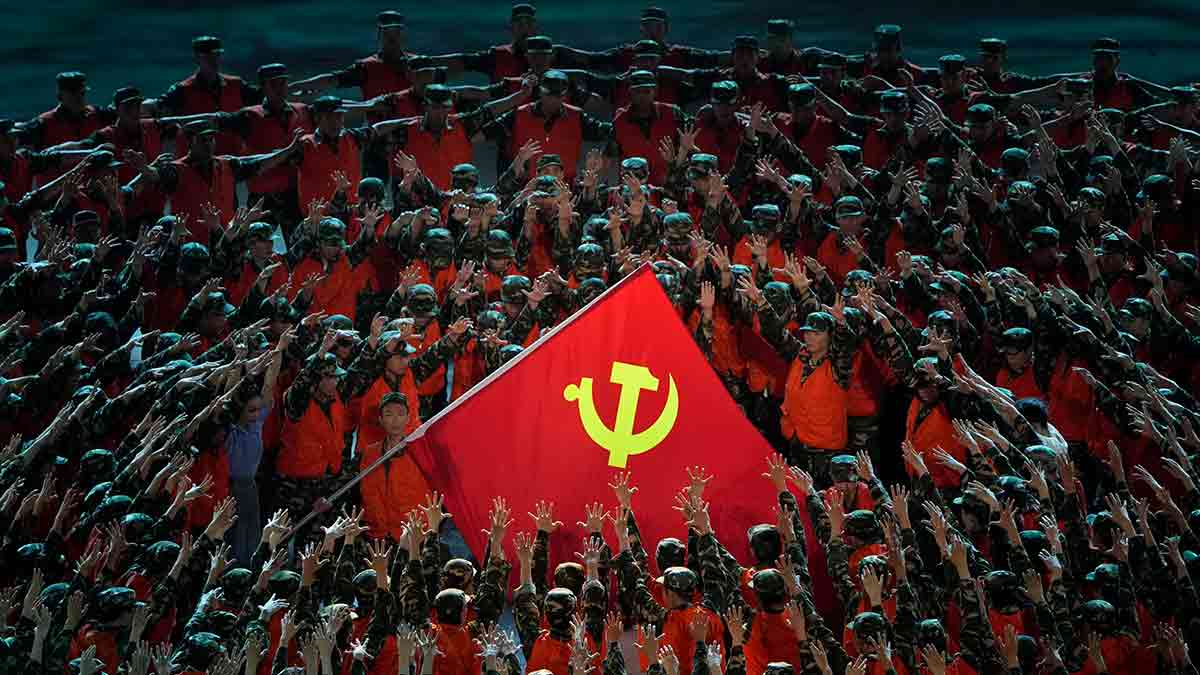
Initiated under Deng Xiaoping, this move towards privatisation was described by the Chinese Communist Party (CCP) as “socialism with Chinese characteristics”. This marked a shift from the Mao-era emphasis on “politics in command” to Deng’s slogan, “to get rich is glorious”.
The “opening up” of the economy was not, however, matched by any such thing in the political and intellectual arena and soon, the CCP was confronted with the 1989 Democracy movement, which was ruthlessly crushed with tanks in Tiananmen Square, under Deng’s leadership.
The economic shift was not “apolitical” by any means, for there was a clear preference for steering economic growth through individual accumulation. Over the years, this has also led to the growing precarity of a large number of Chinese workers, especially those coming from rural areas to work in the exploding construction industry. There have routinely been reports of a very large number of labour protests every year over low and unpaid wages. The number of such protests has dramatically increased since 2023 and these too largely relate to factory closures, low wages and poor working conditions.
Rural protests, too, have been taking place every year in different parts of the country. Most of these relate to land acquisition by the state, sometimes for mining and other economic activities but often also for building things like golf courses for the rich. For instance, one such big clash occurred in Longqiao Township in Hainan province in 2008, where the government had taken over 7,000 hectares of arable land for building a golf course, for which the farmers received very low compensation.
These are conflicts typical of capitalist economies and not the kind of problems workers ought to be facing in any “socialist” society. The stark fact is that it is the workers and peasants who bear the cost of China’s recent emergence as a world power.
Much of the debate on China, among Marxists, has revolved around the extent of private enterprise and the relative decline in the importance of the state sector, which continues to restage the twentieth-century “state versus market” dichotomy. It is well known that the terms “market” and “private enterprise” are anathema to orthodox Marxists and that explains the suspicions of critics regarding the direction China’s economy has taken.
While such a criticism is not incorrect, it is inadequately thought through and often quite misleading.
Most such critics of China reject private enterprise, small commodity production and trade per se, as being capitalist or as necessarily leading to capitalism, which is simply not correct. This criticism can be traced back to Lenin who argued, in the early days of the Soviet Union, that “small-scale production engenders capitalism and the bourgeoisie continuously, daily, hourly, spontaneously and on a mass scale”. However, the same Lenin had to abandon the “war communism” of those early years and embark on the “new economic policy” (NEP) very soon, reintroducing private ownership and trade among the peasants.
The turn to the NEP is generally presented as a “strategic retreat” but never theorised by Marxists. The fact is that allowing small-scale private enterprise has repeatedly been found inescapable by all kinds of communist-led governments, including the CCP. Market and trade have been with humanity from ancient times and in themselves do not constitute capitalism. In fact, there was never a smooth transition to capitalism from such private small-scale production. The relatively freer markets of earlier times actually had to be destroyed before capitalism could take root.
Equally importantly, such an understanding fails to see that the defining feature of capitalist accumulation is the exploitation of social labour (through unpaid wages, long working hours) and of the environment through unpaid costs of polluting and devouring the commons like land, water and forests. Capital, unlike private small-scale production, cannibalises everything in the interests of its endless expansion and accumulation. From that point of view, the Chinese communists have clearly embarked on a path that is difficult to characterise as socialism.
It should also be underlined that “socialism” cannot have any meaning except as a radicalisation of democracy. A system based on authoritarian one-party rule can hardly qualify to be called socialist, even if it manages to reduce extreme poverty, which China has indeed done.
Aditya Nigam, formerly professor at the Centre for the Study of Developing Societies, is a political theorist based in Delhi.
