



LATIN AMERICA
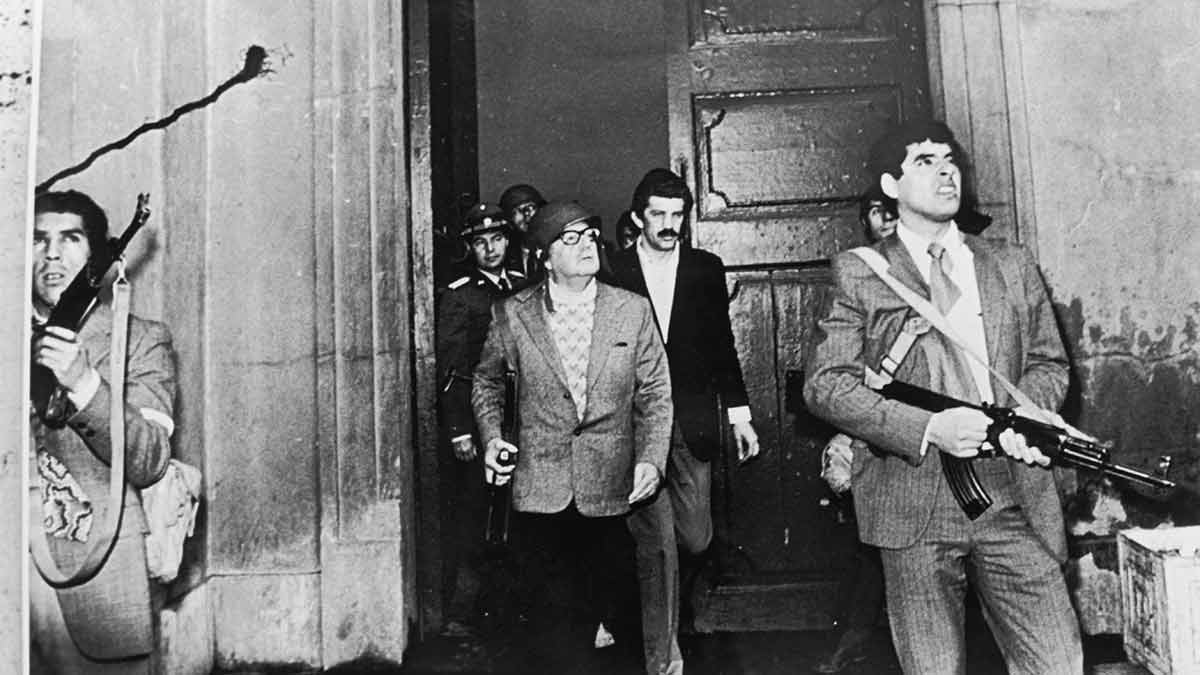
They came for him in the morning. Salvador Guillermo Allende Gossens, the first elected Marxist president in Latin America, knew what lay ahead, and turned down a safe passage suggested by his supporters. Allende was a fighter and would exit on his own terms. “Feet first,” as his niece, the writer Isabel Allende, would recall years later.
As army chief Augusto Pinochet’s men started bombing the Chilean presidential palace, Allende addressed his people on live radio. It was 9:10am on September 11, 1973. “This will be my last opportunity to address you,” he kicked off, and proceeded to single out the generals who betrayed him. “I will pay with my life for the loyalty of the people,” he said.
The address lasted 6 minutes and 20 seconds. Allende then ordered his guards to surrender and retreated to the Independence Salon on the second floor of the palace, which was once a mint. Shortly after 2pm, two shots were heard from the Salon. An infirmary staff, who had rushed upstairs to retrieve his gas mask, pushed the door open only to find the president dead. An AK 47, a gift from his friend Fidel Castro, lay by his side. It was Latin America’s tryst with 9/11.
Chile was a symbol of democracy in Latin America and Allende’s death shattered that image. For the next 17 years, Pinochet led a brutal regime, which ended after international intervention triggered a constitutional referendum in 1989.
Allende’s tenure was marked by economic instability, food shortage and general unrest. The US was not comfortable with his election, and when Fidel Castro visited Chile in 1971, it sealed his fate.
After the coup, the junta hounded people close to his government. One of them, Brigadier General Alberto Bachelet Martinez of the air force, was arrested on charges of treason and tortured at Santiago’s Public Prison. Martinez died in custody. In 1975, his wife, archaeologist Angela Jeria Gomez, and 24-year-old daughter, Michelle Bachelet, were tortured at the detention centre. Upon her release a few weeks later, Michelle first moved to Australia and then to East Germany, where she studied medicine. She became Chile’s first woman president in 2006.
In Cuba, a communist government came to power through the barrel of the gun. Castro was drawn to the left ideology at Havana University, where he studied law. He was a candidate for the House of Representatives in the June 1952 elections, which never took place as General Fulgencio Batista staged a coup in March.
Castro tried to overthrow Batista on July 26, 1953, by staging an attack on the Moncada Barracks. It was a spectacular failure, and Castro and his accomplices were arrested and convicted. In jail, Castro formed the 26th of July Movement. He was later pardoned by Batista, who had been ‘elected’ unopposed as president in 1954. Castro, along with his brother Raul, organised violent uprisings against Batista and had to leave Cuba for Mexico.
In Mexico, Castro and Raul met with the Argentine revolutionary Ernesto Guevara de la Serna aka Che Guevara. Having witnessed the CIA overthrow the socialist regime of Jacobo Arbenz in Guatemala in 1954, Che wanted to erase US presence from Latin America. Arbenz’s crime? He nationalised the unused acres of the American behemoth United Fruit Company to be distributed among his landless people.
The Castros and Che assembled a small but well-trained unit, and sailed back to Cuba on a boat called Granma. They launched a fresh offensive against Batista from the coffee-producing Sierra Maestra ranges in December 1956. On January 1, 1959, Castro took Cuba.
Castro soon became a rallying point for the left and left-of-centre politicians in the region. Even though it is in the Caribbean, Cuba is considered Latin American, thanks to its Spanish colonial past. But unlike other Latin American countries rich in minerals and oil, Cuba’s main source of income has been tourism, with its beaches, old-world charm and antique vehicles. The sanctions imposed by the US over the years have crippled it and after the fall of the Soviet Union in 1991, Cuba started exporting to Venezuela two things it had in abundance—medical expertise and military and intelligence superiority—and got oil and other essentials in return.
What did the Venezuelans get in return? Experienced Cuban personnel in the secret police, key ministries and the armed forces. When the US troops captured president Nicolas Maduro and his wife in Caracas early this year, more than 30 Cubans died in action.
Today, Cuba is in dire straits. The US has stopped oil supply from Venezuela, power outages stretch for hours, food is scarce, hospitals are run-down. The general decline is evident from the piles of garbage on the streets of Havana and the abandoned vintage cars that were once the most visible symbol of la Habana.
While US President Donald Trump talks about wiping out communism and replacing Cuban President Miguel Díaz-Canel, the Castros have retained their stranglehold on power. It has been 10 years since Fidel Castro’s death and eight years since Raul made way for Díaz-Canel. But Raul, 94, is still consulted on all the key decisions.
Raul’s great-nephew Oscar Perez-Olivia Fraga, 55, is the deputy prime minister and could succeed Díaz-Canel if he wins Trump’s trust. He was behind the recent decision to allow Cuban expats and exiles to invest and own businesses in the country. That is a major departure from Che Guevara, who as industries minister nationalised all businesses. Fraga also controls tourism, finance and imports (40 per cent of the economy).
Raul’s grandson and bodyguard Raúl Guillermo Rodríguez Castro aka Raulito, 41, is Raul’s ‘gatekeeper’ and the main touchpoint for Trump’s officials. Born with six fingers on one hand, Raulito is called the crab (‘El Cangrejo’).
The charismatic Hugo Chavez, a military officer who became Venezuelan president in 1998, was neither a communist nor a Marxist. His ‘Bolivarian Revolution’ was named after Simon Bolivar, who fought the Spanish army. Karl Marx had absolute contempt for Bolivar. In a letter to Friedrich Engels, he wrote that Bolivar was the “most dastardly, most miserable and meanest of blackguards”. His military achievements, Marx felt, were exaggerated.
Chavez died in office in controversial circumstances. His death was announced on March 5, 2013. Nicolas Maduro, who succeeded Chavez, claimed imperialist enemies had infected his predecessor and kicked out US embassy officials from Caracas. The opposition claimed that Chavez had died many days before in Cuba, and the news was suppressed to ensure a smooth transition. Maduro hung on to his chair for 13 years, until Trump abducted him and his wife on the night of January 3. Since then, the daughter of a Marxist guerrilla who died in police custody, Delcy Rodriguez, has been ruling the country as acting president. She had been executive vice president under Maduro.
Chavez’s election was a significant moment for Latin America. It triggered the Pink Tide, a term widely believed to have been coined by a New York Times journalist, Larry Rohter. Explaining the election of Tabare Vazquez as the first socialist president of Uruguay in 2004, he wrote that it was “not so much a red tide” but a pink one. While ‘red’ is usually associated with hardline communism and total control, ‘pink’, he reasoned, was more apt for moderate socialist leaders who come to power through elections and who believe in market economy.
Vazquez was an oncologist and anti-tobacco crusader. Under him Uruguay became the first South American country to ban smoking in indoor public places. He introduced health reforms and technology for the poor. The percentage of people living in poverty fell from 30.9 to 12.7; unemployment percentage dipped from 12.7 to 7.
As the Uruguayan constitution does not allow successive presidential terms, Vazquez had to make way for the charismatic José Alberto ‘Pepe’ Mujica Cordano, a former revolutionary who led the simplest of lives. President Pepe legalised same-sex marriage, marijuana and abortion. He donated 90 per cent of his salary—$12,000 a month—to charities that supported the poor and small enterprises, and drove a 1987 Volkswagen Beetle, his costliest asset in 2011.
Pepe has been a critic of the left regimes of Daniel Ortega (Nicaragua) and Maduro. He called Russian President Vladimir Putin a son of a bitch for invading Ukraine.
Returning to power in 2015, Vazquez focused on non-communicable diseases, but his popularity dipped because of the misdeeds of his vice president, Raul Fernando Sendic. A few months after stepping down, Vazquez died of lung cancer in December 2020. After a five-year gap, his party returned to power last year and a history teacher, Yamandú Ramón Antonio Orsi Martínez, became president.
Vazquez had excellent ties with the heads of neighbouring countries, particularly Luiz Inácio Lula da Silva, who was elected president of Brazil in 2003. Lula was born in a poor family of farmers as the seventh of eight children. His father deserted them when Lula was two weeks old, taking a younger cousin of the mother with him. Lula learnt to read and write at the age of 10 after the family moved to Sao Paulo in search of the father; he sired 10 children with his second wife.
At the age of 16, Lula lost a pinky, the little finger of his left hand, in an accident in a factory where he was working. Active in the union, he founded the Workers’ Party in 1980. He lost three presidential elections partly because of his hardline politics and casual dress. An image makeover did the trick in 2002. He won two successive terms and became one of the most loved presidents of the country despite allegations of corruption.
Lula hiked taxes and cut down government expenditure to fund projects to fight hunger, but two years into the term the effort had lost steam. There was a silver lining though: child malnutrition decreased by 47 per cent.
Like other Latin American left leaders who came to power in the Pink Tide, Lula was fortunate that commodity prices were booming (from 2003 to 2013). Thus, funding welfare measures was not an issue, but sustaining them was. Castro had befriended a young Lula and, as president, Lula invested heavily in Cuban infrastructure, particularly in the Port of Mariel, during his first two terms.
His popularity ensured the election of Dilma Rousseff as his successor. She named him her chief of staff, to shield him from investigation of corruption cases. It did not work; the Supreme Court annulled his appointment.
Before the 2018 presidential election, the court sent him to jail, where he remained for 580 days. In 2021, the court found substance in the allegation that the lead prosecutor Deltan Dallagnol and the judge, Sergio Moro, had conspired to convict him. By then, Moro had become minister in the Jair Bolsonaro government. The court also threw out two other cases, enabling Lula to contest the 2022 polls. He became Brazil’s oldest president on January 1, 2023.
In Argentina, Peronism became an alternative to socialism. Peronism is neither capitalism nor communism, but a ‘Third Way’ that championed the empowerment of workers and economic nationalism. It is named after Juan Domingo Peron, who became president in 1946. He gave women the right to vote, built houses for the poor and made university education free, but suppressed dissent.
Well into his second term in 1955, Peron was ousted in a military coup, with tacit US support. After living in exile, he was elected president again in 1973 when Argentina returned to democracy. He died a year later and his wife, Isabel Peron, succeeded him. She herself was ousted in a US-backed coup in 1976.
Peronists and their Justicialist Party returned to power in 1989, with Carlos Menem at the helm. In 2023, they were voted out.
Che Guevara, born in Argentina, was killed in Bolivia in 1967, trying to ignite a revolution. Bolivia had to wait 39 years to get its first left-wing president. Evo Morales, from the indigenous Aymara community, was a coca farmer who became a trade union leader and, later, president in 2005. He nationalised natural resources like lithium, and the economy grew from $9.57 billion in 2006 to $42.4 billion in 2019. The number of people living in extreme poverty decreased from 38.2 per cent in 2006 to 15.2 per cent in 2019.
Morales won a fourth term in the controversial 2019 election, but resigned after mass protests. His Movement for Socialism (MAS) party came back to power in 2020 with former economic minister Luis Arce as president.
During the first Pink Tide, 15 of 21 (including Cuba) Latin American countries had either left, or centre-left or socialist presidents. The second Pink Tide roughly started with the election of Andres Manuel Lopez Obrador aka AMLO as president of Mexico in December 2018.
Currently, Latin America is experiencing an opposite tide, with many extreme right leaders coming to power. The latest in the list is Abelardo De La Espriella, the hard right populist who narrowly won the recent presidential election in Colombia. Neighbouring Peru has chosen another right-wing candidate, Keiko Fujimori, as its president. Good for Trump as he looks for partners in Latin America. Trump’s closest ally in the region is Javier Milei, the right-wing president of Argentina who recently announced that he would travel to Brazil to launch the presidential campaign of Jair Bolsonaro’s son Flavio.
Latin America was home to the first communist party outside of Soviet Russia. In the year of the Russian revolution, a wandering Indian, who travelled the world to raise money for a revolution against the British, dodged British spies in New York and landed in Mexico with his wife. M.N. Roy, 30, from a Bengali family of priests, co-founded the Socialist Workers’ Party in December 1917. It became the Mexican Communist Party two years later. Mexico’s current president Claudia Sheinbaum’s paternal grandfather Chon Juan Sheinbaum, a Lithuanian Jew, was a member of the Mexican Communist Party.
Roy was closely associated with the Communist International (Comintern) and Vladimir Lenin, and had voted for Leon Trotsky’s expulsion from Comintern. Trotsky, a critic of Joseph Stalin, was deported in 1929. He lived in various countries before settling in Mexico in 1937. Mexico’s most celebrated artist, Frida Kalho, and her husband, the muralist Diego Rivera, were members of the Mexican Communist Party. Kalho put up Trotsky at her Casa Azul (The Blue House) in Mexico City and had a brief, passionate affair with him. She called him “little goatee” and painted a Self Portrait Dedicated to Leon Trotsky in 1937. It was gifted to him on the anniversary of the Russian revolution. Trotsky hung it in his study.
After Kahlo and her husband started supporting Stalin in 1939, Trotsky moved out to another safe house in Mexico City, where he survived an assassination attempt by Mexican artist Davild Alfaro Siqueiros in May 1940. Stalin’s assassins finally broke into the safe house on the evening of August 20, 1940. Trotsky was killed by a single blow to his head with an ice axe.
Communism has survived in Latin America, not necessarily as outright left like Castro’s Cuba, a permanently irritating speck in the neighbour’s eye. And the ‘Tides’ are likely to continue whether the US likes it or not.
In 2006, five years after the 9/11 attacks brought down the twin towers in New York, president George W. Bush at the UN General Assembly spoke about the threat of extremism. A day later, Hugo Chavez went up the same podium. “The devil came here yesterday,” he said. “Right here. It smells of sulphur still today.”
And the smell of sulphur is the lived reality for Latin America even today.
