



WEST BENGAL
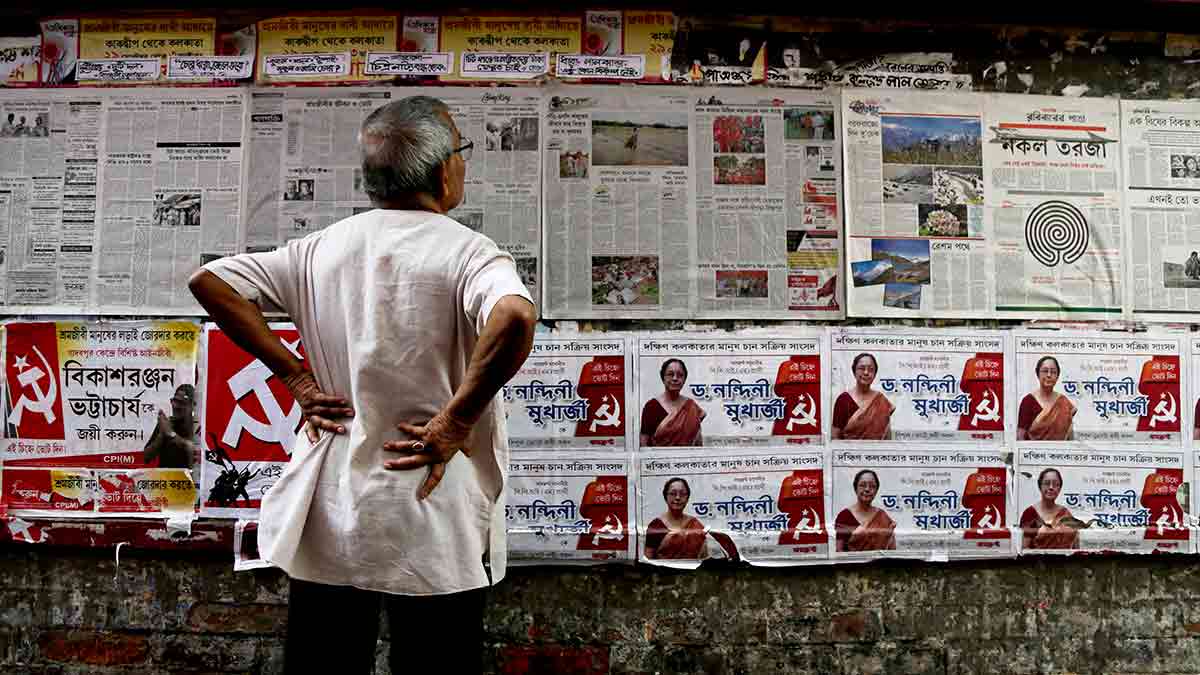
The BJP’s victory over the Trinamool Congress in the West Bengal assembly elections was celebrated with unusual enthusiasm by the CPI(M) workers. Social media was flooded with videos of left workers returning to reclaim long-abandoned party offices. In several places, BJP leaders reportedly facilitated the process, creating the unlikely spectacle of red and saffron coexisting in remote corners of Bengal.
“Ebar Ram, pore Bam” (“First Ram, then left”) has echoed across Bengal ever since the BJP emerged as the state’s principal opposition force. A substantial section of the traditional left vote shifted to the BJP, primarily to defeat the Trinamool.
After winning both Nandigram and Bhawanipur, Chief Minister Suvendu Adhikari openly acknowledged the role played by left supporters. “Of the CPI(M)’s 14,000 votes in Bhawanipur, 10,000 were transferred to me. I am thankful to them,” he said.
Many party workers and left intellectuals believe the Trinamool’s decline will eventually allow the CPI(M) to re-emerge as the principal opposition force. “Many CPI(M) supporters voted for the BJP only to uproot the Trinamool. Primarily, this was not a vote for the BJP but a vote against the Trinamool,” said Saira Shah Halim, left intellectual and author of Comrades and Comebacks: The Battle of the Left to Win the Indian Mind. “Many of the votes that went to the BJP to dismantle the Trinamool will now return to the left. This will become visible in the next municipal elections. At the grassroots level, the CPI(M) is rebuilding its organisational strength. Young leaders are emerging, and we are also reclaiming the rural vote.”
Many leaders, including CPI(M) state secretary Mohammed Salim, argue that the Trinamool has been losing ground rapidly since its heavy defeat in the recent Assembly elections. According to him, the party is “melting faster than ice”. The party points to developments such as the recent Falta repoll to support that claim. After the Trinamool candidate withdrew on the final day of campaigning, the CPI(M) candidate finished second with 20 per cent of the vote.
The CPI(M)’s rural influence is indeed showing signs of revival in a few pockets. One example is Domkal, where Mustafizur Rahman became the sole CPI(M) candidate to secure victory after the party’s five-year absence from the assembly. “Ordinary people still believe in the CPI(M), and once trust is restored, more people will return to us. People understand that only the left can address their real problems,” said Rahman, popularly known as Rana.
However, the CPI(M)’s optimism is sharply contested by its political opponents. “In politics, nothing is permanent and electoral dynamics change every decade. But it was the CPI(M) that supplied its cadres to the BJP and indirectly legitimised hindutva politics,” said Mohammad Tauseefur Rahman, Trinamool MLA from Basirhat Uttar.

Even if the Trinamool continues to weaken, the CPI(M)’s path back to political relevance remains far from assured. A sizeable section of its former supporters has embraced the BJP’s ideological narrative, and it will be difficult for the party to win them back.
Many observers argue that the ideological drift began when the CPI(M) entered into an understanding with the Congress during the Siliguri Municipal Corporation elections in 2015. “It opened the floodgates. If workers could vote for the Congress, they began to believe they could vote for anyone,” said Rajib Das, a retired college professor from Siliguri.
“Historically, once the left loses power, it has struggled to return. Moreover, people still remember the previous left regimes and do not necessarily want it back,” said Shankar Ghosh, BJP MLA from Siliguri, who was once a prominent DYFI leader. He is now a minister in the Suvendu Adhikari cabinet.
The CPI(M)’s path to revival is fraught with challenges. The party’s ideological appeal has diminished, its once-powerful trade unions across Bengal’s industrial belt have weakened considerably, and the party faces an acute financial crisis.
Many political observers say the CPI(M) currently offers little that inspires younger voters or presents a compelling political vision for the future. Although the party may marginally improve its vote share and perhaps increase its seat tally, reaching double digits in the assembly still appears a distant prospect.
Several attempts by the CPI(M) to regain political relevance through issue-based agitations and mass movements have failed to produce lasting electoral gains. The RG Kar protest movement, triggered by the rape and murder of a postgraduate medical student at the state-run hospital, initially appeared to offer such an opportunity. The “Reclaim the Night” campaign drew thousands of young people and women, many of them apolitical, onto the streets. Senior advocate Bikash Ranjan Bhattacharya, the party’s last Rajya Sabha MP from Bengal, represented the victim’s family in court, while several of the movement’s early organisers were associated with the CPI(M)’s youth wing.
“We later realised that the CPI(M) was trying to use the agitation for political mileage. Many of the doctors at the forefront of the movement were CPI(M) supporters. We understood this very late. Now we see the leaders are running away without talking to us when they face us,” said Shekhar Ranjan Debnath, father of the RG Kar victim and husband of Ratna Debnath, now a BJP MLA.
As the movement evolved, the CPI(M)’s youth leaders who had helped drive the protests gradually lost their influence, while the BJP emerged as the principal political beneficiary. For many observers, it reflected the party’s broader inability to convert street mobilisation into sustained electoral support.
Yet, despite its electoral decline, few expect the CPI(M) to disappear from Bengal’s political landscape. The party remains capable of mobilising tens of thousands of supporters for Brigade Parade Ground rallies and continues to play an active role in issue-based protests. Its influence within trade unions, student organisations and sections of civil society also gives it a political presence beyond the ballot box.
Ultimately, the CPI(M)’s prospects may depend as much on the fortunes of the Trinamool as on its own organisational revival. Many within the party believe that only a sustained erosion of the Trinamool’s support base, particularly among minority and rural voters, will create the political space necessary for the left’s return.
