



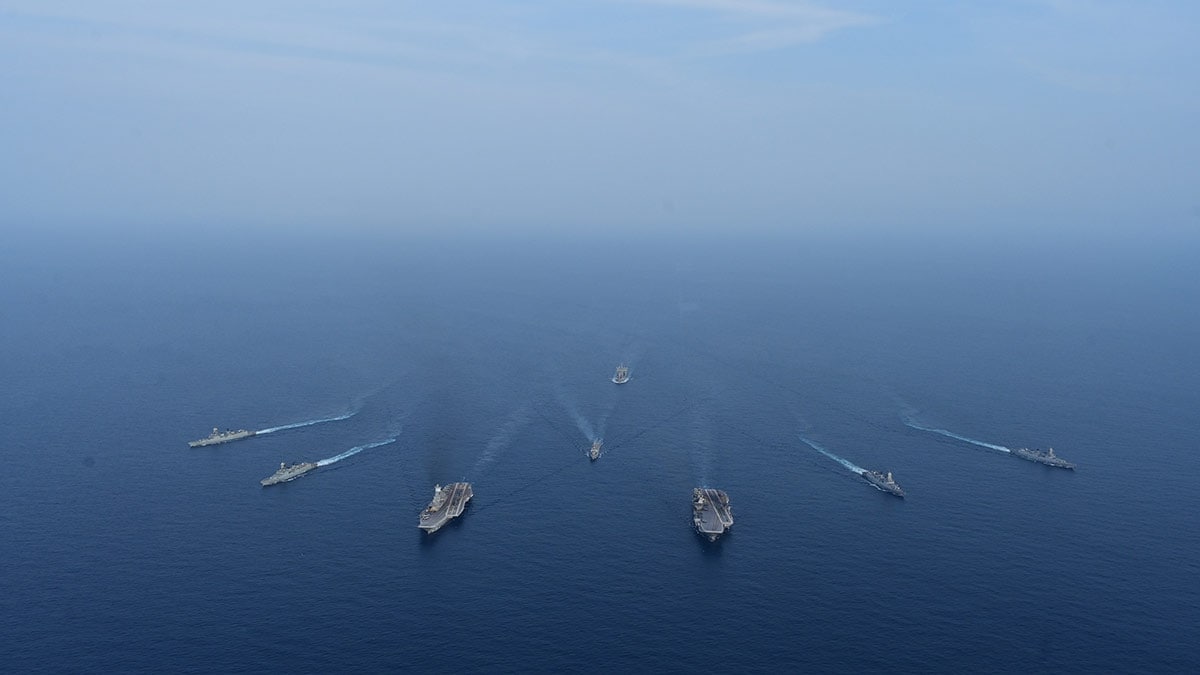
When an Indian warship responds to piracy in the Gulf of Aden, escorts commercial traffic, evacuates citizens or delivers relief after a disaster, it is doing more than flying the flag. It is protecting the sea routes on which India’s economy depends and demonstrating that maritime ambition must be judged not by articulation alone, but by physical presence at sea.
This is not an abstract proposition. Nearly 95 per cent of India’s trade by volume and around 70 per cent by value is handled through its ports. A country so dependent on the sea cannot treat naval power as ornamental. Ports, trade corridors and blue economy plans are vital, but they rest on a harder foundation: the ability to secure national interest across the waters on which prosperity depends. A strong navy is therefore an instrument of security, influence and growth.
History offers a useful warning. After World War II, maritime power shifted decisively from Britain to the US. The Royal Navy remained capable, but Britain’s exhausted economy and shrinking empire reduced the reach that had once underwritten its global position. The US, by contrast, emerged with a navy commensurate with its new economic and political weight. The lesson is simple: great powers cannot remain great without protecting their interests at sea.

That lesson is relevant to India’s 2047 vision. A country aspiring to become a developed nation and a $30-35 trillion economy cannot have a small-country maritime imagination. Such an economy will depend on secure sea lanes, resilient ports, undisrupted energy flows, overseas markets, undersea cables, island partnerships and maritime logistics. India’s future will move across the Indian Ocean and beyond.
This shift is already visible in official thinking. The defence minister’s description of India as an “island country with land borders” captures a strategic reorientation: India is no longer looking at the sea as a boundary, but as the principal arena through which its prosperity, security and influence will expand. That outward, oceanic approach will remain incomplete without a navy equal to the scale of the ambition.
Hard power is the steel frame behind India’s maritime rise. A navy gives a nation options: to deter coercion, to reassure partners, to protect its seaborne trade, to evacuate its citizens, to respond to disasters, to monitor choke points and, when required, to fight. A warship entering a foreign harbour is at once a floating piece of Indian territory, a relief platform, a surveillance node, and most important, a statement of intent. In the Indian Ocean Region, where energy routes, great-power competition, piracy, varied non-traditional security challenges and grey-zone activities intersect, presence itself becomes policy.
The case for a strong navy also extends beyond operations. Naval power is industrial power. A warship is among the most complex systems a nation can build: a moving city, power station, sensor grid, weapons platform, and a command centre compressed into a survivable hull. Building such ships forces a country to master metallurgy, propulsion, electronics, combat systems, precision fabrication, project management and quality control. These capabilities do not remain confined to defence. They spill into the wider economy.
India’s naval shipbuilding record shows this clearly. Official figures place 51 large Indian Navy ships under construction domestically, valued at about Rs90,000 crore. These are not merely naval acquisitions; they are national industrial undertakings that create expertise and work for designers, shipyards, steel plants, electronics firms, MSMEs, welders and marine specialists.
The most vivid example is INS Vikrant, India’s first indigenous aircraft carrier. Built with 76 per cent indigenous content, including 30,000 tonnes of steel from SAIL, it engaged more than 550 original equipment manufacturers and over 100 MSMEs, while generating thousands of direct and indirect jobs. The development of warship-grade steel through collaboration between the Navy, DRDO and SAIL is especially instructive. A military requirement created a national industrial capability.
This is where naval shipbuilding spills into commercial shipbuilding. A yard that learns to build to naval tolerances becomes more credible in civilian markets. A supplier that meets naval standards becomes more competitive in commercial marine systems. A worker trained on warships carries that discipline into merchant ships and repair yards. Defence orders create depth; commercial orders create scale.
Cochin Shipyard is perhaps the best Indian illustration of this bridge. Its reputation has been shaped by demanding naval work, including INS Vikrant and aircraft carrier repairs. That credibility has not remained confined to defence. Cochin Shipyard has exported high-end vessels to customers in Europe, the US and the Middle East, and its record of quality delivery has helped win repeat commercial confidence. The recent order for LNG-powered container vessels for CMA CGM (a French shipping company) signalled something larger: Indian shipbuilding can aspire not only to serve domestic requirements, but also to compete globally.
The central argument, therefore, is simple: India cannot become a major maritime nation without becoming a credible naval power. Ports without protection are vulnerable. Trade without secure sea lanes is fragile. Maritime diplomacy without naval reach is limited. And shipbuilding without demanding anchor customers may remain shallow. Naval power is not separate from maritime ambition; it is the foundation on which that ambition rests.
The writer is former chief of naval staff.
