



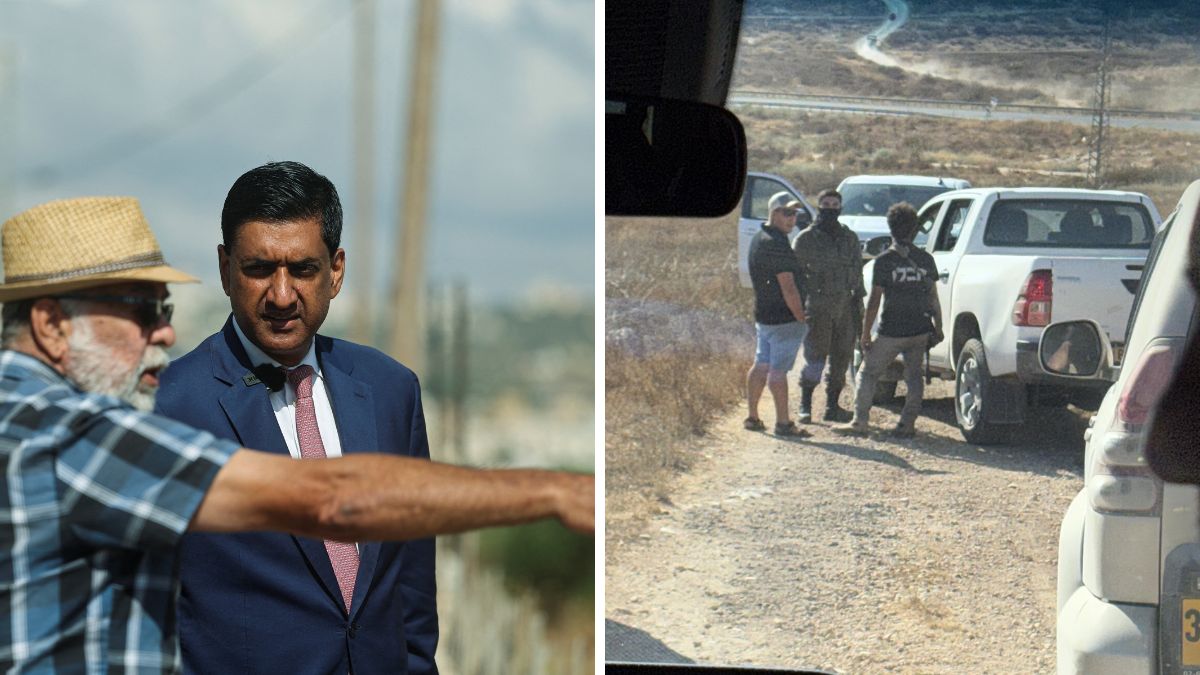
California Democrat Ro Khanna, who is exploring a presidential run in 2028, was detained by armed Israeli settlers on a visit to the West Bank, an incident that has highlighted the growing tensions in the area. Khanna and his team were at Khirbet Zanuta, a small Palestinian Bedouin hamlet in the southern West Bank, on July 8, when the settlers stopped them. The village had been abandoned and later demolished after a wave of violent settler raids intensified following the October 2023 Hamas attacks on Israel. As the delegation surveyed the destruction, a vehicle carrying masked men armed with American-made M4 assault rifles pulled up and blocked the narrow exit road, trapping the congressman's minibus.
The armed settlers held the congressional delegation in a tense 90-minute standoff. According to Khanna, the men taunted the group, shouted profanities in Hebrew and Arabic, and kicked the tyres of their vehicle. Khanna's aide, Cameron Kasky, said the group was stranded for well over an hour, prompting urgent appeals to the US Embassy in Jerusalem and Israeli police for help. The episode underscored the growing problem of settler violence in the West Bank, where more than 700,000 Israelis now live in settlements that most of the international community considers illegal under international law.
A major point of contention afterwards was the conduct of the Israel Defence Forces (IDF). Khanna said that when two IDF vehicles arrived, he initially believed the soldiers had come to escort his delegation to safety. Instead, he said he saw the soldiers chatting with the settlers and smoking cigarettes with them. Khanna accused the IDF of siding with the "hoodlums", claiming that after the settlers finally left, soldiers moved a vehicle to continue blocking the road rather than allowing the Americans to depart.
The IDF and Israeli police presented a different account. An IDF spokesperson said troops were dispatched after reports that Israeli civilians were unlawfully blocking foreign nationals, adding that they "quickly dispersed the Israeli civilians, and reopened the blocked road". The military denied that its soldiers had taken part in blocking the exit. Israeli police, meanwhile, said the group had entered a "closed military zone", insisted officers had witnessed no violence, and stated that the tour leader had been warned about trespassing before the delegation was allowed to leave.
The experience left a profound emotional and political impact on Khanna. Reflecting on the ordeal, he said: "Imagine how people feel every day, Palestinians under the occupation, if they could make an American congressperson feel powerless for 90 minutes." He also said he was struck by what he described as the "arrogance" of the young, heavily armed settlers and of IDF soldiers funded by US taxpayers, arguing that they acted with complete impunity and showed no respect for the presence of an American official.
Khanna, who is Indian American, also said the visit heightened his awareness of his own racial identity. "In Palestine, I felt first as someone who was brown," he said, adding that he witnessed "apartheid-like conditions" and systemic inequality that, in his view, few Americans would support if they saw the reality on the ground. He concluded that the expansion of violent settler activity makes the prospect of a two-state solution increasingly difficult to achieve.
Historically, prospective presidential candidates visited Israel on carefully curated tours designed to bolster their foreign policy credentials through meetings with Israeli leaders and visits to the Western Wall. Increasingly, however, progressive Democrats are travelling to the region to strengthen their credentials as critics of Israeli policy and to draw attention to the human cost of the occupation. Khanna's visit, organised entirely by Palestinians, was intended to offer an unfiltered view of life under occupation.
The detention of a sitting congressman is likely to add further strain to the US-Israel relationship, which has already weakened significantly among Democratic voters. Polling shows Israel's favourability rating among Democrats falling from 59 per cent in 2018 to just 22 per cent by May 2026. Khanna has since said the experience has made him "more resolved" to consider a 2028 presidential bid. A vocal critic of the war in Gaza, he has backed calls to end the $3.8 billion in annual US military aid to Israel, including funding for light weaponry and the Iron Dome. If he enters the race, Khanna has pledged to make Palestinian rights a central issue, signalling that America's changing relationship with Israel could become a defining test in future US elections.
