



Guru Dutt’s love for music and dance flourished at Uday Shankar’s Almora cultural centre where he trained as a dancer and choreographer in the early 1940s. And, with the experience of choreographing on the sets of Prabhat [Film Company], it is not surprising that Dutt began to develop his own film aesthetic in which the choreography of light and music would be central. Dutt’s individual film form drew from different cinematic traditions, including Hollywood and Indian cinema, and his experience as an assistant director and minor actor on the sets of films made in Pune and Bombay meant that he was internalising a developing Indian film aesthetic in the 1940s.
While he began his directorial career with noir melodramas and romantic comedies with their own genre features and styles, Dutt was already developing an expressionist aural aesthetic along with cinematographer V.K. Murthy, his key collaborator, without whose contribution to lighting and camera movement Dutt’s aesthetic would not have been possible.
While Pyaasa (1957) and Kaagaz Ke Phool (1959) are examples of this form, even in a romantic comedy like Mr. & Mrs. 55 (1955), there are several sequences where the distinctive Dutt aesthetic is evident. The song sequence ‘Udhar Tum Haseen Ho, Idhar Mein Jawan Hoon’—with its fluid and lyrical tracking and crane shots moving into close-ups, the enchanting use of light and shadow, Majrooh Sultanpuri’s poetic lyrics, O.P. Nayyar’s music and the duet sung yearningly by Mohammed Rafi and Geeta Dutt—is not only a declaration of love by both protagonists, although almost unwittingly by Anita (Madhubala), but also signifies how Dutt could move effortlessly from the comic tenor of the film into depths of feeling evoked by chiaroscuro lighting, camera movement, lyrics, music and performance, all working together to create a powerful impact. It is not surprising then that Dutt was known for his beautiful song picturisations that captured emotional and psychological depths not otherwise expressible.
Similarly, ‘Meri Duniya Lut Rahi Thi, Aur Mein Khamosh Tha’, sung by a group of qawwals, just after Preetam (Dutt) acts to falsely denigrate himself to create a negative impression on his wife, Anita, because he feels she does not want to be with him, dramatises his feelings of loss and helplessness. Once again, the moving camera, the lighting, Dutt’s close-ups and the lyrics of the qawwali are fundamental for articulating a character’s inner world.
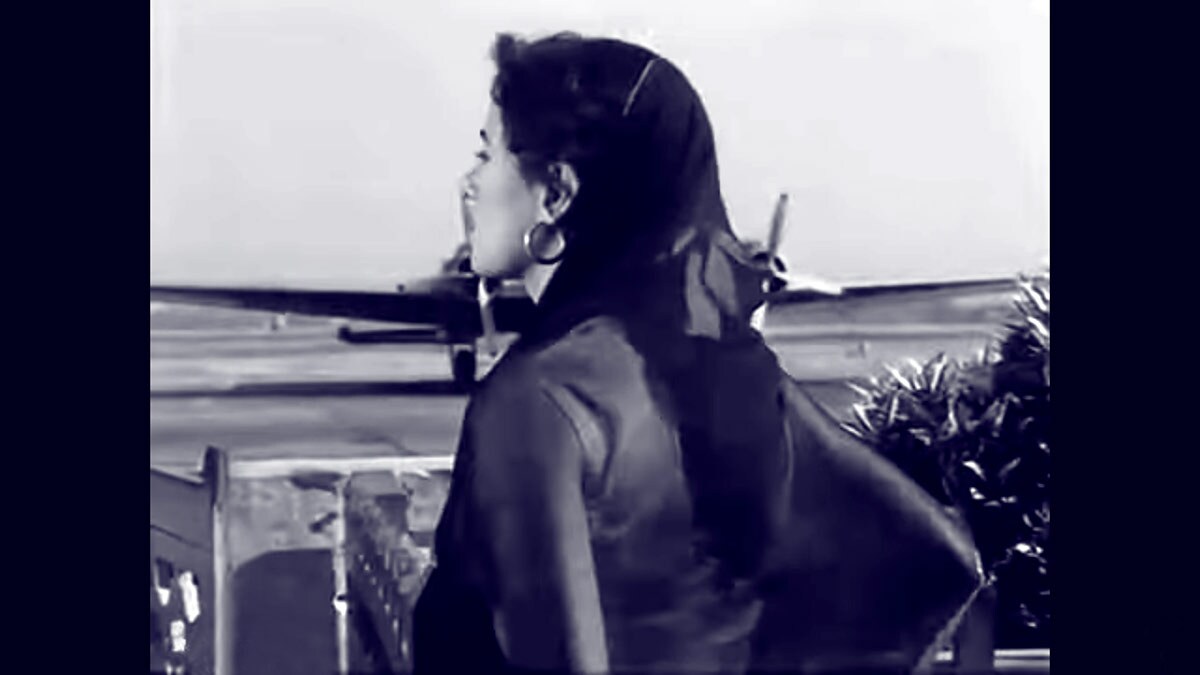
A different expression of this pattern is evident in the denouement of the film. Upset with the divorce proceedings in court, Anita is lying on the couch with the radio playing a heart-rending song of separation: ‘Preetam aan milo …/ Dukhiya jiya bulaye… preetam aan milo…’ which Anita’s aunt switches off. In the next scene, when Preetam is packing and says to his friend Johnny that he will leave for Delhi the next day, the same song keeps playing at a lower volume through their conversation, this time articulating Preetam’s feelings. Once Anita hears the truth from Johnny about Preetam’s self-denigration to ensure that she can leave him easily, she confronts her aunt and leaves to meet Preetam, only to realise that he has already left for the airport. Rushing there with Johnny and Rosie, she tries to get a ticket to board the same plane as his, but to no avail. As she hurries to the boarding gate and sights a plane cruising for take-off, ‘Preetam aan milo…’ begins playing on the soundtrack. Realising that she is too late, she looks towards the departing plane, and the camera tracks into a close-up to the lyrics ‘Dukhiya jiya bulaye… preetam aan milo’. As the plane takes off, she runs to follow it, and Murthy cuts to a tighter close-up of her face, half-lit, looking in the direction of the departed plane, while the lyrics ‘Bheegi raat mein, ped ke neeche/ Aankh michauli khel rachaya’ give voice to her loss. The repetition of the same stanza has Murthy return to the first close-up, and then as the song lines ‘Preetam yaad karo jab tumne/ Prem bhara ik geet sunaaya’ play, he cuts to a tighter close-up of her teary face, holding the shot for a few seconds as her tears fall. The refrain of ‘Preetam aan milo’ continues as she walks away and then Murthy cuts to another close-up as the refrain continues in a higher pitch while she looks tearily at the sky that has swallowed up the plane, only then to feel a touch on her shoulder, and turning back, exclaims joyfully, “Preetam.” He has not yet left and the happy ending returns the film to the comedic tone of the earlier parts of the film.
The heightening and amplification of emotion via camera work, music and song is a key feature of the Indian melodramatic cinematic tradition and Dutt’s articulation of this form brought to it a balletic fluidity and grace that was beautiful and distinctive. In films like Pyaasa and Kaagaz Ke Phool, Dutt would develop his critiques of capitalism with its prostitution of human emotions and values at the altar of capital, and express his sympathy for the poor and for oppressed women through an aesthetic moulded in music what (director) Mani Kaul identified as “sculpting with light”. Even in films he produced like Chaudhvin Ka Chand (1960) and Sahib Bibi aur Ghulam (1962) that are critiques of feudalism, his contribution and his aesthetic are visible, especially in the song picturisations. A tragic figure who left the world too soon, Dutt lives on in the exquisite cinema he created.
The writer is retired professor of cinema studies, School of Arts & Aesthetics, Jawaharlal Nehru University.
