



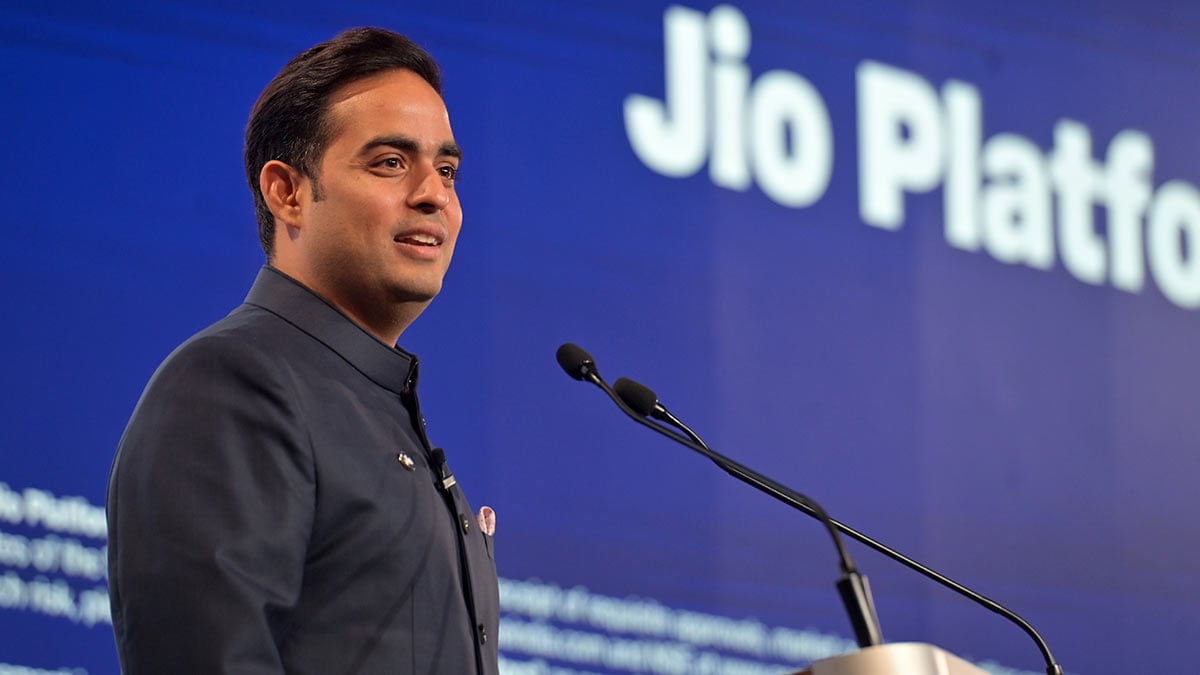
The initial public offering of Jio Platforms has gone through just as Mukesh Ambani would have hoped for. At Rs30,188 crore, it was the largest IPO in Indian history. Jio Platforms, the holding company of telecom services provider Reliance Jio Infocomm, received 1.4 crore applications from investors. That is said to be the most for any IPO globally.
More heartening for Ambani would be the investor appetite. At a time when foreign institutional investors are taking money out from the domestic market, Jio Platforms got bids worth Rs1.39 lakh crore from marquee sovereign wealth funds and asset managers. In all, the IPO got bids worth Rs7.4 lakh crore. That is higher than the GDP of countries such as Jordan, Nepal, Iceland and Paraguay.
Yet, for Ambani, it is also about how the listing takes ahead his succession plan for son Akash, the larger family and the Reliance Industries group.
From the moment Akash returned after completing his bachelor’s degree in economics from Brown University in the US in 2014, Ambani set the plan in motion. That year, Akash joined the board of Reliance Jio Infocomm and was involved in the foundational stages of Jio. The company launched its telecom services in 2016 and went on to disrupt the Indian market by making data cheap for the masses. In 2022, Akash took over as chairman of Jio Infocomm from his father.
Since then, Akash has been the face of the company. In the days leading to the IPO’s opening, it was Akash who led interactions with the media, brokerages and investors. Ambani and his wife, Nita, carefully kept themselves out of the limelight, but made sure Akash, and the IPO, got the best of resources. That Uday Kotak, founder of Kotak Mahindra Bank and one of India’s most respected entrepreneurs, introduced Akash during the press briefing showed that the junior Ambani had all the backing needed to make the IPO successful.
“It’s important to note that this is not succession planning. This is succession management,” says Kavil Ramachandran, former professor of family entrepreneurship at Indian School of Business. “Making a strategy is easy. Executing it is the toughest part. A lot of business families in India have failed in the management of succession. With the IPO, Mukesh Ambani has shown that he is very good in succession management.”
Now that the IPO is done, Akash will be tested. “Being a publicly listed company brings in a lot of public accountability,” says Ramachandran. “Your performance is measured according to the stock’s performance... there is no doubt that Jio is big and will become bigger. What investors would want to see is the role Akash will play in the coming years.”
A credible showing will not just cement Akash’s place as a next-generation leader to look out for, but will also take forward the larger succession management. Ambani’s eventual aim is to make sure the third generation of the family doesn’t experience the bad blood that defined the previous one. Also, if plans go on well, the next in the IPO queue is the group’s retail business that Isha heads.
Generational shift
As he begins his stint as the managing director of a publicly listed company, Akash just needs to go back to his family’s history for inspiration. His grandfather was a trailblazer. After a stint as a dispatch clerk in Yemen, Dhirubhai came back to India in 1958. With savings of Rs15,000, he started a trading company to import yarn. Vimal, the popular textile brand, was launched in 1966. Though Licence Raj limited entrepreneurship, Dhirubhai found ways—with many questioning his methods—to scale his business. He invested heavily in backward integration that eventually led to the setting up of the world’s largest oil refinery in Jamnagar, Gujarat.
Equally remarkable was his understanding of retail investors. Reliance Industries went public in 1977. He turned the company’s annual general body meetings into music concert-like events filling stadiums. Market commentators credited him for democratising equity markets for the masses.

But what he probably missed was a succession plan. “Most Indian entrepreneurs make the mistake of thinking they will live forever. They don’t leave a will behind, or don’t have a succession plan,” says a senior executive who has worked closely with business groups in India. He requested anonymity.
Dhirubhai’s death in 2002 led to a public fallout between his sons Mukesh and Anil. They came to a settlement only three years later. While Ambani took charge of the petrochemicals business, Anil got the telecom, power and finance businesses. The two also signed a non-compete agreement that lasted 10 years.
Ambani used that time to incubate a telecom business, and launched Jio just a year after the non-compete clause expired. But he didn’t stop at telecom. In 2006, he launched Reliance Retail. Just like Jio disrupted the telecom industry and emerged as the biggest player, Reliance Retail, too, became the largest in its sector. Similarly, Ambani’s bets in media, entertainment, sports and new energy have seen Reliance Industries continue on a trajectory of fast growth.
Since 2005, the stock of Reliance Industries has multiplied by 18 times, as against BSE Sensex, which grew 11 times. Reliance Industries’ net profit of Rs95,754 crore in FY26 comfortably beats the company’s revenue for the whole of 2005, which was Rs73,164 crore. The consolidated revenue in FY26 was Rs11.75 lakh crore.
Akash would be well-versed with this timeline. What he needs to do is to continue what his grandfather and father excelled in—build scale, diversify and deliver returns to shareholders. That is not an easy task. World over, research has shown that family businesses begin to falter by the time the third generation takes over. One of the biggest reasons is a delay in succession. Ambani has made sure that is not a hurdle at Reliance Industries.
From customer to enterprise
The telecom industry is not what it used to be a decade ago. When measured by overall subscriber count, India ranks second in the world with 1.3 billion. China tops the table. But India comes first when the ranking is in terms of mobile data consumption. Ambani can claim some of the credit for the massive data explosion thanks to Jio’s low tariffs. But the domestic industry has evolved fast and that requires a shift in strategy.
“Now the focus is beyond pure telecom services,” says Purushothaman K.G., national AI leader, and head, technology transformation, at KPMG India. “It’s about value-added services and bundled products. Segments like OTT, fixed broadband and enterprise are the ones that are growing in prominence. Data centres will unlock value for all the players.”
At present, Jio Infocomm trails Airtel, which derives a higher percentage of its revenue from value-added and digital services. Telecom services make up nearly 90 per cent of Jio’s top-line. That number is widely believed to be much lower for Airtel. Another bugbear for Jio Infocomm is its lower ARPU, or average revenue per user. It has been trailing Airtel for a while and the gap seems to be increasing. As per information from the first quarter of the current financial year, Airtel had an ARPU of Rs263.9, whereas Jio Infocomm’s was Rs215.6. A year ago, Airtel’s was Rs211 and Jio Infocomm’s Rs181.7.
A bit of historical context is important here. “Airtel started in 1995. It entered the market when the price of owning a mobile phone and making calls was very high. Only people who could afford it became its customers,” says Mahesh Uppal, director at the Delhi-based Com First, which advises on policy, regulation and strategy in the telecom industry. “On the other hand, Jio attracted customers because of its lower tariffs. Though it gained market share rapidly, its customers don’t have a similar buying power.” That partly explains Jio’s lower ARPU.
Says Purushothaman: “The quality of growth will matter as much as customer additions. Operators would want to move customers towards higher value plans, making product bundling increasingly important. This is expected to intensify in the coming months.”
In his recent interactions, Akash has shown the inclination to go beyond the basic pricing strategy. “Jio retains the ability to increase prices but we would prefer to give customers additional services and charge for those offerings instead of using simple price hikes to drive growth,” he told the media ahead of the IPO.
Investors will take heart from that statement.
But direct-to-customer is one segment. Equally important is enterprise play, especially with 5G. Industry observers expect both Jio Infocomm and Airtel to centre their 5G strategy on enterprise clients. “That brings better margins. No player right now has an obvious advantage here. At the same time, this race won’t be won by just prices, but what the overall value of the offering is,” says Uppal.
Akash has the advantage of a clean balance sheet. About Rs27,500 crore of the Rs30,188 crore-IPO will be used to clear Jio Infocomm’s debt. It will become a zero net-debt company post the IPO. Apart from saving about Rs2,000 crore in annual interest servicing costs and freeing up cash, Akash will now be able to build a larger war chest to invest in satellite communication and data centres. “Capital shouldn’t be used to cross-subsidise low tariffs but should be invested in newer segments,” says Purushothaman. At the same time, adds Uppal, financial muscle alone is not enough. “Jio’s competition is coming from the likes of Amazon, Google and SpaceX. Each of them is as deep-pocketed. What they do with the money will be the differential,” he says.
Rest of the plan
Recent events at TVS, the Chennai-based auto major, have shown that merely dividing a family’s assets between the next generation might not be enough to avoid discord. At the heart of the dispute, between chairman Venu Srinivasan and his wife, Mallika, is the 2020 partition of the group between their children—son Sudarshan and daughter Lakshmi. While Srinivasan believes the partition was complete, Mallika has said that “no economic settlement has been reached”. What was agreed upon, she argued, were responsibilities and not ownership.
“Parents often believe that doing allocation is the end of responsibility. They assume that the family will be together. That is a wrong assumption,” says Ramachandran. “They (next generation) will push as much as possible for what is good only for their SBU (strategic business unit) and not for the whole family or the group.”
Ambani seems to have been wary of this aspect. All his children are non-executive directors of Reliance Industries. Ambani, Nita and their three children hold an identical 0.12 per cent stake in the company. In Jio Platforms, while Ambani is the chairman and Akash is the managing director, Isha and Anant are also on its board as non-executive directors. The pattern is similar in Reliance Retail, where Isha is the face, but Akash and Anant are on its board.
In other words, while Ambani has given responsibilities to each of his children, it is not yet clear how he plans to divide the ownership.
But there is still time for that. In the coming quarters, the focus will solely be on Akash. When the results for the third quarter, which ends on December 31, are announced in January, Akash will be expected to address the investor community. It remains to be seen if he will interact with brokerage analysts or not. If he does, it would be an opportunity for the outside world to hear and understand him.
Till now, Akash’s public appearances have been carefully curated. “He is polite, approachable and keen on the technology-side of things,” says the senior executive quoted earlier. But not much is known about him and his management style. Neither is it known if he has a core team of his own. Earlier this year, there was a re-shuffle in Jio Platforms management. Chief executive officer Kiran Thomas, who in previous years was seen alongside Akash during Reliance Industries AGM, was replaced by Pankaj Pawar. It was Pawar who stood with Akash, Isha and Kotak during the IPO press briefing. “Mukesh Ambani has his close circle of associates. They are well known and can be seen across the boards of Reliance companies. Previously, this was the group who used to strategise. Akash’s working style is not known yet,” says the senior executive.
That, and much more, will be clearer as the Akash-led Jio Platforms operates as a publicly listed entity.