



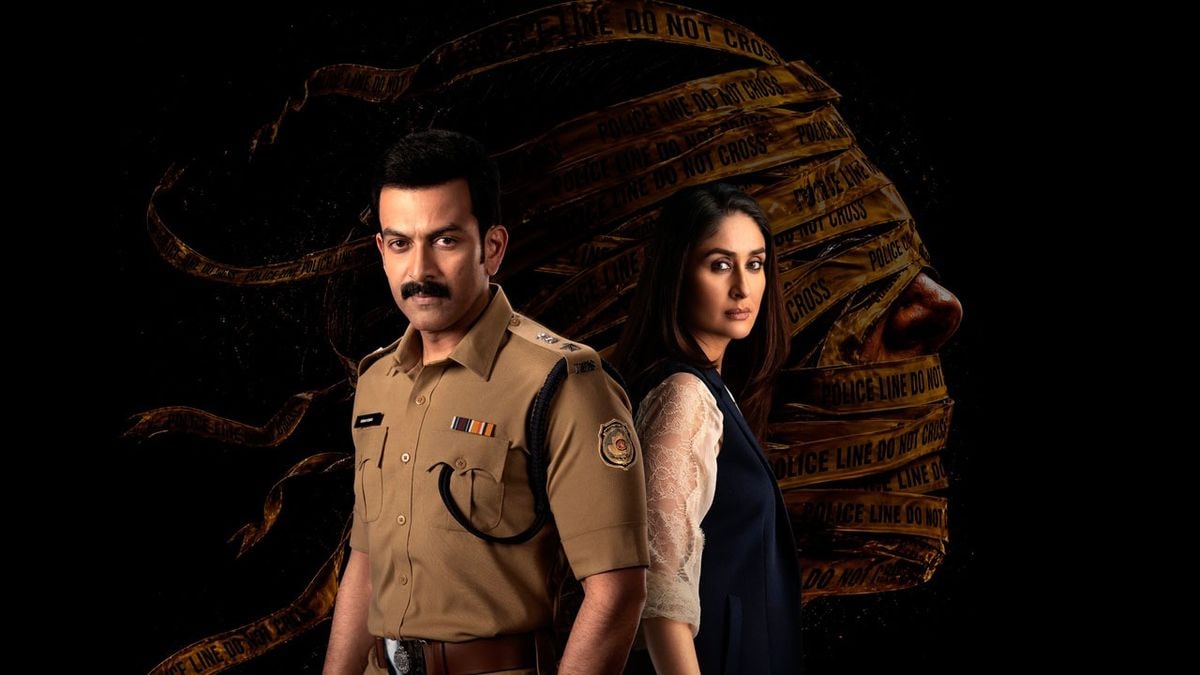
The first time that DCP Ajooni Kohli (Kareena Kapoor) sees DCP Raman Kumar IPS (Prithviraj Sukumaran) face-to-face is through the latter’s phone screen: She is addressing the press, and as she is about to conclude her statement, she looks directly into the camera, as if to make a gesture of challenge to the latter as he watches her speak. When they finally do meet, and this is not a spoiler, it’s just once during the entire film.
Interestingly, despite not sharing the screen for the rest of the runtime, “Daayra” makes us feel as though they have been communicating all the time, sitting across the table from each other, engaged in heated debate. The exchange of perspectives is presented through the manner in which Ajooni and Raman operate in two different timelines. Their thought processes come through very clearly in these sequences that lead to their first in-person meeting. The reason the face-to-face confrontation happens only once is that the film tracks two separate events: the before and after of a heinous, picked-from-the-headlines event. By the time they finally meet, much has already been said; now only the last chapter or, rather, the last paragraph, remains.
I read somewhere that Meghna Gulzar was first approached to make “Daayra” six years ago, a year after the Hyderabad encounter killing of four suspects in the Disha gang-rape and murder case. But “Daayra” could be made any time. The subject has no expiry date. Post-Nirbhaya, India hasn’t gotten better. It feels very much like the country has gotten more unsafe for women. Even today, on the day of this film’s release, I was greeted by the distressing news of a Delhi teen’s gang-rape and murder. Again, the number of suspects, involving juveniles, is the same: four. What a harsh reminder!
We feel Nirbhaya’s presence strongly in the background of “Daayra” as it explores a case eerily similar to the 2019 Disha case. The faceless juvenile suspect lives in the same neighbourhood of the fictional town that sounds similar to the Hyderabad location. It goes without saying that this is an upsetting film. The inevitable blood-boiling, horrifying event comes only at the end of the film and, while disturbing, as it should be, Meghna treats it with the sensitivity it requires, keeping the depiction short, just enough to get the point across. It’s not that all female filmmakers follow the same approach — there are a few examples in international cinema who have presented the brutality in the goriest, nightmare-inducing manner — but, thankfully, Meghna knows that it’s not necessary to put viewers, especially the female members in the audience, through such an ordeal.
Prithviraj is perfectly cast as the representative of the collective rage that many of us feel at the apathy of the system and mistrust in the judicial system. Ajooni presents the viewpoint of that judicial system, telling us, through her interactions with others, that our rage and prejudices shouldn’t dictate our emotions. Raman and Ajooni handle emotions in their individual ways. Both are controlled, but the former’s face is a clear giveaway: he is always angry, save for those brief occasions when he is with his wife, who makes him smile. In fact, he even addresses his anger issues when a fellow officer asks him about it. The film didn’t need to tell us this; Prithviraj’s body language makes it evident. Ajooni, on the other hand, is Kareena at his most relaxed and mature: a woman who seems to take joy in her work even when she is told that she will have to cancel her holiday; she seems to sail smoothly through these circumstances, even when informed of a distressing incident involving a loved one, someone whose influence has clearly shaped her ideology.
Despite the yin-and-yang quality of their characters, Raman and Ajooni bring a measure of comfort because they are, after all, the audience surrogates, depending on which side of the debate you are on. They keep this largely talking-head movie engaging. However, one also feels that “Daayra” lacks something in terms of character development. Ajooni’s motivation is backed up by solid background information and a bit of ambiguity, thereby adding a fascinating layer, whereas the same cannot be said of Raman. The only thing we know about him is his shared history with his colleagues — the information that they aren’t new to this encounter business. (There is a mention of an acid attack and a visual of a dhaba named ‘Aarushi’, both possible nods to Meghna’s earlier films.) I must also add that Jitendra Joshi, who delivered an excellent performance earlier this year in Anurag Kashyap's "Bandar", showcases a different side of him in "Daayra". He is a phenomenal actor in the same league as Pankaj Tripathi, Manoj Bajpayee, or Nawazuddin Siddiqui.
But it’s not just the characters that keep a certain distance — or, should I say, ‘daayra’ (boundary) — between us. The questions that the film raises aren’t anything we haven’t heard before. This is why it sometimes feels like the screenplay was constructed out of familiar online debates around the many haunting rape cases — anything from men’s perception of women to mental instability to juvenile crimes — that continue to occur in our country no matter how many debates we have engaged in already. It has reached a point where one has become so drained and cynical to the point that one is compelled to say that it doesn’t matter who says what anymore, because, as Ajooni herself says in one scene, as far as attitudes don’t change, writing new laws is pointless.
Having said that, one cannot dismiss “Daayra” as pointless even though it doesn’t make a definitive stand on the debate of whether the cops should act by their own ‘laws’ or whether they should let the courts do their duty. It wants us to make up our own minds while leaving us with an image that throws up different questions. Unlike Meghna’s far angrier “Talvar”, which I felt was also stronger and more intellectually stimulating, the relatively more sedate “Daayra” feels like it had the potential to go further but, for some strange reason, it held back.
Film: Daayra
Director: Meghna Gulzar
Cast: Prithviraj Sukumaran, Kareena Kapoor, Pragati Mishra, Jitendra Doshi
Rating: 3.5/5
