



Films are often a reflection of the society they emerge from. If that holds true, a few recent Hindi films suggest a pushback against the religious jingoism and majoritarianism that have increasingly found space in the mainstream Hindi film landscape. Case in point being Imtiaz Ali’s Main Vaapas Aaunga, Netflix’s Operation Safed Sagar and now Aamir Khan-produced and Rajkumar Santoshi-directed Batwara 1947.
Previously named Lahore 1947, the movie is based on Asgar Wajahat’s acclaimed play Jis Lahore Nai Vekhya, O Jamya E Nai (He who hasn’t seen Lahore has not truly been born).
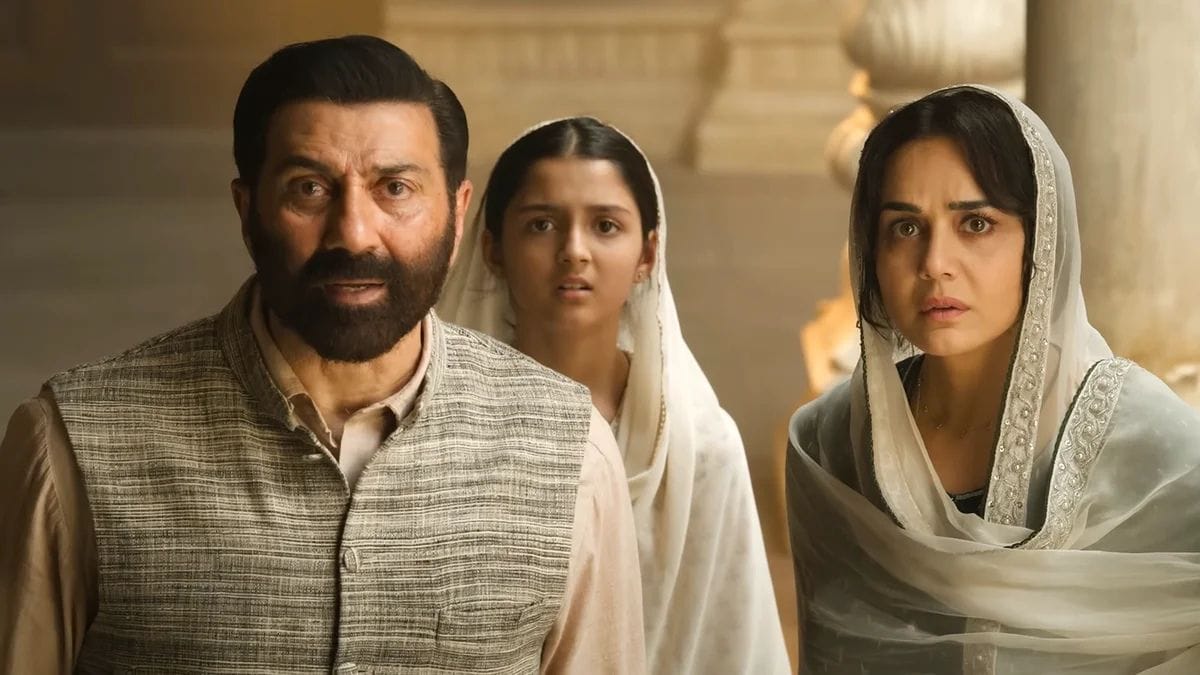
Sunny Deol, known for playing son-of-the-soil, patriotic type, plays Sikander Mirza, a Muslim businessman from Meerut. The film opens with India’s Independence with Mirza distributing sweets in celebration. But alongside the euphoria is the communal carnage. When Hindu rioters reach his doorstep, Mirza is forced to flee India with his family – his wife Hamida (Preity Zinta), daughter Tanno (Khushi Hajare) and son Javed (Karan Deol).
In Pakistan, they languish in a relief camp before being allotted a haveli in Lahore. They enter only to find an elderly Hindu woman already living there. The haveli belongs to Durgavati (Shabana Azmi), whose son Ratanlal, and his family are missing.
Initially, the Mirzas try to get rid of her, calling her ‘budhiya’, and tricking her into leaving. But their hostility gradually gives way to affection, and they eventually find themselves fighting the world to protect the Hindu woman they now call “maiyya”.
Batwara 1947 wears its message of communal harmony on its sleeve. It makes a straightforward case for compassion, religious tolerance and the possibility of people of different faiths living together in harmony. Its heart, certainly, is in the right place. But that, unfortunately, is where the film’s strength starts and ends.
Despite being based on a solid premise, and adapted from a stellar play, the Bollywoodised treatment renders the storytelling overly-dramatic and equally old-fashioned. As the film’s villain, the fanatic politician Yaqub (Abhimanyu Singh) is reduced to a caricature, Sunny Deol plays, well, Sunny Deol. He punches the air, delivers loud monologues and is physically capable of taking on an entire gang of villains single-handedly.
While Azmi can’t put a foot wrong, the film undercooks her bond with the Mirzas, making it difficult to feel the emotional weight behind their decision to protect and kill for one another. Zinta's Hamida is largely relegated to the background, while the most underwhelming character is Javed's Karan, who is hardened by the death and destruction around him and wants Durgavati killed, only to soften far too quickly.
The lighting and sets, too, do little to immerse you in the story, often looking too artificial. The biggest disservice, however, is to Lahore itself. Delhi’s twin and a cultural centre in its own right, the city is barely allowed a presence in the film, reduced instead to little more than a set.
Rating: 2/5
