



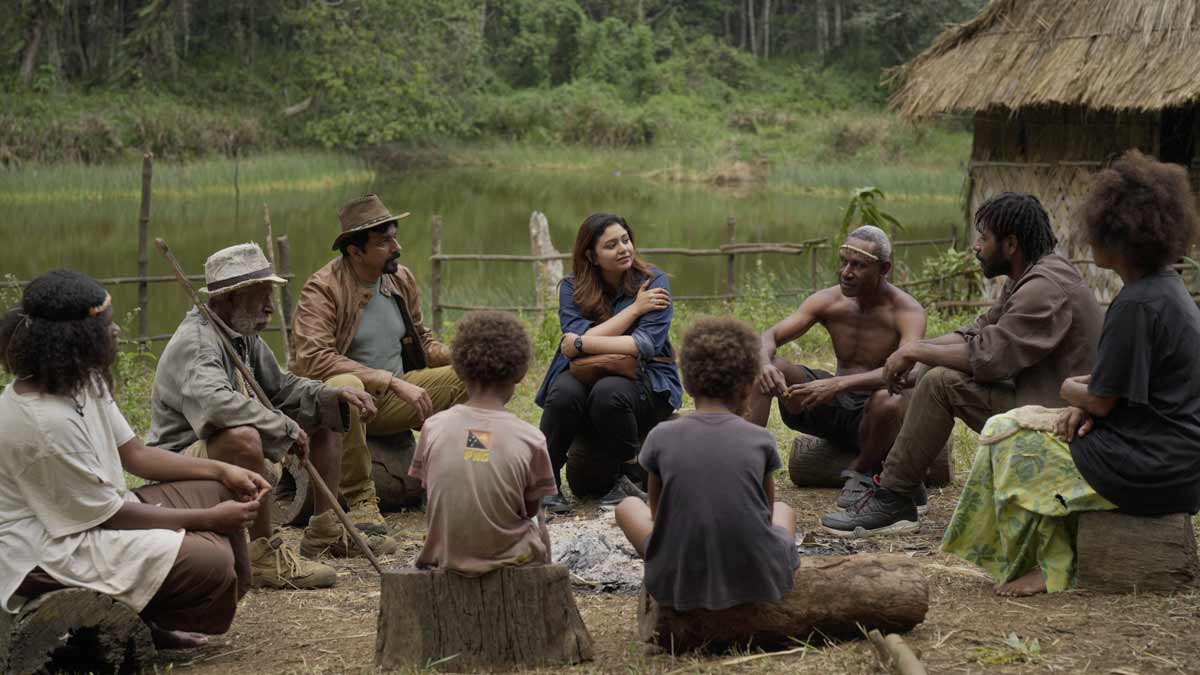
Papa Buka, the latest film by director Dr Biju, takes us on a journey through the forgotten chapters of World War II. Set against the serene landscape of Papua New Guinea (PNG), the film bridges the connection between two Indian historians and a Papua New Guinean war veteran, Papa Buka. Unlike other war films, Papa Buka is a slow-paced and meditative movie that compels the audience to listen to personal stories and reflect on the pain and memories of a war that crossed oceans.
Papa Buka reflects the historical reality that both Papua New Guinean and Indian soldiers were drawn together by events far beyond their control. The film hints that both groups fought and suffered in a war that was not truly theirs, shaping their lives in ways neither chose.
One of the film’s greatest strengths is its cinematography, which highlights the rich biodiversity of Papua New Guinea and illustrates the connection that the indigenous people have to the land. Furthermore, the village scenes and close-up shots give the film a vivid texture that brings the environment to life.
Equally compelling is the film’s cultural immersion. Rather than treating Papua New Guinea as an exotic backdrop, the director allows its people, customs, and oral traditions to drive the narrative. The film portrays clan dynamics, spirituality, and identity in a respectful manner.
Another strength of Papa Buka is its deliberate use of local languages. Rather than relying on English or simplified dialogue, the film allows conversations to unfold naturally in Indian and Papua New Guinean dialects. This choice is more than stylistic; it is an essential part of how the film preserves cultural identity.
The Papua New Guinean actors bring authenticity and emotional nuance to their roles. The titular character, Papa Buka, played by Sine Boboro, is especially compelling. His expressions carry warmth, pain, and authority, and serves as both a guide for the historians and a bridge to the past.
The character selection is well-balanced, featuring characters of diverse backgrounds and age groups whose presence expands the story’s cultural scope. The way these characters are intertwined gives the film a natural rhythm. The conversations unfold slowly, and the relationships feel organic. Although the characters differ in language, customs, and worldviews, their human experiences intersect. Small gestures like shared meals, exchanged stories, and quiet moments of recognition make the cultural bridge feel authentic rather than symbolic.
An important tool used for storytelling in this film is silence. It becomes another form of communication between characters from different cultures. In this stillness, the mesmerising, yet eerie, sounds and sights of the forest are elevated.
The film’s atmosphere is further shaped by the music of Ricky Kej, a three-time Grammy Award winner. For the soundtrack, Kej drew inspiration from tribal rhythms and instruments, archival recordings, and natural soundscapes. The result is a subtle score that supports the film’s contemplative tone without overshadowing it.
For Papua New Guinea, Papa Buka is more than a film; it is a cultural milestone. By centering PNG voices, traditions, and histories, it asserts the nation’s place on the global cinematic stage. Its Oscar nomination amplifies this impact, bringing it international recognition.
The nomination is significant not only for its prestige but for its visibility and opportunity: it signals to the world that Papua New Guinean cinema has stories worth telling, voices worth hearing, and artistry on par with global filmmaking. It also highlights the continued relevance of a collaboration between Papua New Guinea and India, reflecting how both communities are linked through a war they did not choose and honouring that shared legacy today.
