



JALANDHAR
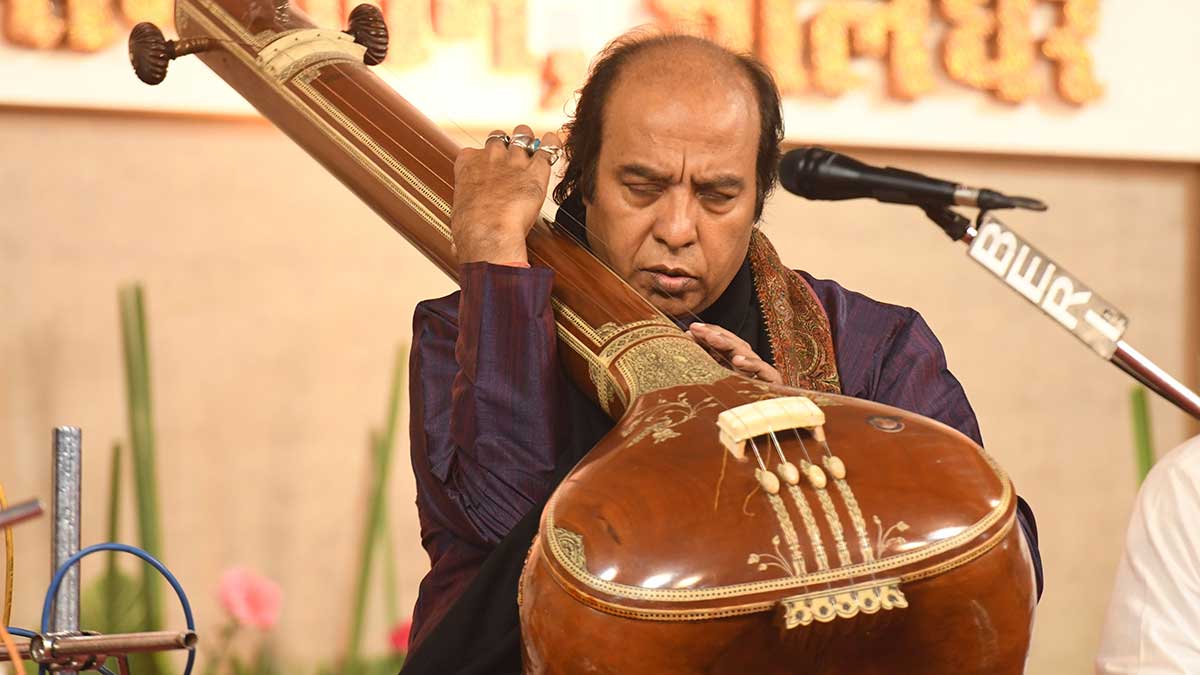
Forty minutes into the alaap (the improvised section of a raga) in Raga Bageshwari, it became difficult to tell whether the notes were coming from an instrument. Dhrupad singer Ustad Faiyaz Wasifuddin Dagar paused, which might have gone unnoticed if not for what followed: a faint but clear response from the audience, as if the sound had radiated outwards and returned.

Dagar resumed and paused again, this time deliberately. He gestured gently towards the listeners, most of whom were sitting cross-legged under a pandal (marquee). There was again a soft response. For those moments, there appeared to be little difference between the performer and the listener.

“It was anahat naad—unstruck sound, or the sound heard when nothing is played,” Dagar said later.

In Hindustani classical music, especially dhrupad, audiences do not usually hum along as they do at popular music concerts. What happened here was different. The listening was so deep that sound appeared to emanate on its own.
Dagar belongs to a family of dhrupad singers. He said four generations of his family had performed at the venue, with records going back to 1920, when his great-grandfather Allahbande Khan had performed there. He said listening to dhrupad for long periods required a trained ear. On that cold December night, Dagar’s performance lasted over two hours. The notes stayed with the audience long after the concert ended.
The Dagar tradition is considered to be one of the oldest living traditions of dhrupad. It traces its lineage to Swami Haridas, a 15th-century musician. Behram Khan of Jaipur was one of the key figures who trained generations of Dagars. According to Dagar, his ancestors had performed at the court of Maharaja Ranjit Singh, the first king of the Sikh empire.
Dagar was performing at the 150th edition of the Harivallabh Sangeet Sammelan in Jalandhar, Punjab. Founded in 1875, the festival is widely regarded as one of the oldest continuously held Hindustani classical music festivals in the world. It has survived colonial rule, partition, the formation of the Indian republic, years of militancy in Punjab, and the economic changes brought about by the Green Revolution.
Despite its long history, the festival is not widely known outside classical music circles. Many listeners travel from across India and abroad for the three-day event, held every year in the last week of December.
“My father, uncle and grandfather all performed here,” Dagar said. “They told us how people came wrapped in blankets. Some brought cots because concerts went on till morning. The audience here is different. It expects more. Elsewhere, performances are constrained by time. Here, artists are pushed.”
Many musicians see performing here as an important milestone. Sitarist Shubhendra Rao said his guru, Pandit Ravi Shankar, believed that unless one had performed at Harivallabh, they were yet to make a mark. Rao performed a duet with his wife, cellist Saskia Rao-de Haas. Their performance continued past midnight and received a standing ovation. This was Rao’s fourth appearance at the festival, after first performing here in 2002.
✱ ✱ ✱
The Harivallabh festival did not begin as a classical music institution. It began as a barsi, the death anniversary of Swami Tulja Giri organised by his disciple Baba Harivallabh. Musicians sang dhrupad and dhamar (two of the oldest forms of Hindustani classical music) at the gathering. Saints, sadhus and fakirs joined the anniversary langar.
Next year, well-known musicians of undivided Punjab turned up, including Mian Ahmed Bakhsh (Phillaur), Mian Muhammad Bakhsh (Hoshiarpur), Vilayat Ali and Mira Bakhsh (of Sham Chaurasi gharana), along with musicians from Amritsar and Lahore. Baba Harivallabh died in 1885 and the tradition was continued by his disciple, Pandit Tolo Ram. Then, the tradition was to play Raga Basant in the evening, Bihag at night and Bhairavi in the early morning.
Jalandhar tabla player Pandit Ramakant, now in his 80s, said, “I have been coming here for the past 75 years. Earlier, musicians would gather near the pond by the ancient goddess temple. Arrangements were made for firewood for sadhus to set up their dhunis (sacred fire pits). Dhrupad was sung. One moved from one gathering to another. The singers saw it as their duty to perform here and did not charge anything.”
Initially, the festival involved only singers from Punjab. In 1901, it opened to others upon the chance arrival of Pandit Vishnu Digambar Paluskar, who was on his way to Jwalamukhi, now in Himachal Pradesh. That year, Paluskar had set up Gandharva Mahavidyalaya in Lahore. He surprised the gathering with his rendition of Raga Jaunpuri. As he became a regular fixture, he brought musicians from across the country, including his disciples Vinayakrao Patwardhan, Narayanrao Vyas and Pandit Omkarnath Thakur. Then came two more significant interventions, with senior IPS officer Ashwini Kumar helming the organising committee, and the North Zone Cultural Centre (NZCC) in Patiala getting involved in 1989. Those were the days when terrorism was at its height, when artists were brought with police protection so that festival could continue without disruption.
The festival’s long history has been mostly recited orally or through news coverage, with a rare book by Joginder Singh Bawra. One famous incident relates to the arrival of Mahatma Gandhi in 1919 at the festival, as he was in Amritsar for the Congress session held in the aftermath of the Jallianwala Bagh massacre. Gandhi reached so late that three key musicians—Bhaskar Rao, Ramakrishna Bua and Pandit Krishna Rao—were asked to perform together.
In 2001, Pandit Ajoy Chakraborty from the Punjab gharana sang so heart-rendingly that the audience was moved to tears. The state higher education minister of the time, Master Mohan Lal, went onstage to touch Chakraborty’s feet.
Bawra recorded an incident from the 125th edition when former Kashmir chief minister Farooq Abdullah was in attendance. Inspired by the performance of those like Meeta Pandit, he insisted on singing onstage. He sang, More Ram, kab aayoge more angna (My Ram, when will you visit my home).
A year later at the same venue, two tabla players—Bhore Khan and Mehmood Dhaulpuri—clashed over who would go onstage first. But the more famous duel in music history was from 1912 or 1913, between Pandit Paluskar and Ustad Kale Khan, the durbari musician of Kashmir. At 1am, Khan sang Raga Darbari, mesmerising the audience. When Paluskar’s turn came, Khan sarcastically challenged him to do better. They were both called onstage for a competition, which continued for two hours until Khan caved.
A little known fact associated with Jalandhar is how it shaped one of India’s greatest singers. In the 1940s, an adolescent Bhimsen Joshi spent two years here searching for a guru. Jalandhar musician Bhagat Mangat Ram trained him, after which Joshi met Vinayakrao Patwardhan at Harivallabh, who guided him to Sawai Gandharva of the Kirana gharana, a tradition he adopted.
✱ ✱ ✱
One could get a feel of Punjab as one travelled by road from Delhi to Jalandhar, with trains running late due to fog. Hundreds of langars could be seen along the national highways, commemorating the martyrdom of the four sons of the last Sikh Guru Gobind Singh. At the venue, a pandal inside the temple complex with a food court outside greets the visitors. Over the years, the pandals have been made water proof, unlike two decades ago when this writer first visited the festival. Early mornings, in the biting cold, water would leak inside. Many carried their quilts inside.
In this edition, shehnai exponent Pandit Shailesh Bhagwat regaled the audience with Saraswati Vandan and a Punjabi dhun (tune) in Raga Bhairav. In 1996, when he had performed here, the listeners would not let him go even after midnight as they wanted more. “Music is a form of God for me,” Bhagwat said.
Addressing the tussle between popular and classical music, he said that the latter cannot be imposed. “It is not to be forced,” he said. “Whoever wants to learn will learn.” He described three kinds of sound created by God: music, human speech and noise, the last of which must be avoided. Cities that heard music of such intensity were blessed, he said. It takes decades of practice for maestros to perform before a receptive audience.
On the second day of the festival was another uplifting experience. Santoor player Abhay Rustam Sopori, who had performed here in 2001 with his father Bhajan Sopori, struck soulful notes on his instrument. He had a legacy to preserve as he was acutely aware that many in the audience had listened not only to his father, but also to generations of maestros. His performance was memorable. At one point, he said softly, “I lost track of time.” The audience had, too.
But the real show-stealer was Pandit Ronu Majumdar, who seemed to win hearts even before lifting the flute to his lips. Speaking in fluent Punjabi, this Bengali musician expressed his affection for Punjab’s musical traditions. His evocative, strong notes coupled with a high energy duet with flautist Shashank Subramanyam captivated the audience. He also played Gandhi’s favourite bhajan, ‘Vaishnav Jan To’. The festival ended on the third day with a moving performance by Pandit Sanjeev Abhyankar, which went on till 4am. It was his eighth time at the festival. According to tradition, the final artist was showered with marigold flowers till the stage was covered in petals.
✱ ✱ ✱
The festival is not only a platform for established performers, but it also helps identify new talent. Music competitions are held every year, with the winners invited to perform at the festival.
S.S. Ajimal, an octogenarian and long-time director of the Harivallabh organising committee, recalled how the festival was sustained in its early decades. “After Independence, people contributed whatever they could, sometimes even a rupee,” he said. “Today, in the age of live streaming and social media, physical audiences have thinned. Most listeners now come from outside Jalandhar, but the sarais (resting places for travellers) are full and langars continue.” The festival operates on an annual budget of around Rs80 lakh and depends on support from the state and Central governments.
Music in Punjab has become louder and more global, and sustained engagement with classical music has narrowed to specific communities. Traditions now survive largely among groups such as the Namdharis (a Sikh sect) and within gurdwaras. “As more gurdwaras have come up, young Sikhs are learning tabla and other instruments to become ragis,” tabla maestro Pandit Ramakant said. “It provides stable livelihoods.”
Harivallabh has endured for 150 years by adapting without surrendering its core. In the past, it shaped musical practice across the region, influencing local festivals and social rituals. Today, in an era of digital access and fleeting attention, its relevance rests on something that remains unchanged: the discipline of listening.
