



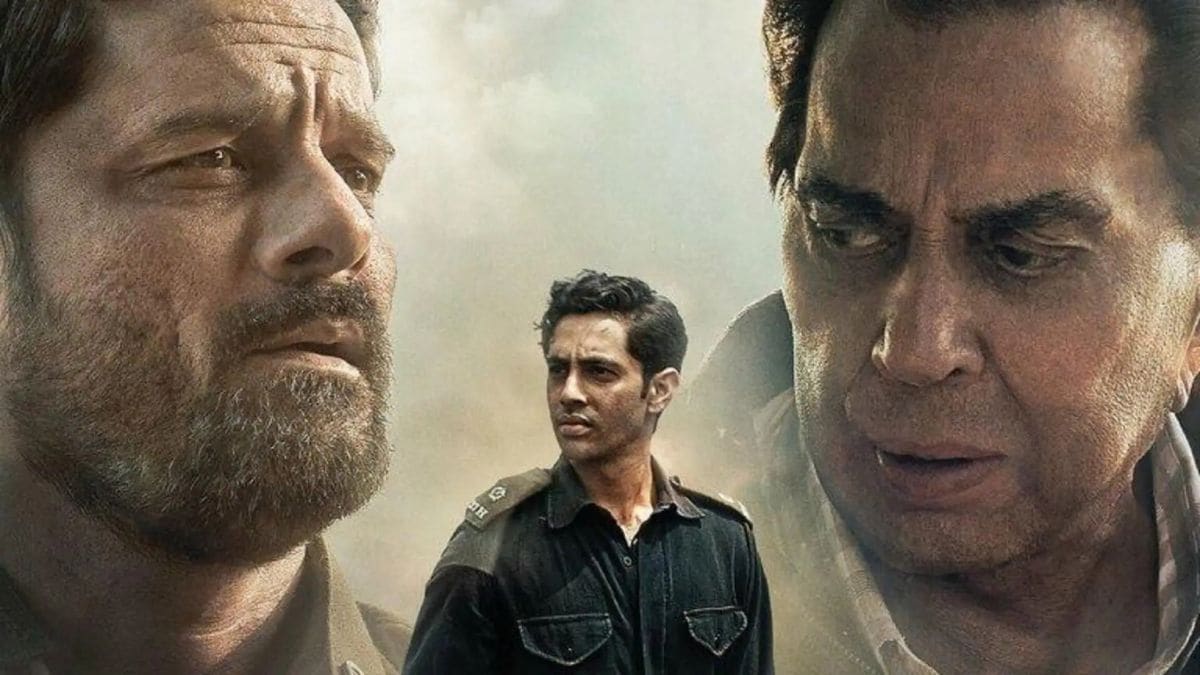
There is a scene in Ikkis where Lt. Arun Khetarpal (a suitably enthusiastic and driven Agastya Nanda) is lovingly admiring the poster of the 1969 war movie The Bridge at Remagen, and his girlfriend Kiran (Simar Bhatia) asks, "You love war movies, do you?" Ikkis demonstrates that its maker, Sriram Raghavan, loves war movies, too. He understands what makes the great war movies... great. He understands that when you're making a men-on-a-mission movie, it's most important to focus on the qualities of the men — their individual personalities, what makes them tick, what their goals are, their guilt, regrets...
Like the best of the men-on-a-mission movies set against the backdrop of a major battle, such as The Guns of the Navarone, The Dirty Dozen, or even The Great Escape, Raghavan takes us up close to his lead characters, taking the necessary time to get us acquainted with them, enough to get us invested in their fates.
But here's another brilliant thing that Raghavan does with Ikkis that I didn't expect to see before going in. Before getting into it, I want to be honest here: I was a bit sceptical, initially, at the thought of the filmmaker behind Johnny Gaddar, Andhadhun, and Merry Christmas making a war movie at a time when there are so many of them being made, across various eras in Indian history, with no standout qualities whatsoever — most of them extremely aggressive and characterised by a fervently jingoistic behaviour. There's nothing wrong with making a patriotic movie — any war movie would feel empty and lifeless if it were unpatriotic — but Ikkis demonstrates how you can do it beautifully.
It knows that you can make a war movie that respects its heroes, salutes their valour and sacrifices, without taking unnecessary detours, passing off fiction as truth, without excessive battle cries... basically, without giving audiences a headache. The casting is spot on, across the board, with Sikander Kher, as Arun's superior, bringing just the right measure of comic respite when he is not busy taunting the younglings.
Raghavan and his writing team take a non-linear approach, with events from 1971 and 2001 — before and after the demise of Arun Khetarpal — running concurrently. The idea here is prioritising humanity, harmony, and brotherhood above politics and religion, reinforced by the presence of the dynamic between one character who is the heart and soul of Ikkis, ML Khetarpal (Dharmendra), and Brigadier Nisar (Jaideep Ahlawat).
This is a film that's running through the perspective of these two characters, aside from Arun's. The fact that Arun's father hailed from Pakistan's Sargodha and lived there before the Partition adds an extremely poignant dimension to the storytelling. The 2001 Pakistan portions that see ML Khetarpal visiting Nisar and his family are some of the most moving portions from Ikkis.
Ikkis is a fitting swan song for Dharmendra, who imbues his character with a strong sense of history and ethos. Raghavan's writing also benefits from the manner in which he dispenses certain bits of information. He believes that some "missing" developments are more impactful when revealed at a much later time, a belief shared by Ahlawat's Nisar, a character whose significance to the story is a crucial "plot twist" revealed in due time, suitably heightening the emotional weight by the time we get to the finale.
Raghavan's filmmaking is also a delight for cinephiles who are sticklers for details and prefer their war movies with a noticeable degree of inventiveness. Aside from the multiple timelines giving the film a slightly Dunkirk-esque quality, we get some moving transitions with the aid of Raghavan's editor, Monisha R. Baldawa. The sequence where Arun enters Pakistan and remarks that "everything looks just the same," and the film cuts to the 2001 timeline with his father having a lovely time with Nisar's family and friends in Pakistan.
The sequence where Arun's father tells Nisar about a piece of his father's binocular that he hid in the bark of a tree still resting at his former home, Nisar peering into the lens, and the film cuts to the extreme close-up of Arun's pupils reflecting a burning tank — a shot reminiscent of the opening of Ridley Scott's Blade Runner. Or how about a radio playing an old song next to a lonely, dead soldier, as though the machine was singing the eulogy for him because there was no one else to do that for him?
Credits also to cinematographer Anil Mehta for stripping the battle sequences of unnecessary glamour and instead opting for a straightforward approach — an effective combination of clear geography, coherent action, and neatly rendered visual effects. The focus is more on realistic mood and atmosphere than carnage (rarely depicted in slow motion, and for good reason). Ikkis, in a nutshell, has some of the best qualities of Stanley Kubrick's Full Metal Jacket (unglamorous action) and Steven Spielberg's Saving Private Ryan (strong emotional quotient). It's one of the best anti-war films ever made. I shouldn't have doubted Sriram Raghavan.
Film: Ikkis
Director: Sriram Raghavan
Cast: Agastya Nanda, Dharmendra, Sikandar Kher, Aryan Pushkar, Simar Bhatia
Rating: 4/5
