



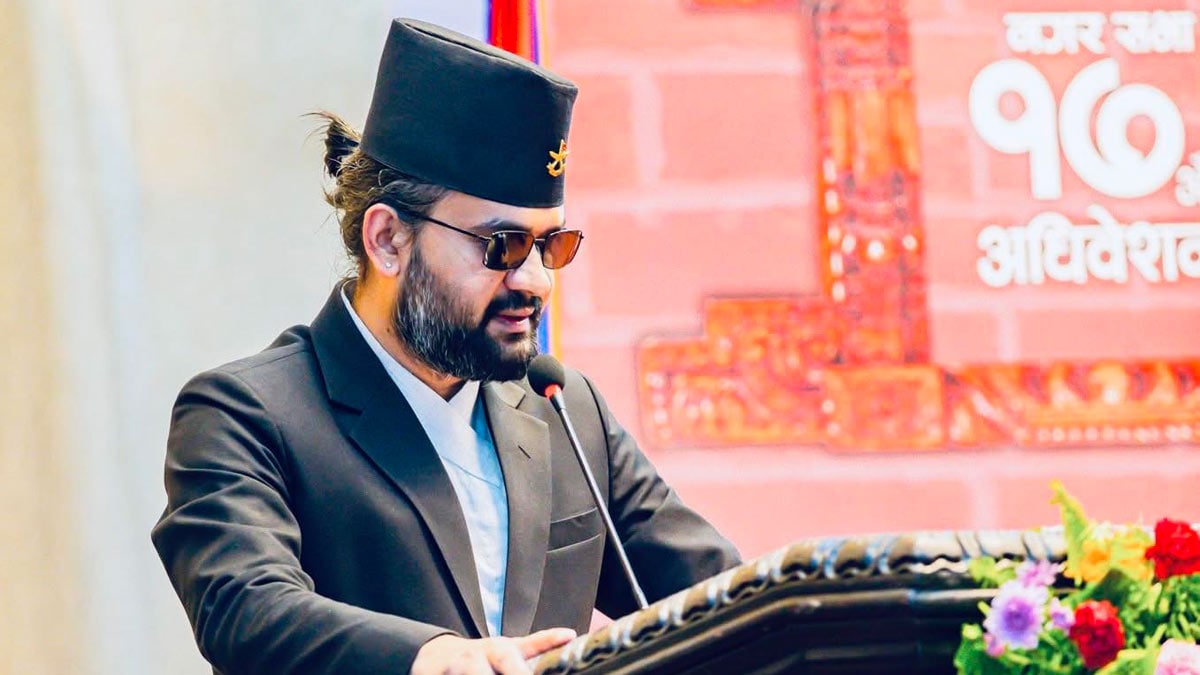
A day after Nepal Prime Minister Balen Shah stirred a hornet’s nest both in his country and India with his admission that his country encroached upon Indian territory, the new government is now struggling to contain the aftermath. Shah’s controversial statement came in reply to lawmakers’ questions in Parliament on Lipulekh, Limpiyadhura, and Kalapani, the Indian territory in a strategically important Himalayan area located near the India-Nepal-China tri-junction. Nepal claims the territory to be its.
“I have only recently found out that it is not only India that has encroached on Nepali territory, but Nepal has also encroached on Indian territory in many places,” he said in response to one question regarding Lipulekh, Limpiyadhura, and Kalapani.
The dispute regarding Lipulekh, Limpiyadhura, and Kalapani stems with the Treaty of Sugauli signed between Nepal and British India after the Anglo-Nepalese War in 1816. As per the treaty, the Kali River was designated as Nepal’s western boundary, but this soon evolved into a controversy over the river’s origin.
Though 97 per cent of the nearly 1,850-kilometre (km) India-Nepal border has been settled, disputes exist over Kalapani-Lipulekh-Limpiyadhura in the north-west and Susta along the Bihar border in the south.
The tension is mostly over the Kalapani-Lipulekh-Limpiyadhura region as India maintains an administrative and military presence there. Lipulekh Pass also serves as an important route for the Kailash Mansarovar Yatra, which Nepal objects to, claiming that the pass lies within Nepali territory.
Kathmandu also objected to India inaugurating an 80-km road linking Dharchula to Lipulekh in 2020. In retaliation, Nepal amended its constitution and adopted a new political map incorporating Kalapani, Lipulekh and Limpiyadhura as its own.
Now that Shah’s admission has triggered a huge controversy, stunned Nepali media and diplomatic experts jumped to issue clarifications regarding the statement, with experts stating Shah’s statements “dumbfounded the Nepali public, which has always believed that India is the one encroaching on Nepali land.”
Multiple foreign policy experts too jumped in with their two cents, to state that such a “statement from a sitting prime minister to Parliament was not just inappropriate but wrong.” “India itself has never officially complained about Nepal occupying Indian territory, yet our prime minister has raised the issue,” Nepal’s former ambassador to India, Nilambar Acharya, was quoted by Nepali Times.
Diplomats and experts on border matters said that Nepal has not encroached upon Indian territory in the way the prime minister suggested in Parliament.
The country’s foreign ministry also issued a statement clarifying the Prime Minister's statement that his remarks were related to cross-border occupation and encroachment in the Dasgaja area, the legally defined 10-yard (approximately 30-meter) "no man's land" between the borders of Nepal and India.
The Kathmandu Post also quoted Toya Baral, former director general of the Department of Survey, who claims that 1,200 hectares of Nepali land is currently occupied by Indian citizens, while 1,250 hectares of Indian land falls within Nepali territory. He cites the latest boundary survey conducted by the two sides in 2007.
“In 2007, we finalised 182 sets of boundary maps between Nepal and India using the Global Positioning System, excluding Susta and Kalapani,” Baral told the Post. “While finalising the updated boundary maps, we also found that citizens living on both sides of the border were occupying land across the boundary.”
Baral led the Nepali side in preparing the Nepal-India border maps that were completed in 2007. He argues that issues related to encroachment, cultivation, and possession on both sides of the international border remain unresolved. “The BWG is working to resolve them,” he said. “However, Nepal has not encroached upon Indian territory. The prime minister’s statement is technically incorrect. Susta and the Kalapani sector are different issues. Susta is a case of Indian encroachment, whereas the Kalapani sector is fundamentally a territorial dispute,” said Baral.
