



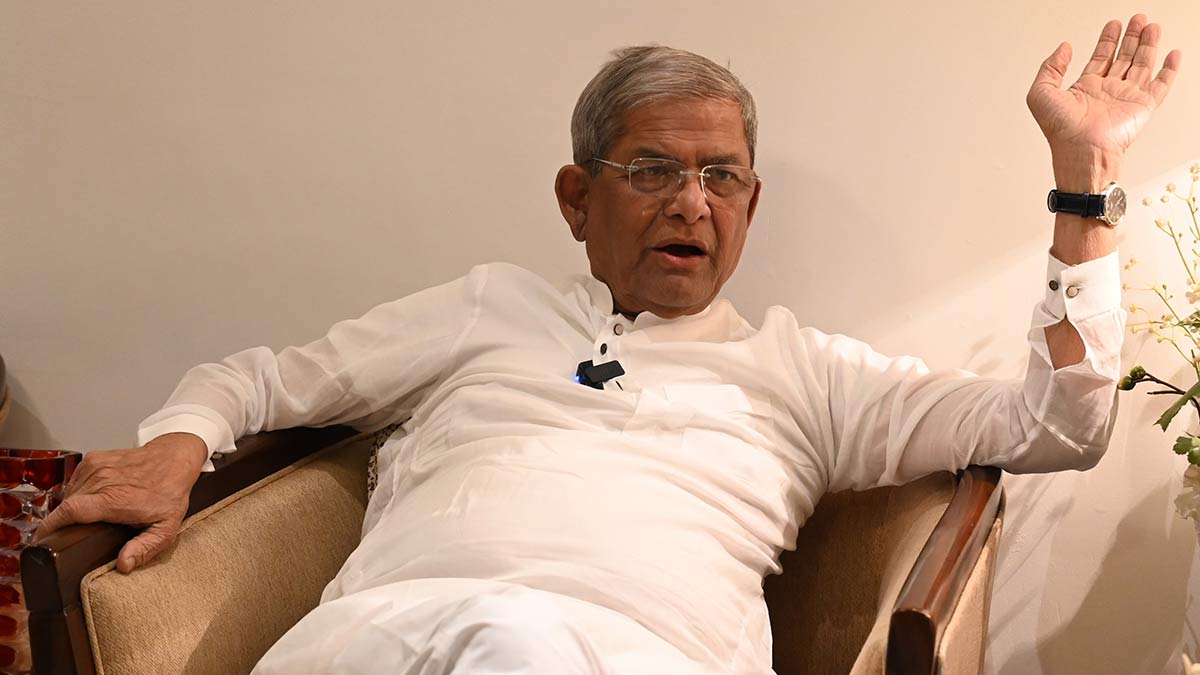
The ruling Bangladesh Nationalist Party (BNP) on Thursday nominated its secretary general Mirza Fakhrul Islam Alamgir as its candidate for the country's presidency, setting the stage for his election as the next head of state.
The Bangladesh presidential elections will be held on August 20, ahead of which the 78-year-old veteran leader resigned from his post as the BNP's secretary general and from its highest policy-making standing committee after being nominated, as per senior joint secretary general Ruhul Kabir Rizvi.
"It is with great pleasure that I announce on behalf of the Bangladesh Nationalist Party that our dedicated secretary general, Mirza Fakhrul Islam Alamgir, has become the BNP's presidential candidate," he said, as per a PTI report.
The nomination was announced after a meeting of senior BNP leaders with PM Tarique Rahman, who is also the party chairman, at the Prime Minister's Secretariat.
Under the Election Commission's schedule, Alamgir was required to submit his nomination papers by 4:00 PM on Thursday.
Bangladesh's main Opposition, Jamaat-e-Islami, has fielded the party-led alliance partner Liberal Democratic Party (LDP) Chairman Colonel (Retd) Oli Ahmad. Ahmad has already submitted his nomination papers to the Election Commission.
The August 20 election comes after former president Mohammed Shahabuddin resigned on July 24—about two years before the end of his term—citing serious health problems. He was a longtime ally of deposed prime minister Sheikh Hasina.
Under the Constitution, a new president is required to be elected within 90 days of the office falling vacant.
Parliamentary Speaker Hafiz Uddin Ahmad is currently serving as the acting president, as required under the Constitution following a vacancy in the office.
The Constitution provides for the president to be elected by Parliament.
The BNP, which was voted to power in the February 12 elections, currently commands a two-thirds majority in Parliament, putting Alamgir in a strong position to secure the presidency.
If elected, Alamgir will become Bangladesh's 23rd president. He has been one of the seniormost faces at the BNP, having served as acting secretary general from 2011 before formally taking over the post in 2016.
He played a prominent role in leading the BNP during the imprisonment of its then-chairperson and former PM Khaleda Zia and the absence of Rahman, who was abroad at the time.
The president is largely a ceremonial head of state under Bangladesh's parliamentary system, with key constitutional powers, including appointing the prime minister and the chief justice.
Though the president is the supreme commander of the armed forces, those powers are generally exercised on the advice of the prime minister.
The report also cited political analysts, who had said that the presidency could assume greater significance under the caretaker government system recently reintroduced to oversee general elections, at which time the president's power would increase significantly in commanding the armed forces.
The analysts also opined that Alamgir's nomination could be a well-calculated move by the BNP to equip the president with more power by amending the Constitution.
An economist by training, Alamgir made his political debut as a left-leaning student activist when Bangladesh was still East Pakistan. Bangladesh was liberated from Pakistan with India's help in 1971.
After joining the BNP in the early 90s, Alamgir served as the state minister for agriculture and civil aviation.
When the BNP returned to power in the February 12 elections this year, Alamgir was made the local government minister.
On Shahabuddin's resignation
Shahabuddin, a 1971 Liberation War veteran and former lower judiciary judge, had taken the presidential oath in April 2023 for a five-year term.
Though he cited health complications as the reason for his resignation, it came amid speculations that PM Rahman's government was uncomfortable with the largely titular head of state.
Local media reports also claimed that Shahabuddin had contacted Hasina over the phone, which disappointed the BNP's top leadership. The former president had since dismissed the reports as "baseless".
Elected to the highest office by the previous Parliament, the 76-year-old and was the only person still holding his constitutional position, long after the violent July-August 2024 student-led street protest that toppled Hasina's Awami League government in August 2024.
