



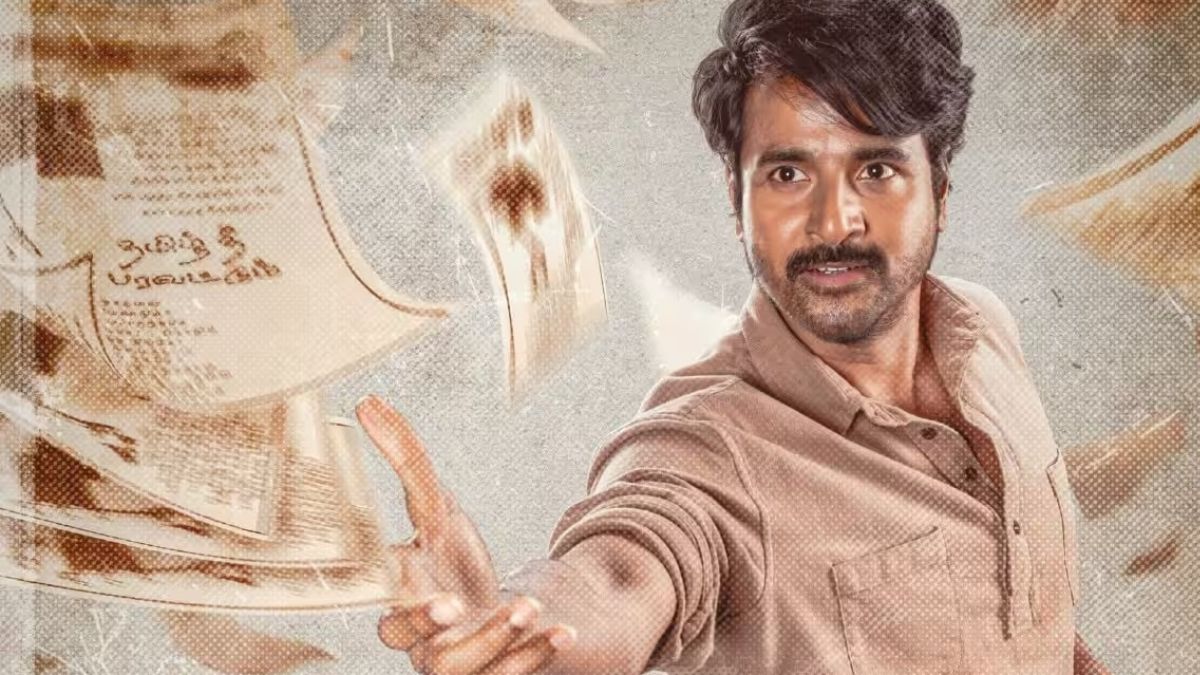
Trains and train stations play a major role in Sudha Kongara's new film Parasakthi. They act as markers for crucial events in her narrative. Sudha opens the film with an intense train fight between two men that, in another director's movie, would have been the climax. But it makes sense why Sudha does this in Parasakthi. It's a crucial event that turns out traumatic for its hero, Chezhiyan. An event that would compel him to choose a path of non-violence. An event that feels like the climax and beginning at once. It would take another traumatic event at a train station, which recalls the former event, to bring out a side of Chezhiyan that has been dormant between the two events. A train and a train station would figure in the film's explosive (literally!) scenes, too.
Oddly enough, though, the impact of the three aforementioned sequences involves characters who are not related to Chezhiyan, but make the biggest impression in Sudha's film. It makes one wonder whether the other characters, such as Chinna (played by Atharva) or Ratnamala (Sreeleela), were really necessary to take this story forward, since their presence doesn't bring much in terms of emotional contribution. Or perhaps better casting would've worked. Or better writing?
There's a sense of inconsistency in the writing of the three characters and their dynamics with each other. Why does Sreeleela suddenly go from the mischievous, playful, "dumbo" girl in the film's early portions to a mature, nerdy, scientist type in the film's third act? The evolution doesn't look organic. And Atharva feels just like an over-enthusiastic character from a Mani Ratnam film whose only notable quality is that he is... over-enthusiastic. Ravi Mohan's villainous turn is nothing to write home about either. It's hard to get fully invested in such characters who feel two-dimensional rather than three-dimensional. Furthermore, the entire film, despite being competently staged (with a notable contribution from veteran cinematographer Ravi K. Chandran), doesn't bring anything new to the table.
There's the nagging feeling that we have seen situations like these before, and I don't mean the central conflict, the 1965 anti-Hindi agitation that took place in Tamil Nadu. In fact, it's what keeps the film going whenever it seems to be experiencing an energy dip. Of course, the subject draws attention to the political affiliation of the film's backers but Parasakthi cannot be simply dimissed as another "propaganda" film because it’s a film fighting for a healthy, sensible cause, and despite the fictionalised cinematic plot construction around one of the most significant events in not just Tamil Nadu (featuring some key political figures not mentioned by name) but in Indian history, Sudha's film takes on the duty of issuing a clarion call for resisting unwanted intrusion into our integrity, identity, and endeavours to make progress. It's a film that clarifies, through its characters, that it's not against Hindi or those who speak it, but against its imposition of it. It rightly brings up the point that the other state wouldn't like it if this state tried to impose its language on them.
Parasakthi doesn't exactly have one of Sivakarthikeyan's finest performances, but the actor doesn't do a bad job either. He has done better, though. Also, why does every Sivakarthikeyan film require a song-and-dance sequence? Is it so mandatory that the filmmaker doesn't have any say in it? Or is it that Sivakarthikeyan's fans want to see him do it in every film? Because Parasakthi is one of those films that could've been a smoother film without these unnecessary commercial cinema ingredients that act as speed-breakers.
Perhaps Parasakthi is the kind of film that Sudha would've made with Rajinikanth if she were a filmmaker in the 1980s or 1990s. I say this because at one point in Parasakthi, Sivakarthikeyan is framed as a silhouette against the sun, as Mani Ratnam did with Rajini in Thalapathy. It's not just Thalapathy that came to mind while watching this, but also Priyadarshan's Kaalapani, in that these are films that present characters who are forced to work in the company of people whose ideologies are the complete opposite of theirs. Parasakthi works well as a film that evokes a strong revolutionary spirit — it has, indeed, a few "high" moments that make you want to cheer, and these include a cameo from a popular Malayalam actor — but is it the kind of film that's memorable enough to warrant a rewatch? I didn't think so.
Film: Parasakthi
Director: Sudha Kongara
Cast: Sivakarthikeyan, Ravi Mohan, Sreeleela, Atharva
Rating: 3/5
