



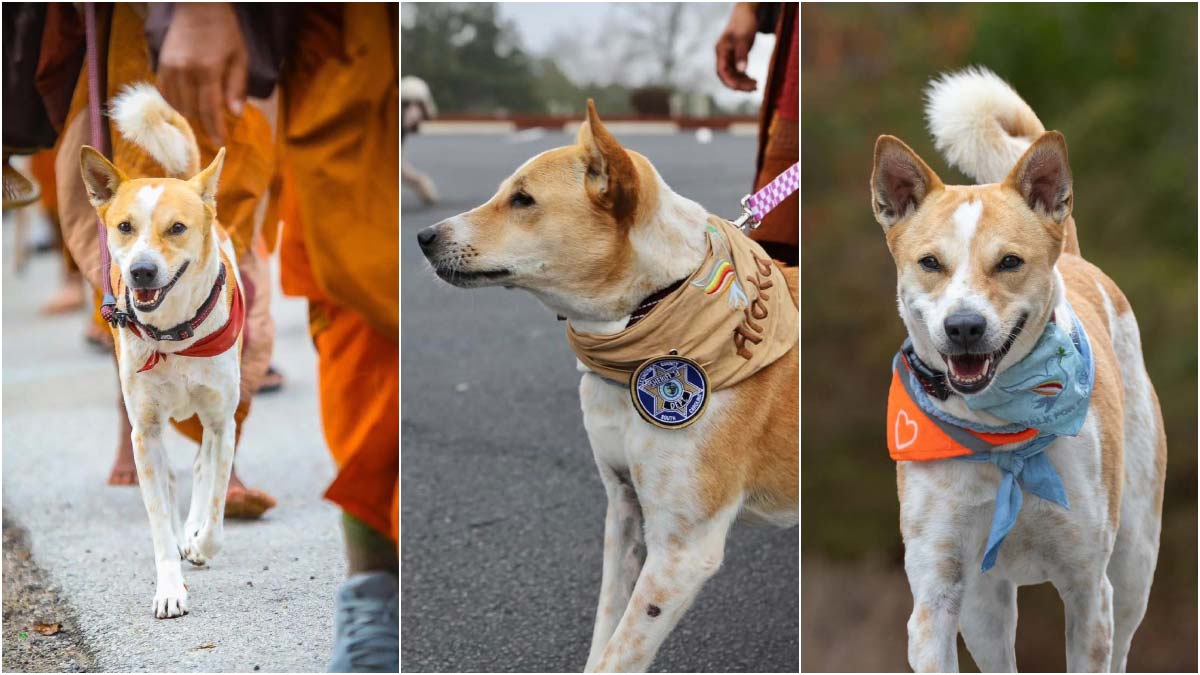
Sometimes peace does not arrive with speeches, slogans, or protests. Sometimes it arrives quietly on four paws.
An Indian ex-stray dog is the talk of the town, as his gentle presence and quiet companionship bring calm and connection while drawing attention from residents, animal lovers, and social media alike.
Known as Aloka, a name meaning “light” or “illumination” in Sanskrit, this four-year-old Indian Pariah dog is currently the silent leader of a 3,700 km cross-country pilgrimage across 10 US states. Alongside 19 Buddhist monks from the Huong Dao Vipassana Bhavana Center, Aloka is walking from Texas to Washington, D.C., in a 120-day ‘Walk for Peace’ that has transformed from a quiet spiritual exercise into a viral national sensation.
The story began when this stray started to follow the monks during a 112-day peace walk across India. Since then, he has accompanied his fellow walkers in the peace march globally.
‘Walk for Peace’ is a moving meditation. In Buddhist history, walking is a form of active meditation. Ancient monks didn’t just walk to reach a destination; they walked to shake off mental defilements like greed, anger, and ego. By walking 3,700 km across the US, the monks are not protesting against something; instead, they are walking for the cultivation of internal peace and are essentially planting seeds of mindfulness.
Aloka was one of the many nameless strays in India. He was amongst other Indian pariah dogs living in the streets, like millions of strays that remain unnoticed. No home. No certainty. Just survival.
While Aloka is being celebrated in the news and on social media, India is currently grappling with heated legal and social debates over how to manage stray dog populations and the cruel injustice they face every day. Amidst this chaos, seeing an Indie rise to become an international sensation and a global icon of peace provides a powerful narrative of redemption and overlooked value.
To understand Aloka is to understand the 15,000-year history of the Indian Pariah. Often dismissed as strays on the streets of metro cities, these dogs are, in fact, one of the world’s oldest and most resilient primitive breeds.
What makes Aloka special is not the enormous distance he walks. It is the bond he shares with the people around him. They walk together as true companions. This is chosen loyalty.
The monks didn't just see a dog; they saw a companion. A presence that felt like peace; a quiet soul walking with them.
Hence, the monks named the then nameless dog ‘Aloka’, meaning light.
This blissfully unconscious dog displays a stoic patience. He doesn't bark at distractions, walks off-leash. He is a true disciple of the path, a living reminder that tranquility and kindness aren’t a human invention, but a natural state that even a former street dog can master.
Despite being hit by a car and falling ill during the initial journey, Aloka refused to leave their side. His resilience was so profound that the monks eventually brought him to the United States, where he has traded his life as a street survivor for a role as a global ambassador of compassion.
The monks didn’t rescue Aloka by taking him to a shelter; they walked with him. This highlights the Vipassana philosophy of coexistence, that the animal isn’t a problem to be solved, but a fellow traveler.
While Aloka remains blissfully unaware of his metrics, he has inadvertently become the “Zen” companion we didn't know we needed. Even though Aloka doesn't know what a “follower” is, he has become a global celebrity on the internet. With over 1,60,000 fans on Instagram (@alokathepeacedog), his page has turned into a daily must-watch for people all over the world.
People love seeing him in his cozy green and red sweaters, leading the monks through morning mist, taking a well-earned nap after a long day, or playing with the kids along his route. Aloka has proven that you don’t need to say a word or do a lot to go viral. His account is a digital hangout where thousands of strangers come together every day just to share a little bit of his peace. Supporters can also track Aloka’s exact location via the live GPS map hosted on the Walk for Peace website, allowing the digital community to walk with him in spirit.
The most profound part of this marketing strategy is that it isn’t a strategy. The monks don’t view Aloka as a marketing tool, but the world does. This has led to Aloka being an accidental brand that has done more for the awareness of Buddhism and animal welfare in 100 days than most traditional PR campaigns do in a decade. He has shifted the narrative of stray dogs from being a problem to be solved to souls to be respected. His soft influence story tends to spark a renewed conversation about the treatment of indies in India and the potential for shelters worldwide, and to rethink how they view unadoptable strays.
Aloka, with his heart-shaped mark leading the way, remains a quiet pilgrim, unaware that he is a hero to millions and reminds us that perhaps peace isn't something we find at the end of a journey, but something we carry with us, one paw print at a time.
