



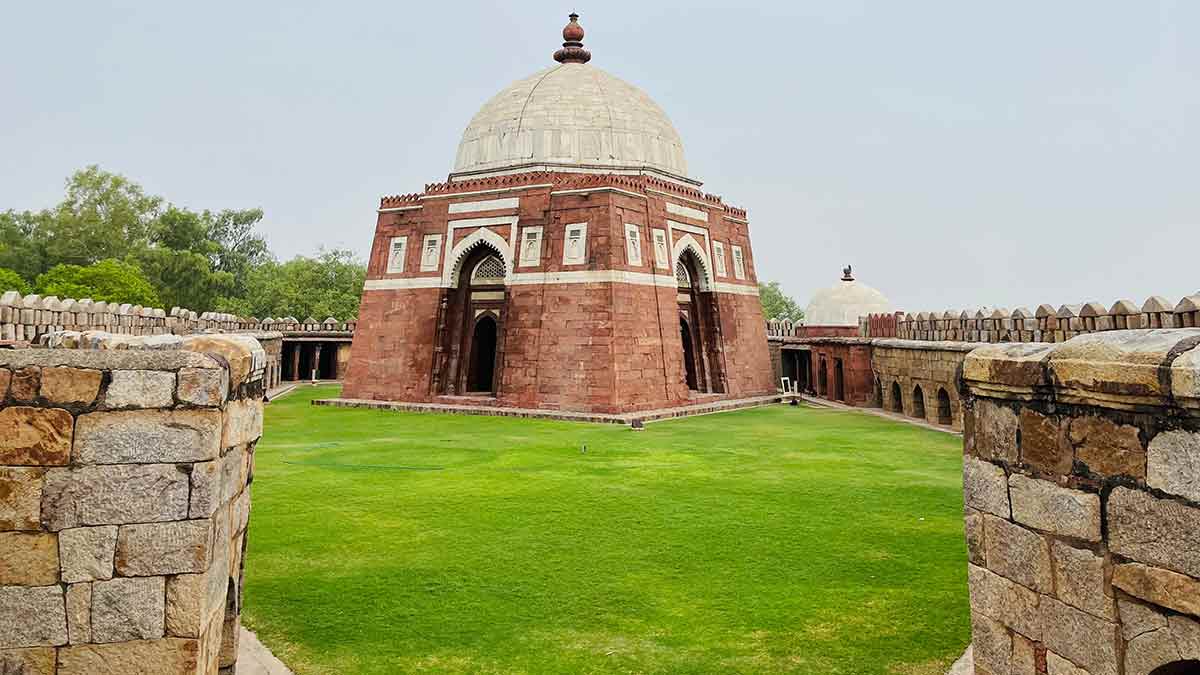
Which king or dynasty has left the most number of monuments in Delhi? I’d bet all my 13th century silver tankas, if I had any, that most people would vote Shah Jahan and the Mughal.
Truth be told, Delhi has a lot more sultanate monuments than those left behind by all the badshahs from Babur to Bahadur Shah, and all the gora sahebs from Lord Lake to Mountbatten. Among the sultans, the Tughlaqs count for more; among the Tughlaqs, Ferozeshah accounts for the most.
Want to count? Leave your oft-trod walkways of Chandni Chowk and Shahjahanabad, and drive to Delhi’s largest fort Tughlaqabad, the little Adilabad, Ghiyasuddin’s tomb with leaning walls, the Satpula, or the Jahanpanah of the early Tughlaqs. Or to Feroze’s Kotla, Hauz Khas, the hunting lodges of Malcha Mahal, Pir Ghaib, Mahipalpur and Teen Murti. Going by Ferishta, Feroze alone built 845 tanks, piers, bathing ghats, inns, masjids, tombs, and little citadels.
Then why do people think of Delhi as more Mughal or British than say Tughlaq, Khilji or Lodi? Two reasons. One, the Mughal emperor of opulence has overwhelmed the mindscape of Delhizens and even India’s rulers with his majestic Red Fort and the Jama Masjid. Two, most people confuse anything and everything mediaeval and Islamic as Mughal, even if it was built by the Mamluks, the Khiljis, the Tughlaqs, the Sayyids or the Lodis.
Now for the biggest irony! In a few years, a scholar with a Master’s in history from Delhi University will be as clueless about the sultans’ legacies, as are those unlettered sods who call all Islamic structures as Mughal. For, going by the DU’s new syllabus, a student is not going to learn much about any sultan from Iltutmish to Ibrahim Lodi in his two-year MA History course. Two elective papers, ‘The Delhi Sultanate: Structures of Authority in Mediaeval North India’ and ‘History of North India, 1400-1550’, are being dropped from the university’s PG history syllabus, along with a few others.
It is not a question of leaving out five dynasties, or a few score sultans who sat on the Delhi throne. Those rulers might have been illustrious like Iltutmish or degenerate like Razia’s brothers, kind like Ferozeshah or cruel like Balban, wise like Muhammad bin or foolish like Muhammad bin (he was called ‘the wise fool’). They were of all types that you would find in any dynasty, be it Hindu or Muslim, pagan or Christian, Buddhist or Jain.
The age of the sultans was one that witnessed cataclysmic changes in the way the Indian state evolved—right from early state formation to our understanding of a syncretic culture. It was the sultans who made Delhi the focal metropolis of the larger north Indian polity. It was when Iltutmish refused the ulema’s fiat to impose sharia laws on Hindus that a state that tolerates multiplicity of faiths began to evolve.
History is a continuum. You can’t knock out a period from it. The story of India would be incomplete without the sultans.
Indeed, there have been arguments that Indian history, as taught in schools and colleges, has been far too Delhi-centric. National histories across the world haven’t been any different. The story of the central metropolis of any region dominates over the histories of the peripheries. Britain’s history is largely England’s at the cost of Scotland’s and Wales’, France’s story is essentially that of the Gauls and the Franks, Russia’s is around the duchy of Muscovy, and Germany’s that of Prussia. Peripheries ought to get more focus, but it should be by widening the canvas of pedagogy and not by shrinking it.
