



When walking in Bhutan, there are few sights more uplifting than that of Buddhist prayer flags crackling in the high wind against a spotless blue sky. Or of a prayer wheel turning slowly to the sound of a bell, propelled by a mountain stream. Or of a chorten (the Himalayan word for a stupa), often just a simple pile of earth and stones, daubed white and a dark red, that one can find scattered around pilgrim paths or on windswept mountain passes.
Sometime the chorten is a towering monument, elaborately designed and constructed, like the 108ft tall (the number 108 being auspicious in several traditions including Buddhism and Hinduism) National Memorial Chorten in Thimphu built in 1974 to honour the third king, His Majesty Jigme Dorji Wangchuck. But humble or ornate, the chorten has persisted down the centuries; the earliest were built to enshrine the relics of the Buddha. Chortens are not houses of worship but their sealed structures usually contain spiritual texts and holy relics. They are prayers encased in stone and earth meant to radiate peace and merit to all those who pass; their blessings are meant for all sentient beings.
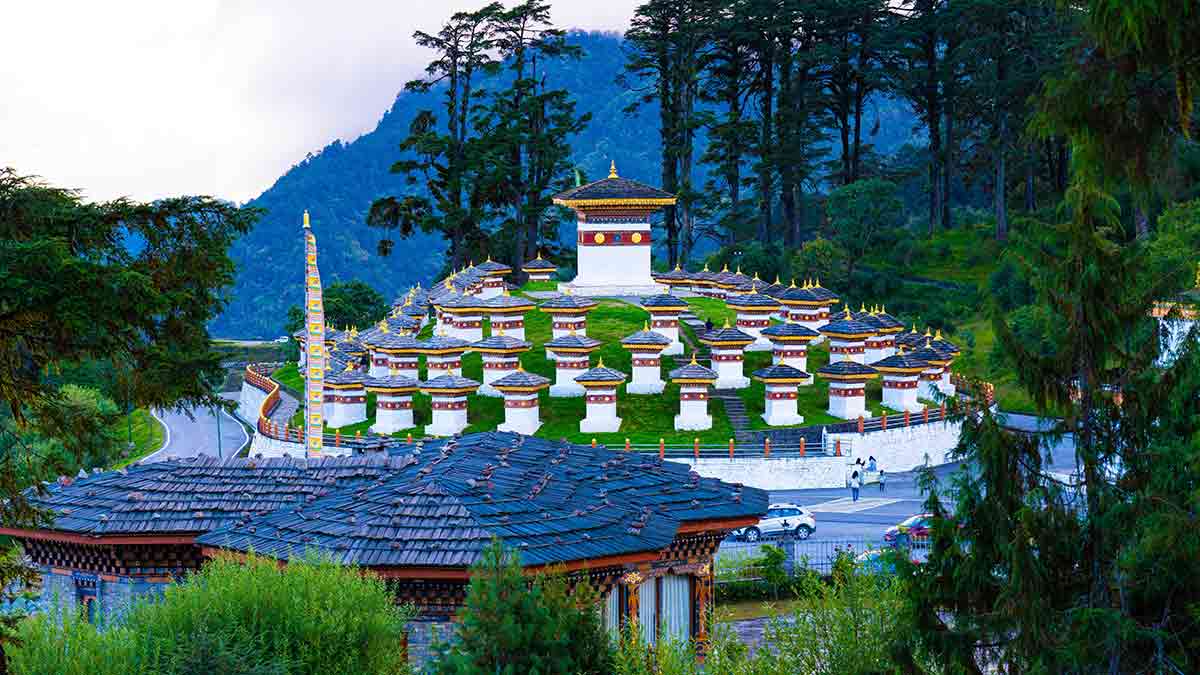
A striking collection of 108 chortens is set among the rhododendron bushes at Dochu La, the 10,000ft high pass that leads from Thimphu to the Punakha valley. Commissioned by the Queen Mother, Ashi Dorji Wangmo Wangchuck, these chortens honour the Bhutanese soldiers who died in the 2003 operation—launched under the leadership of the fourth king, His Majesty Jigme Singye Wangchuck—to flush out Indian insurgents camped in southern Bhutan.
Now there is Project 108, which will see the completion, in one single day, of 108 chortens along the Mau chhu river as part of the Gelephu Mindfulness City in southern Bhutan. The city itself has been envisioned by the present king, His Majesty Jigme Khesar Namgyel Wangchuck, as an oasis of mindfulness and sustainable economic development amid increasing global uncertainties. It will combine innovation with traditional Bhutanese values of spirituality and harmony with nature. In this carbon-negative ecosystem, the chortens, each 15m high, will be spaced 108m apart in a single line, a procession of prayer along the river. Their form will be classical, or Jangchub, the form used to commemorate Buddha’s enlightenment. Built on a square pedestal symbolising the earth as a solid foundation for all existence, they will rise through tiered steps, a rounded dome and spiral rings to a canopy topped off with the moon, sun and flame, symbolising the union of compassion and wisdom.
Volunteers, of which there is no dearth, are already preparing the sites. In Buddhist tradition, building a chorten is one of the most meritorious acts one can undertake, not just for oneself but for all those who encounter it. Engineers and Buddhist masters are putting it all together. And on November 1, a workforce of 40,000 volunteers—school children and retirees, diplomats and farmers, monks and technology professionals, doctors and artists—will complete the chortens in unison. This is not another building project being completed dramatically as a spectacle but rather a high spiritual point where united effort becomes shared merit.
Even as Bhutan, once pristine and remote, opens up increasingly to engagement with the world and the influences of cutting-edge technology, innovation and financial networks, the procession of chortens will be a reminder in the shining new city of an alternate way of development, where everything is not about profit and greed. A reminder to reflect, to think, to wait.
Truly, Bhutan, just across our borders, is on another—and better—planet.
The author was India’s high commissioner to the UK and ambassador to the United States.
