


 Add as a preferred source on Google

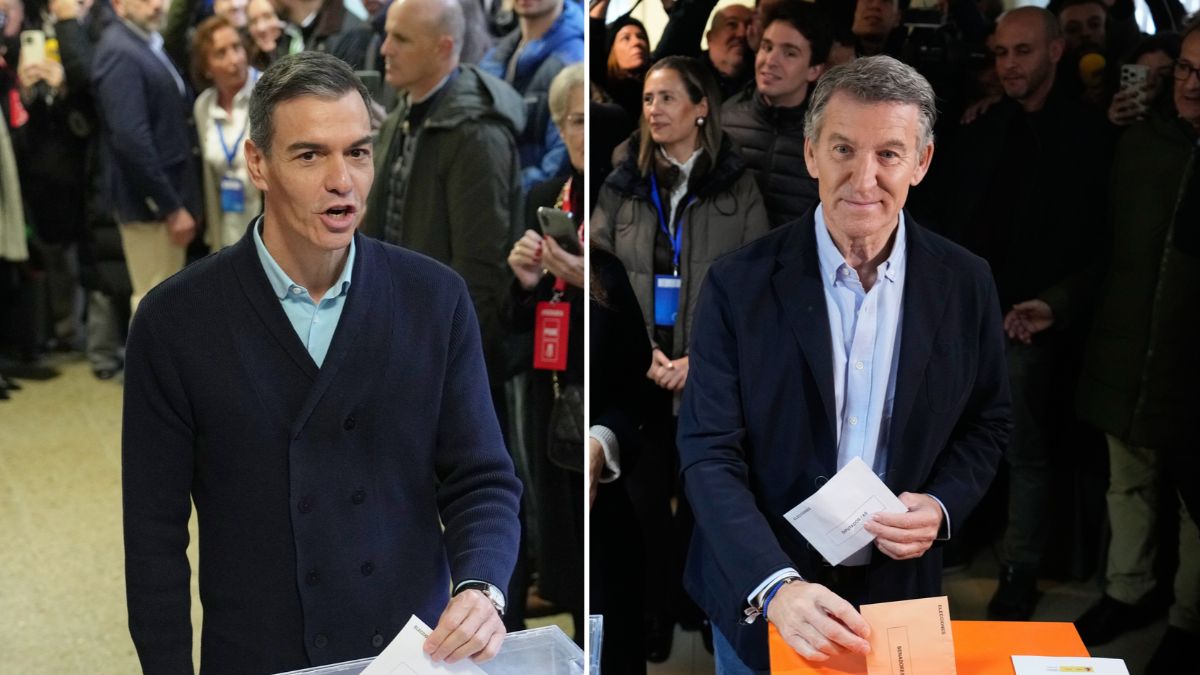
Around 39 million people have been called to vote in a snap general election in Spain on Sunday.
The election has attracted attention as forecasts show that the opposition leader Alberto Núñez Feijóo of the conservative Partido Popular (PP) is leading in the polls.
The snap election was called by the socialist Prime Minister Pedro Sánchez, who has been ruling with coalition governments since 2018 after the parliament rejected his housing measures.
Despite Feijóo leading the polls, he is not expected to secure a majority alone to form a government.
All eyes are therefore on Santiago Abascal, of the rising far-right Vox party, who may emerge as the kingmaker. Vox, with its anti immigration policies, is Spain’s third-largest political party.
A Partido Popular win would also mean it would be the first time a far-right national government could form in Spain since the end of the Francisco Franco’s dictatorship nearly five decades ago. A coalition between the two could double the seats.
Sánchez, meanwhile, has been calling for voters to stop the far right. He says that the his internal data showed that he could win a majority with smaller left-wing parties.
He is banking on the progressive and undecided voters to take at least 176 seats for left parties in the 350-member parliament.
Some of the polls show the socialist party catching the PP but at the expense of the far left, who are needed for Sanchez to win the re-election.
Analysts meanwhile say that a coalition between the PP and Vox is the likely outcome.
In 2023, Spain ended up with a hung election after Feijóo won the most seats but failed to form a government. Sánchez continued his term as Prime Minister after forming a coalition with the Sumar party.
Sánchez says that a PP-Vox government win would be “a regression” and like “rolling back the clock 40 -50 years.”
Spain is currently short of 750,000 homes amid rising immigration, rising rents and evictions. The country saw large-scale protests and strikes earlier this month after being shaken by recent events, including the Cueta migrant crisis and the eviction and death of Maricarmen. There were also two rail accidents with mass casualties.
Polling forecasts show that participation could reach 80 per cent.
Pedro Sánchez believes turnout will be high. "There is an epic mobilisation, that is what I am seeing and sensing. It is going to be one of the highest turnouts in our democracy and that in itself is important," he told the media. He also spoke of a "historic mobilisation" that leaves him with "good feelings".
