


 Add as a preferred source on Google

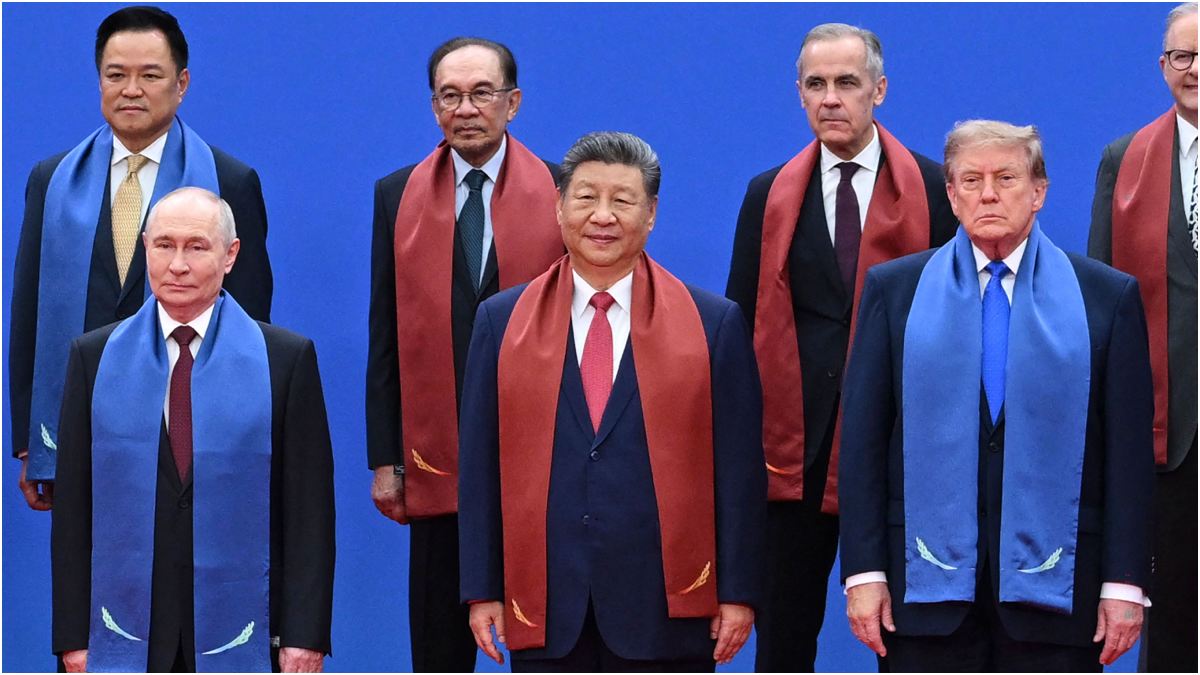
In these times of torrid wars, when the American, Chinese and Russian Presidents meet for a three-way conversation, it ceases to be just a conversation.
As the world's eyes were riveted on Shenzhen, the southern China hub in Guangdong Province, on Thursday (November 19), one thing was clear — the course of world geopolitics was being set.
The very fact that a joint statement came out is in itself an indication that the talks went well.
At least a year of preparation at top levels had gone into the meeting, held on the sidelines of the APEC Summit. To say that it overshadowed the APEC deliberations would be an understatement.
Metaphorically, the oversized, circular table where the three leaders sat for a 90-minute parley may well have represented the globe. The effort to self-appoint as 'joint-guardians' was evident.
Putin was apt in describing the trilateral as diplomatic history. He said, "When it comes to history and historical importance: no such meetings had taken place before, and now it has happened. This is undoubtedly a page in diplomatic history."
While a range of agenda items — from trade to competition to the conflicts in Ukraine and Iran — was put on the table, there was no doubt in anyone's mind that the nuclear weapons issue formed the core.
While minute details are yet to emerge, Xi's comment can be considered the most important. Chinese media reported Xi as saying that, as the main victors of World War II, China, Russia and the US should steadfastly "safeguard the postwar international order".
Significantly, Xi said that nuclear weapons, the 'Sword of Damocles' that hangs over humanity, should be completely prohibited and thoroughly destroyed over time to make the world free of nuclear weapons. "They should be comprehensively banned and completely destroyed... A nuclear war cannot be won and must never be fought."
Trump is reported to have said it is "vital" that the three countries cooperate to "combat the threat of nuclear proliferation in other countries around the world."
In a way, Shenzhen may have provided the ground for the seeds of a new treaty in the offing — to cut back on nuclear weapons and to look yonder at the arsenal of other countries.
Till now, China had pushed back on joining negotiations for a trilateral nuclear arms-control effort, pointing out that its nuclear arsenal is much smaller in comparison to what the US and Russia have stockpiled and deployed.
The numbers tell the story.
According to SIPRI, in January 2026, Russia had an estimated inventory of 5,420 nuclear warheads, followed closely by the US with 5,042, while China had 620. Russia and the US together hold around 83 per cent of all stockpiled warheads.
At fourth place was France with 370 warheads, and the UK with 225 was fifth. India was at sixth place with 190 warheads, followed by Pakistan with 170. The other two are Israel with 90 and North Korea with 60.
Till now, four nuclear weapons treaties have defined the architecture.
The NPT (Non-Proliferation Treaty), in force since 1970 with 191 parties, has just seen its third consecutive Review Conference fail in May 2026, with no consensus final document.
The CTBT (Comprehensive Test Ban Treaty), signed in 1996, has never entered into force. Nine Annex-2 states — including the US, China, India, Pakistan, North Korea and Israel — are still missing.
The TPNW (Treaty on the Prohibition of Nuclear Weapons), in force since 2021 with 75 parties, bans the bomb outright — but not a single nuclear-armed state has joined it.
And the New START (Strategic Arms Reduction Treaty), the last US-Russia cap, expired on February 5, 2026 — making it the first time since 1972 that the US and Russia have no legally binding ceiling and no inspections.
That is why Shenzhen matters.
For the first time, China did not say no to the table. It sat at it. And at that table, all three leaders spoke the language of abolition, not just arms control.
Tri-polarity got a thumbs up in Shenzhen. Nukes got a big thumbs down.
Whether that thumbs down becomes a treaty — a real successor to New START, but this time trilateral — will be the test of whether November 19 was history, or just a photo-op.
New Delhi, like the rest of the world, will be watching. India is not at that table, but with 190 warheads, it is very much in the room.
